

.png)
MBA to Product Manager Course: A Practical 70-Hour Learning Path
An MBA can give you a strong base in strategy, finance, market analysis, communication and leadership. Product-management work demands that you apply those strengths in a different setting: understanding users, choosing what to build, defining success, working with technical teams and making trade-offs when the answer is not obvious.
This MBA-to-product-manager course is organised around that transition. It combines PM foundations, hands-on product work and structured interview preparation across 56 lessons and 69.5 hours of listed learning time.
Course at a glance
| Course element | What is included |
|---|---|
| Structure | 3 modules and 16 topic blocks |
| Estimated learning time | 69.5 hours |
| Module 1 | PM foundations and MBA skill translation — 14 hours |
| Module 2 | Product strategy and execution — 25.5 hours |
| Module 3 | Interview mastery — 30 hours |
| Learning formats | Readings, quizzes, workshops, case studies, practice exercises, capstone work and mock interviews |
| Technical prerequisite | No prior coding experience is assumed; the curriculum includes technical literacy for non-engineers |
| Main outputs | Skills-gap plan, user-research artefacts, metrics framework, competitive analysis, PRD, prototype, product-strategy document and interview story bank |
How the learning path fits together
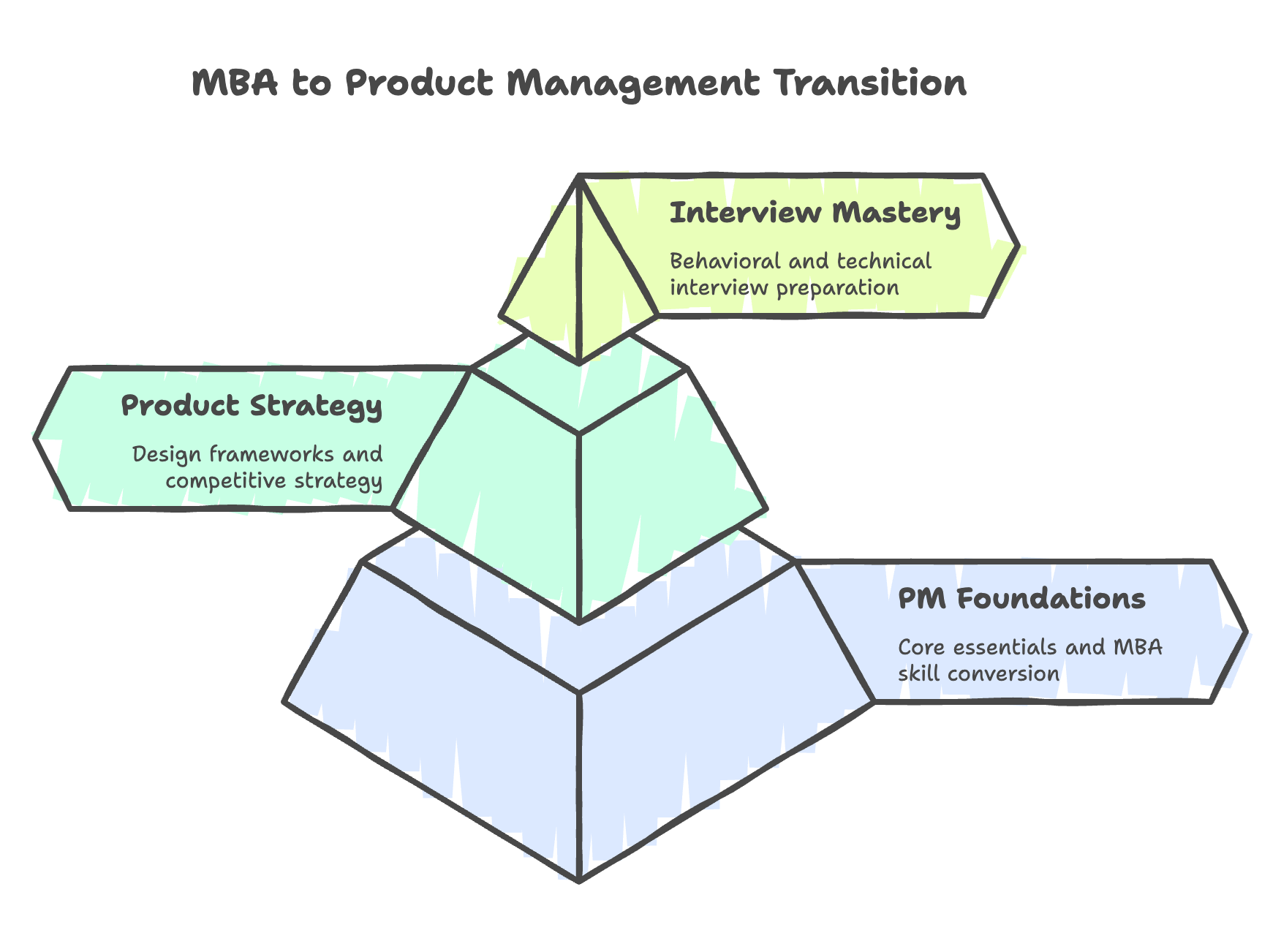
The order matters. Module 1 identifies what you can already transfer from your MBA and where you need additional practice. Module 2 converts that knowledge into product decisions and artefacts. Module 3 helps you explain the same thinking clearly in interviews.
Who this course is designed for
This learning path is most relevant to:
- MBA students deciding whether product management is a suitable career path
- Recent MBA graduates preparing for associate or early-career PM roles
- Professionals from consulting, marketing, operations, finance, analytics or strategy who want to move into product
- Non-engineering candidates who need enough technical fluency to work with developers and handle basic technical PM questions
- Candidates who understand PM theory but need a structured interview-practice plan
The course is not a substitute for product experience, and completing it does not guarantee a job offer. Its purpose is to help you build relevant skills, create evidence of your thinking and prepare more deliberately.
What you should produce while completing the course
Passive reading is not enough. Treat the workshops and case studies as portfolio-building exercises.
| Stage | Suggested evidence of learning |
|---|---|
| Foundations | MBA-to-PM skill map, personal gap analysis and technical terminology checklist |
| User understanding | Interview plan, user persona and customer journey map |
| Metrics and strategy | KPI tree, North Star Metric rationale, cohort-analysis notes and competitive map |
| Product definition | PRD, prioritisation rationale, wireframe or prototype and product-strategy document |
| Interview preparation | STAR story bank, product-design case notes, analytical practice sheets, company brief and mock-interview scorecards |
Do not present hypothetical exercises as professional work. Label them clearly as course projects or independent case studies.
A realistic completion schedule
The curriculum totals 69.5 hours before optional reading and revision. Choose a pace that leaves enough time to complete the exercises properly.
| Weekly study time | Approximate completion time |
|---|---|
| 6 hours per week | 11–12 weeks |
| 8 hours per week | 8–9 weeks |
| 10 hours per week | About 7 weeks |
Module 1: PM Foundations and MBA Skill Translation
Estimated time: 14 hours
This module establishes what product managers do, translates common MBA strengths into a product context, builds technical literacy and introduces user-centred thinking. Links in the final column are optional supporting readings; “Course material” means no separate public guide is linked.
Core product-management essentials
| Lesson | Format | Time | Supporting guide |
|---|---|---|---|
| The Product Manager's Role: Responsibilities and Daily Workflow | Reading | 45 min | A day in the life of a product manager |
| Agile Fundamentals: Sprints, Ceremonies and User Stories | Reading + quiz | 1 hour | Agile vs Waterfall for product teams |
| Product Development Lifecycle: Concept to Launch | Reading + case study | 1 hour | Product development life cycle explained |
Converting your MBA skill set
| Lesson | Format | Time | Supporting guide |
|---|---|---|---|
| Strategic MBA Frameworks in a Product Context | Reading + examples | 45 min | Course material |
| Leadership Without Authority: Influencing Product Teams | Reading | 45 min | Stakeholder-management practices for PMs |
| MBA to PM: Skill Mapping and Gap Analysis | Interactive exercise | 1.5 hours | MBA-to-product-manager transition guide |
Technical knowledge for non-engineers
| Lesson | Format | Time | Supporting guide |
|---|---|---|---|
| Technical Foundations Part 1: Development Environments, APIs and Coding Context | Reading + quiz | 1 hour | Do product managers need to know how to code? |
| Technical Foundations Part 2: Cloud, SDLC and Technical Debt | Reading + quiz | 1 hour | Technical debt for product managers |
| Decoding Engineering Conversations: Terminology Guide | Reading + flashcards | 45 min | Course material |
User-centred product thinking
| Lesson | Format | Time | Supporting guide |
|---|---|---|---|
| User Research Fundamentals: Methods and Interview Techniques | Reading | 1 hour | How to conduct successful user interviews |
| Creating Effective User Personas: Template and Examples | Workshop | 1 hour | Practical guide to user personas |
| Customer Journey Mapping: Visualisation and Workshop Guide | Workshop | 1 hour | Customer journey mapping for PMs |
Building your PM network
| Lesson | Format | Time | Supporting guide |
|---|---|---|---|
| PM Networking Playbook: Informational Interviews, Relationships and Referrals | Reading + templates | 1.5 hours | How to get referrals for product roles |
| Module 1 Assessment: Knowledge-Gap Analysis | Quiz + action plan | 1 hour | Course material |
Module 1 outcome
By the end of this module, you should be able to explain the PM role in your own words, identify which MBA skills transfer directly, recognise your most important gaps and speak more confidently with product, design and engineering teams.
Module 2: Product Strategy and Execution
Estimated time: 25.5 hours
This module moves from understanding product management to doing the work: defining users, selecting metrics, analysing competitors, writing product documents and developing a coherent strategy.
Product-design frameworks
| Lesson | Format | Time | Supporting guide |
|---|---|---|---|
| The CIRCLES Method: A Structured Product-Design Framework | Reading | 1 hour | How to solve product-design questions |
| CIRCLES in Action: Step-by-Step Design Exercise | Workshop | 1 hour | Product-design interview rubric |
| Beyond CIRCLES: Alternative Product-Design Approaches | Reading | 45 min | Course material |
User-focused design
| Lesson | Format | Time | Supporting guide |
|---|---|---|---|
| Effective User Segmentation: Methods and Analysis | Reading | 1.5 hours | Jobs-to-Be-Done framework |
| Designing for Diverse Audiences: TikTok Case Study | Case study | 1.5 hours | Course material |
| Accessibility and Inclusive Design: Principles and Practice | Reading | 1 hour | Design thinking and UX for product managers |
Metrics and analytics
| Lesson | Format | Time | Supporting guide |
|---|---|---|---|
| Product Metrics That Matter: Selecting and Defining KPIs | Reading | 1 hour | Essential product-management metrics and KPIs |
| North Star Metric Framework: Finding a Useful Guiding Measure | Reading + exercise | 45 min | North Star Metric framework |
| Retention Analysis: Cohorts and Engagement Patterns | Reading + practice | 1 hour | Product-analytics fundamentals |
| A/B Testing: Design, Implementation and Analysis | Reading | 1 hour | How to run A/B tests for product decisions |
Competitive strategy
| Lesson | Format | Time | Supporting guide |
|---|---|---|---|
| Competitive Analysis Toolkit: Matrices and Positioning Maps | Reading + templates | 1.5 hours | How to conduct a competitive analysis |
| Slack vs Teams: Competitive-Strategy Teardown | Case study | 1.5 hours | Slack's product-led-growth case study |
| Platform Economics: Network Effects and Ecosystem Strategy | Reading | 1 hour | Understanding product-led growth |
Product documentation and design
| Lesson | Format | Time | Supporting guide |
|---|---|---|---|
| PRD Anatomy: Components of an Effective Product Requirements Document | Reading + examples | 1.5 hours | How to write a PRD from scratch |
| PRD Workshop: Instagram Dark Mode Feature Exercise | Workshop | 1.5 hours | Product-requirements documentation practices |
| Wireframing for Non-Designers: Tools and Techniques | Reading + tutorial | 1 hour | Overview of product-design tools |
| Figma Essentials: User Flows and Prototypes | Video tutorial | 1 hour | Prototyping tools and Figma |
| Airbnb Group-Booking Flow: Wireframing Workshop | Workshop | 1 hour | Airbnb product-market-fit case study |
Strategic product management
| Lesson | Format | Time | Supporting guide |
|---|---|---|---|
| Product-Strategy Frameworks: From MBA Analysis to Product Choice | Reading | 1.5 hours | How to build a product strategy |
| Amazon's Working Backwards Method: Press Release and FAQ | Reading + exercise | 1.5 hours | Amazon Prime product-strategy analysis |
| Module 2 Capstone: Build a Product-Strategy Document | Capstone project | 2 hours | Product strategy vs product tactics |
Module 2 outcome
You should finish this module with a small body of work that shows how you approach a product problem: who the user is, what the problem is, how success will be measured, which options you considered, what you recommend and why.
Module 3: Interview Mastery
Estimated time: 30 hours
This module turns your course work and past experience into interview evidence. It covers behavioural stories, product design, analytical reasoning, technical judgement, business strategy and full mock interviews.
Behavioural interview preparation
| Lesson | Format | Time | Supporting guide |
|---|---|---|---|
| PM Behavioural Questions: Categories and Response Strategy | Reading | 1 hour | Behavioural questions for PM interviews |
| Leadership Story Workshop: Crafting STAR Narratives | Workshop | 1.5 hours | A leadership example beyond your formal role |
| Failure and Growth Stories: Demonstrating Learning | Workshop | 1.5 hours | How to discuss failure in a PM interview |
| Cross-Functional Influence: MBA-to-PM Stories | Workshop | 1.5 hours | Using data to influence others |
Product-design interviews
| Lesson | Format | Time | Supporting guide |
|---|---|---|---|
| Anatomy of a Product-Design Interview: Structure and Flow | Reading | 1 hour | Shopify product-design interview guide |
| Consumer-App Design: Approach and Practice Cases | Practice exercise | 1.5 hours | How to solve product-design cases |
| Enterprise Product Design: B2B Practice Cases | Practice exercise | 1.5 hours | B2B vs B2C product-management considerations |
| Whiteboarding Techniques: Virtual and In Person | Reading + practice tips | 1 hour | Product-design review practices |
Analytical and technical interviews
| Lesson | Format | Time | Supporting guide |
|---|---|---|---|
| Market-Sizing Methodology: Frameworks and Mental Maths | Reading | 1 hour | Course material |
| Estimation Practice Lab: iPhone Sales Calculation | Practice exercise | 2 hours | Course material |
| Technical PM Questions for MBAs: System-Design Basics | Reading | 1 hour | Technical product-manager career guide |
| Uber's Algorithm: Breaking Down a Technical Case Study | Case study | 1 hour | How to solve product trade-off questions |
Strategy and business-case questions
| Lesson | Format | Time | Supporting guide |
|---|---|---|---|
| Monetisation Models: Analysing Revenue Strategies | Reading | 1.5 hours | SaaS product-pricing strategy |
| Go-to-Market Strategy: PM Interview Framework | Reading | 1.5 hours | Building a go-to-market strategy |
| New-Market Entry: Practice Cases and Analysis | Practice exercise | 1.5 hours | Product internationalisation strategy |
Interview simulation and final preparation
| Lesson | Format | Time | Supporting guide |
|---|---|---|---|
| Behavioural Mock Interview: Practice and Evaluation | Mock interview | 2 hours | How to answer behavioural interview questions |
| Product-Design Mock Interview: Practice and Feedback | Mock interview | 2 hours | Product-design case guide |
| Technical and Analytical Mock Interview: Practice and Assessment | Mock interview | 2 hours | Product-manager interview guide |
| Company-Research Framework: Tailoring Your Approach | Reading + template | 1.5 hours | Researching and preparing for major technology companies |
| Your "Why PM?" Story: An Authentic MBA-to-PM Narrative | Workshop | 1.5 hours | How to answer “Tell me about yourself” |
| Interview-Day Success Guide: Logistics and Final Preparation | Reading + checklist | 1 hour | Product-management interview preparation |
Module 3 outcome
You should leave this module with a reusable interview system rather than a set of memorised scripts. That system should include a story bank, a consistent way to structure product cases, written assumptions for analytical questions, company-specific research and notes from multiple timed mock interviews.
Authoritative companion references
The course readings explain concepts in a PM context. Use the following primary sources when you need formal definitions or standards:
- The official Scrum Guide for Scrum accountabilities, events and artefacts
- W3C Web Content Accessibility Guidelines 2.2 for accessibility recommendations, success criteria and conformance guidance
- Google's original HEART framework research note for user-centred product metrics
- Amazon's explanation of Working Backwards for the customer-first product-development mechanism
Additional resources
Essential reading guides
| Resource | Purpose | Supporting guide |
|---|---|---|
| Cracking the PM Interview: Chapters 1–4 Guide | Key concepts and implementation notes | Course material |
| Inspired: Key Concepts for MBAs | Apply core product principles in an MBA-to-PM context | Recommended product-management books |
| Swipe to Unlock: Technical Concepts Summary | Build practical technical vocabulary for PM work | Technical skills for product managers |
Templates and tools
| Resource | How to use it |
|---|---|
| MBA-to-PM Skills Translation Matrix | Map existing MBA skills to PM responsibilities and identify gaps |
| Product Requirements Document Template | Structure a PRD and document assumptions, requirements and success measures |
| User Persona Canvas | Convert research observations into a focused user profile |
| CIRCLES Method Worksheet | Practise a structured approach to product-design cases |
| Interview Preparation Tracker | Track cases, story coverage, feedback and repeat mistakes |
Community and continued growth
| Resource | Purpose | Supporting guide |
|---|---|---|
| PM Conferences and Networking Guide | Find relevant learning and networking events | Product-management conferences guide |
| Advanced PM Learning Path | Plan continued development after the course | Product-manager career-path guide |
Frequently asked questions
How long does the course take?
The listed lessons total 69.5 hours. A learner studying for eight hours per week would need roughly eight to nine weeks, excluding optional reading, revision and repeated mock interviews.
Do I need a technical background?
No coding prerequisite is assumed. You will, however, need to learn enough about APIs, software-development processes, technical debt and basic system design to communicate effectively with engineers and reason about product trade-offs.
Is an MBA enough to become a product manager?
An MBA can provide useful business, analytical and communication skills, but it is not proof that you can perform product work. Hiring teams may also look for evidence of user understanding, product judgement, execution, technical collaboration and measurable impact. Use the course exercises to build honest evidence of those abilities.
Does the course cover PM interviews?
Yes. Module 3 contains 30 hours of behavioural, product-design, analytical, technical, strategy and mock-interview preparation. It is most useful when you practise aloud, record your answers and revise them after specific feedback.
Must I complete every lesson?
Start with the Module 1 gap analysis. Complete the foundational material, then spend more time on the areas where your evidence is weakest. A candidate with strong analytics experience may need more user-research practice; a non-technical candidate may need more time on APIs and system-design basics.
What should I show in a PM portfolio?
Use selected course exercises to show your reasoning: a clear problem statement, research assumptions, user definition, prioritisation, success metrics, trade-offs and a recommendation. Clearly label simulated projects so they are not mistaken for professional experience.
Start with your gap analysis
Begin with the MBA-to-product-manager skill-mapping and gap-analysis guide. Write down what you already know, what you can prove through past experience and which gaps require new work. That assessment should determine how you move through the rest of the curriculum.