Introduction
The Netflix account verification time increase to 10 minutes represents a significant user experience degradation that requires systematic investigation. Account verification is a critical touchpoint in the user journey that directly impacts activation rates, user satisfaction, and ultimately retention.
I'll approach this issue by first establishing clarity on the exact nature of the problem, then systematically analyzing potential causes across technical, product, and user dimensions before recommending targeted solutions.
This analysis follows a structured approach covering issue identification, hypothesis generation, validation, and solution development to address the Netflix verification delay.
Step 1
Clarifying Questions (3 minutes)
Why it matters: Understanding the magnitude of change helps prioritize the severity and identify when the issue began. Expected answer: Previously 30-60 seconds. Impact on approach: A 10x increase suggests a fundamental system change rather than gradual degradation.
Why it matters: Correlating the timing with system changes narrows down potential causes. Expected answer: Recent security enhancement or backend authentication system update. Impact on approach: Would focus investigation on specific system components affected by the change.
Why it matters: Segmentation helps isolate whether this is a universal problem or limited to specific conditions. Expected answer: Varies by region or device type. Impact on approach: Would narrow investigation to affected segments and their unique characteristics.
Why it matters: Pinpoints the specific component causing the bottleneck. Expected answer: Delay occurs during the processing phase after user submits verification code. Impact on approach: Would focus on specific backend systems rather than communication channels.
Why it matters: Ensures we're solving a real problem rather than a measurement anomaly. Expected answer: No changes to measurement methodology. Impact on approach: Confirms we need to investigate actual system performance rather than metrics collection.
Step 2
Rule Out Basic External Factors (3 minutes)
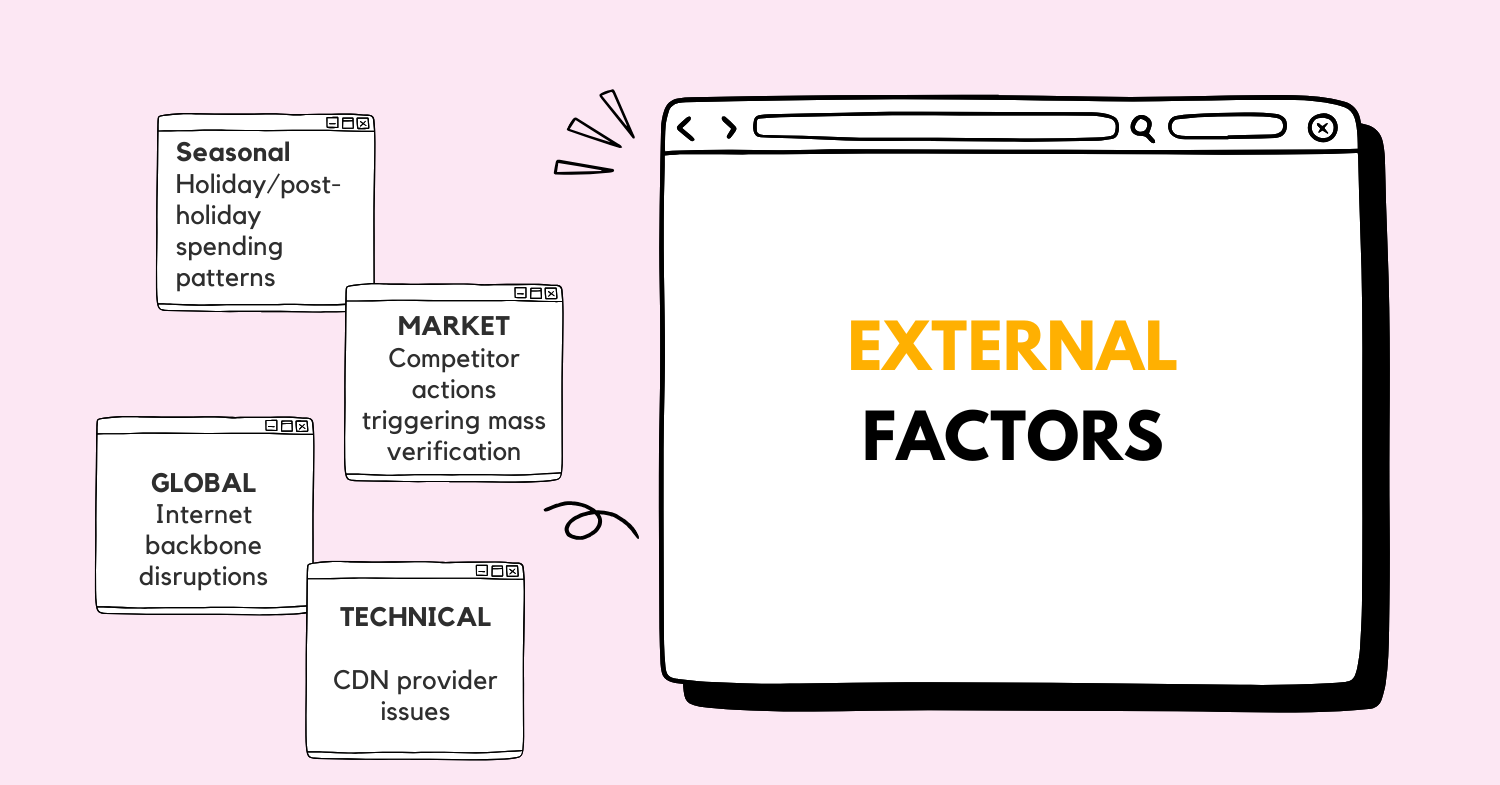 Before diving into internal systems, let's quickly assess potential external factors that could impact Netflix verification times:
| Category | Factors | Impact Assessment | Status |
|---|---|---|---|
| Natural | Seasonal usage spikes (holidays, major releases) | Medium - Could cause temporary system load | Consider - But would affect other metrics too |
| Market | Competitor actions triggering mass verification | Low - Unlikely to cause sustained issue | Rule out - No correlation with competitor moves |
| Global | Internet backbone disruptions | Medium - Could affect global response times | Rule out - Would impact all services, not just verification |
| Technical | CDN provider issues | High - Could directly impact delivery | Consider - But would likely affect content delivery too |
| Technical | Third-party authentication service degradation | High - Direct impact on verification | Consider - High probability factor |
The verification time increase is likely not due to broad external factors that would impact multiple services. The specificity of the issue to verification suggests internal systems or specific third-party dependencies are more probable causes.
Step 3
Product Understanding and User Journey (3 minutes)
Netflix's account verification system serves multiple critical functions:
- Security: Preventing unauthorized access to accounts containing personal and payment information
- Fraud prevention: Limiting account sharing beyond household boundaries
- User authentication: Ensuring legitimate users can access their content across devices
The typical verification flow involves:
- User initiates login on a new device or after suspicious activity
- System generates a verification code
- Code is delivered via email or SMS
- User receives and enters the code
- Backend validates the code
- User gains access to their account
The 10-minute verification time could be disrupting this flow at multiple points, potentially causing significant user frustration, increased support tickets, and even account abandonment. This is particularly problematic for Netflix's core value proposition of instant entertainment access.
Edge cases worth considering include:
- Users in regions with poor connectivity
- Verification during peak usage hours
- Multiple simultaneous verification attempts
- Recently changed contact information
- Accounts flagged for potential sharing violations
Step 4
Metric Breakdown (3 minutes)
Let's break down what "verification time" actually measures in the Netflix ecosystem:
The verification time metric likely encompasses:
- Time to generate verification code
- Time to deliver code to user
- Time for user to receive and enter code
- Time to process and validate the entered code
- Time to grant access after successful validation
Key segments to analyze:
- Device types (mobile, TV, web)
- Geographic regions
- Connection types
- New vs. returning users
- Time of day/peak usage periods
Understanding which component is causing the delay is crucial for targeted remediation. A 10-minute verification time suggests a systemic issue rather than user behavior change, as users typically enter codes promptly once received.
Step 5
Data Gathering and Prioritization (3 minutes)
To effectively diagnose the verification delay, I would request the following data:
| Data Type | Purpose | Priority | Source |
|---|---|---|---|
| Verification time breakdown by stage | Identify specific bottlenecks | High | Authentication service logs |
| Error rates and types | Detect failing components | High | Error tracking system |
| System performance metrics | Identify resource constraints | High | Infrastructure monitoring |
| Code delivery success rates | Check communication channels | Medium | Email/SMS delivery logs |
| User behavior patterns | Detect changes in user response time | Medium | Analytics platform |
| Recent deployment timeline | Correlate with issue onset | High | Release management system |
| Geographic distribution of delays | Identify regional patterns | Medium | Global performance dashboard |
| Third-party service performance | Check dependency issues | High | Vendor monitoring tools |
I would prioritize data that helps isolate which part of the verification flow is causing the delay. If the issue is in code generation or validation, we'd see backend system metrics showing problems. If it's in delivery, we'd see patterns in communication service performance.
The most critical data points would be timestamps from each stage of the verification process to pinpoint exactly where the 10-minute delay is occurring.
Step 6
Hypothesis Formation (6 minutes)
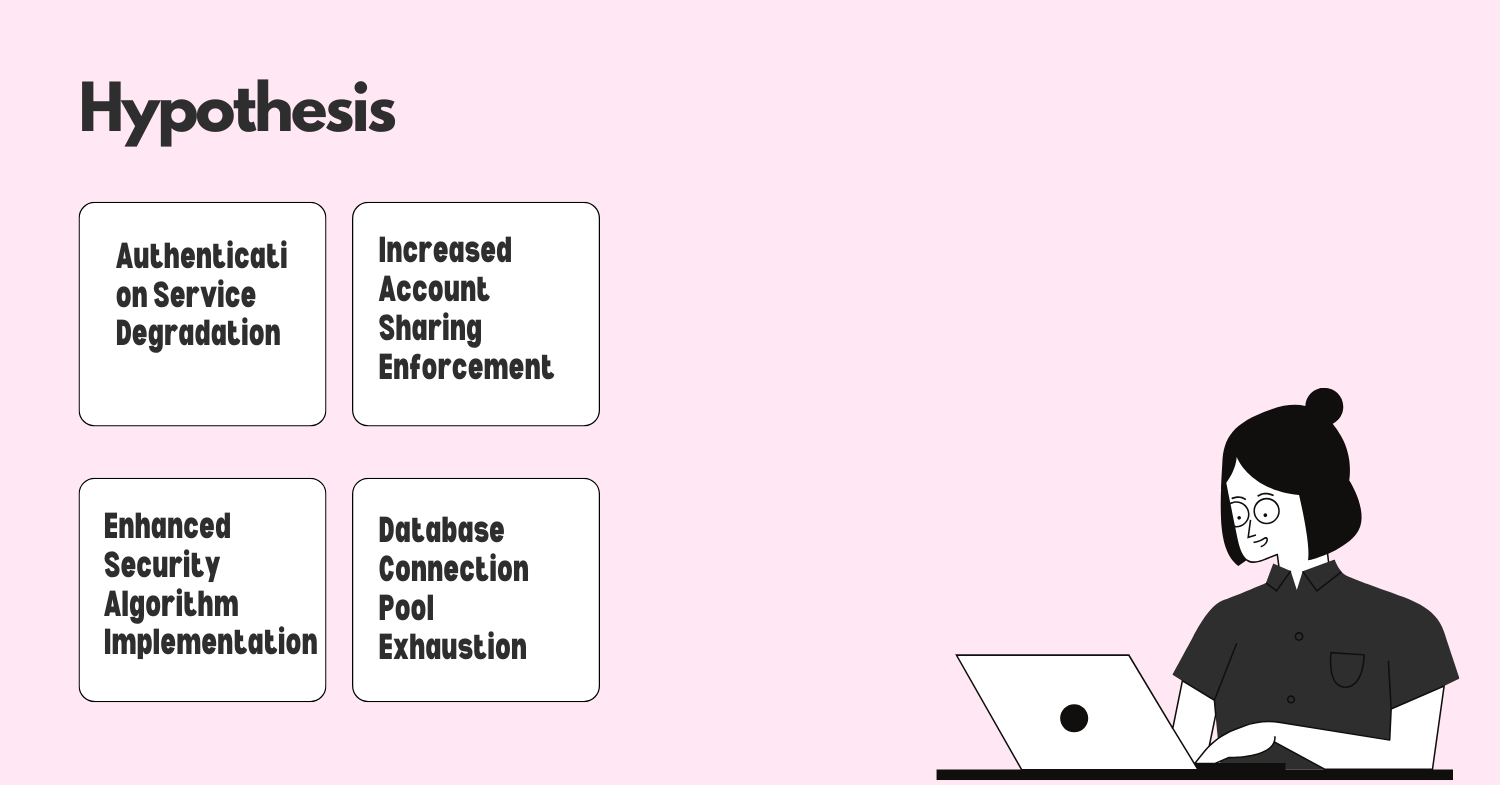 Based on the information gathered, here are my primary hypotheses for the Netflix verification time increase:
1. Technical Hypothesis: Authentication Service Degradation
The verification system may be experiencing performance degradation due to resource constraints or inefficient processing.
Evidence points:
- Consistent 10-minute delay suggests a timeout or queue processing issue
- Affects verification specifically rather than other Netflix services
- May correlate with growing user base without infrastructure scaling
Impact assessment:
- High severity - directly impacts user experience and account access
- Potentially affecting all verification attempts globally
Validation approach:
- Analyze authentication service logs for increased latency
- Check resource utilization metrics (CPU, memory, connections)
- Review recent code changes to authentication services
- Test verification in controlled environment with performance monitoring
2. User Behavior Hypothesis: Increased Account Sharing Enforcement
Netflix's recent crackdown on password sharing may have triggered a massive increase in verification requests, overwhelming the system.
Evidence points:
- Timing may correlate with new account sharing policies
- Verification is a key mechanism in enforcing household boundaries
- Could explain why specifically verification is affected
Impact assessment:
- Medium-high severity - strategic initiative causing technical bottleneck
- Potentially temporary as system adjusts to new normal
Validation approach:
- Compare verification volume before and after sharing policies
- Analyze geographic patterns matching sharing enforcement rollout
- Check if delays correlate with sharing detection triggers
3. Product Change Hypothesis: Enhanced Security Algorithm Implementation
A new, more sophisticated security verification algorithm may have been implemented that takes longer to process but provides better protection.
Evidence points:
- Security enhancements often trade speed for protection
- Would specifically affect verification without impacting other services
- May have been implemented without performance testing at scale
Impact assessment:
- Medium severity - intentional change with unintended consequences
- Affects all users but improves security posture
Validation approach:
- Review recent security enhancement deployments
- Compare algorithm processing time in test vs. production
- Check if verification complexity increased (more factors checked)
4. Infrastructure Hypothesis: Database Connection Pool Exhaustion
The verification system may be experiencing database connection pool exhaustion, causing requests to queue until connections become available.
Evidence points:
- 10-minute delay suggests a standard connection timeout
- Database operations are central to verification (checking credentials)
- Would explain consistent timing across verification attempts
Impact assessment:
- High severity - architectural bottleneck affecting all users
- Likely to worsen during peak usage periods
Validation approach:
- Monitor database connection pool metrics
- Check for connection timeouts in logs
- Analyze database query performance during verification
- Test with increased connection pool size
Step 7
Root Cause Analysis (5 minutes)
Applying the "5 Whys" technique to each hypothesis:
Authentication Service Degradation
- Why is verification taking 10 minutes? Because the authentication service is responding slowly.
- Why is the authentication service slow? Because requests are queuing up waiting for processing.
- Why are requests queuing? Because the service cannot handle the current volume of verification requests.
- Why can't it handle the volume? Because either resources are insufficient or processing efficiency has decreased.
- Why are resources insufficient/processing inefficient? Because either the system wasn't scaled properly for current demand or a recent change introduced inefficiency.
This suggests either a capacity planning issue or a regression in system performance due to a recent deployment.
Increased Account Sharing Enforcement
- Why is verification taking 10 minutes? Because the verification system is overwhelmed with requests.
- Why is it overwhelmed? Because there's a sudden increase in verification volume.
- Why is there increased volume? Because more users are being prompted to verify their accounts.
- Why are more users being prompted? Because Netflix implemented stricter account sharing detection.
- Why is this causing delays? Because the verification infrastructure wasn't scaled to handle the increased enforcement activity.
This points to a product strategy decision that had unforeseen technical implications.
Enhanced Security Algorithm Implementation
- Why is verification taking 10 minutes? Because the verification process itself is taking longer.
- Why is the process taking longer? Because more security checks are being performed.
- Why are more checks being performed? Because a new security algorithm was implemented.
- Why was a new algorithm implemented? To enhance account security and reduce fraud.
- Why is it causing delays? Because the performance impact wasn't properly assessed before deployment.
This suggests a trade-off between security and performance that wasn't fully evaluated.
Database Connection Pool Exhaustion
- Why is verification taking 10 minutes? Because requests are waiting for database connections.
- Why are they waiting? Because all available connections in the pool are in use.
- Why are all connections in use? Because they're not being released quickly enough or the pool is too small.
- Why aren't connections being released/why is the pool too small? Because either there's a connection leak or the configuration hasn't been updated for current scale.
- Why wasn't this caught? Because database connection metrics weren't being properly monitored or load testing wasn't representative.
This points to a specific technical configuration issue that could be relatively straightforward to address.
Most Likely Root Cause: Based on the consistent 10-minute delay and the specificity to verification, the Database Connection Pool Exhaustion hypothesis seems most plausible. The 10-minute mark suggests a timeout threshold, which is common in database connection configurations. This would explain why the issue affects only verification (which likely has its own database connection pool) and why the delay is consistent rather than variable.
Step 8
Validation and Next Steps (5 minutes)
To validate our hypotheses and implement solutions, I propose the following approach:
| Hypothesis | Validation Method | Success Criteria | Timeline |
|---|---|---|---|
| DB Connection Pool Exhaustion | Monitor connection pool metrics during verification attempts | Identify connection wait times approaching 10 minutes | 24 hours |
| Authentication Service Degradation | Deploy additional authentication service capacity and observe impact | Verification time decreases with added capacity | 48 hours |
| Enhanced Security Algorithm | A/B test with previous algorithm for subset of users | Significant performance difference between algorithms | 1 week |
| Account Sharing Enforcement | Analyze verification volume correlation with sharing detection | Clear pattern between sharing flags and verification spikes | 3 days |
Immediate actions (24-48 hours):
- Increase database connection pool size for verification services
- Implement connection leak detection and timeout reduction
- Add monitoring alerts for connection pool utilization
- Deploy additional authentication service capacity
Short-term solutions (1-2 weeks):
- Optimize database queries used during verification
- Implement connection pooling improvements
- Review and optimize security algorithm if it's contributing to delays
- Implement rate limiting and graceful degradation for verification spikes
Long-term prevention (1-3 months):
- Redesign verification system for better scalability
- Implement progressive security checks (fast path for low-risk verifications)
- Develop better load testing that simulates verification patterns
- Create automated scaling based on verification demand
Step 9
Decision Framework (3 minutes)
| Condition | Action 1 | Action 2 |
|---|---|---|
| Connection pool metrics show exhaustion | Increase pool size by 50% | Implement connection timeout reduction to 5 minutes |
| Authentication service CPU/memory at capacity | Scale horizontally with 100% more instances | Implement request prioritization to favor new device verifications |
| Security algorithm taking >30 seconds | Revert to previous algorithm temporarily | Optimize algorithm with performance focus |
| Verification volume increased >200% | Implement queue-based processing with user notification | Temporarily reduce verification requirements for low-risk scenarios |
| Third-party delivery services degraded | Switch to alternate provider | Implement multi-channel verification (both email and SMS) |
This framework provides clear decision paths based on validation outcomes, ensuring we can respond quickly as more data becomes available.
Step 10
Resolution Plan (2 minutes)
1. Immediate Actions (24-48 hours)
- Increase database connection pool size for verification services by 100%
- Implement connection timeout reduction from 10 to 5 minutes
- Deploy additional authentication service instances
- Add real-time monitoring dashboard for verification performance
- Communicate to users that we're aware of and addressing the issue
2. Short-term Solutions (1-2 weeks)
- Refactor database access patterns in verification flow
- Implement connection pooling improvements with better resource management
- Optimize security verification algorithms for performance
- Add circuit breakers to prevent cascading failures
- Develop better load testing specifically for verification scenarios
3. Long-term Prevention (1-3 months)
- Redesign verification architecture for horizontal scalability
- Implement risk-based verification with tiered security levels
- Develop predictive scaling based on usage patterns
- Create dedicated verification infrastructure separate from main services
- Establish performance budgets for security enhancements
This approach addresses the immediate user experience issue while building toward a more resilient verification system that can handle Netflix's scale and security requirements.
.png)