Introduction
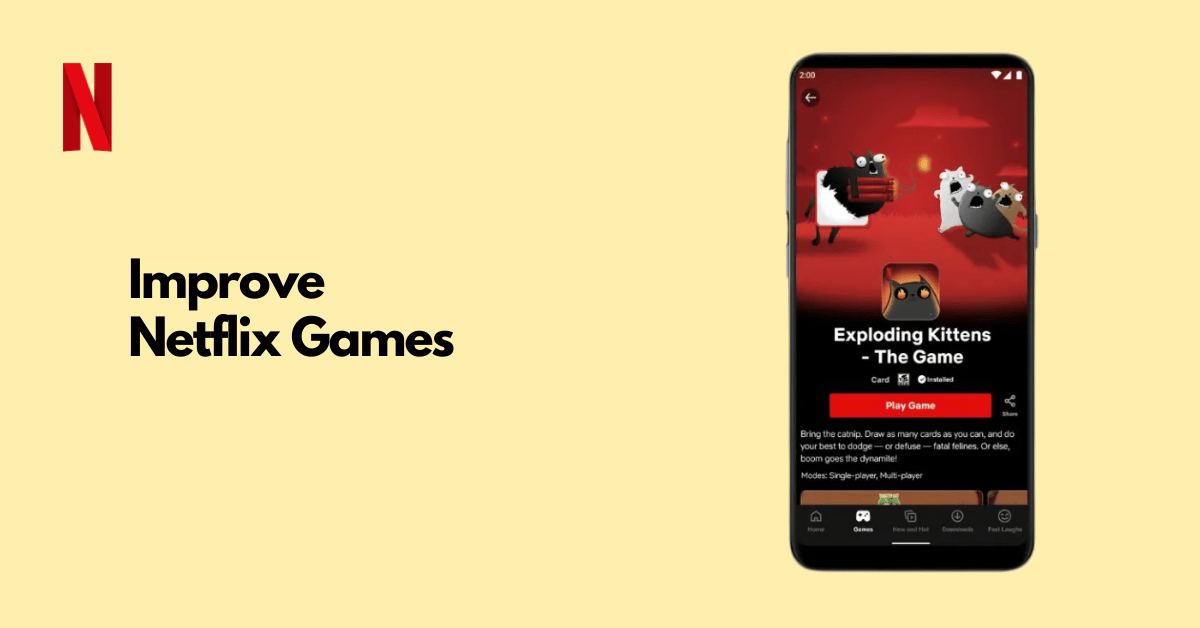
I'll approach improving Netflix Mobile Games by examining the current state, identifying key user segments and pain points, and developing strategic solutions that align with Netflix's broader content ecosystem. I'll focus on enhancing discovery, engagement, and retention while leveraging Netflix's unique position as both a streaming and gaming platform.
I'll be using a structured approach that includes clarifying the problem space, understanding user segments, identifying pain points, generating solutions, prioritizing initiatives, and establishing metrics for success.
Step 1
Clarifying Questions (5 mins)
- Why it matters: This fundamentally shapes our approach—whether we optimize for cross-platform engagement, standalone gaming experience, or subscription value.
- Expected answer: Primarily focused on retention and engagement for core Netflix subscribers.
- Impact on approach: If retention-focused, I'd prioritize integration with Netflix content; if revenue-focused, I'd explore monetization models beyond subscription.
- Why it matters: Helps identify whether our primary challenge is awareness, conversion, or retention.
- Expected answer: Likely low single-digit percentage of subscribers actively playing games.
- Impact on approach: Low awareness would suggest focusing on discovery; low engagement would point to content quality or game selection issues.
- Why it matters: Ensures our improvement recommendations align with how success is currently defined.
- Expected answer: Likely tracking game downloads, daily/monthly active users, session length, and impact on overall Netflix retention. Impact on approach: Would tailor solutions to move specific metrics that matter most to the business.
- Why it matters: Helps understand content strategy alignment and what types of games resonate with Netflix users.
- Expected answer: Mix of Netflix IP-based games and third-party titles, with IP-based games showing stronger engagement.
- Impact on approach: Would influence recommendations around content strategy and IP leverage.
I'd like to take a minute to organize my thoughts before moving to the next section.
Step 2
User Segmentation (5 mins)
Key Stakeholders
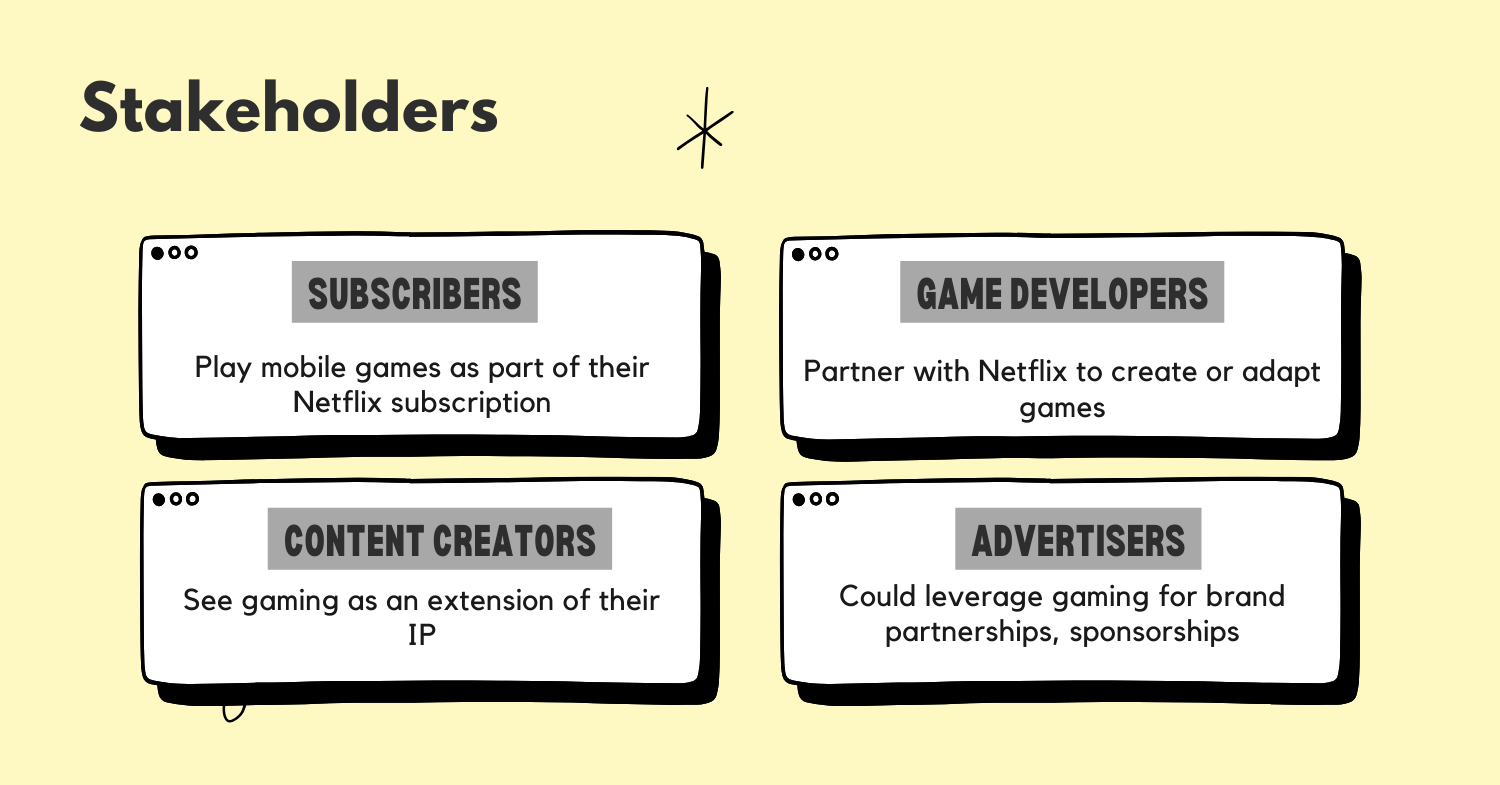
The Netflix Mobile Games ecosystem involves several key stakeholders:
- Netflix subscribers (primary users)
- Game developers and studios
- Netflix content teams (shows/movies)
- Mobile platform providers (Apple/Google)
I'll focus on Netflix subscribers as they're the primary users whose experience we're trying to improve.
Sub-segments
Looking at Netflix subscribers who could engage with mobile games, I can identify several behavioral segments:
- Content Extenders: Users who want to extend their experience with Netflix shows/movies through related games
- Casual Gamers: Subscribers who play mobile games occasionally but don't consider gaming a primary entertainment activity
- Value Maximizers: Users who want to get the most from their Netflix subscription and see games as added value
- Dedicated Gamers: Netflix subscribers who regularly play mobile games and have high expectations for quality
Let's prioritize these segments:
| Sub-Segment | TAM (1-10) | Frequency (1-10) | Potential Value (1-10) | Total Score |
|---|---|---|---|---|
| Content Extenders | 8 | 7 | 9 | 504 |
| Casual Gamers | 9 | 5 | 6 | 270 |
| Value Maximizers | 7 | 4 | 5 | 140 |
| Dedicated Gamers | 4 | 9 | 7 | 252 |
Content Extenders score highest because:
- TAM (8): Large portion of Netflix users are invested in Netflix original content
- Frequency (7): Likely to engage regularly with content they're fans of
- Potential Value (9): High potential for cross-media engagement and retention
Persona for Content Extenders:
- Demographics: 25-40 years old, busy professionals or parents
- Behaviors: Watches 1-2 hours of Netflix daily, follows specific shows/franchises closely
- Motivations: Wants to stay connected to favorite content between seasons
- Pain points: Limited time for entertainment, frustrated when favorite shows end
- Quote: "I finished Stranger Things and now I have to wait a year for the next season. I wish there was a way to stay in that world longer."
Step 3
Pain Points Analysis (10 mins)
Let's examine the user journey for Content Extenders interacting with Netflix Mobile Games:
- Awareness: Learning that Netflix offers mobile games
- Discovery: Finding games related to content they enjoy
- Access: Downloading and launching games
- Onboarding: Learning how to play
- Engagement: Playing the game regularly
- Connection: Experiencing links between game and Netflix content
- Progression: Advancing through the game over time
- Community: Sharing experiences with other fans
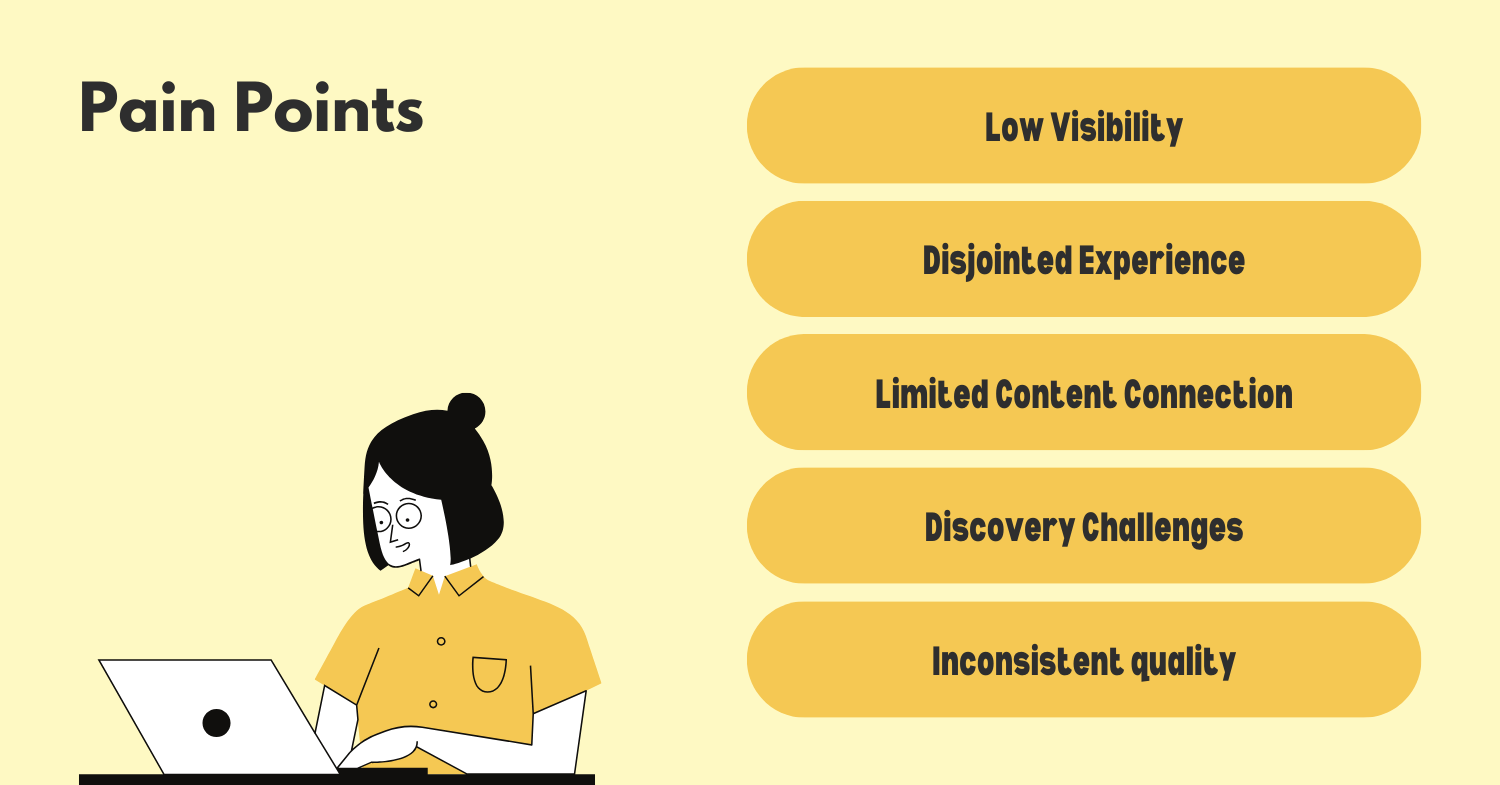
Key Pain Points:
-
Low Visibility: Games are hidden in a tab that many users never explore
- Severity: 9/10
- Frequency: 10/10
- User quote: "I've been a Netflix subscriber for years and had no idea they offered games until my friend mentioned it."
-
Disjointed Experience: Having to leave Netflix app, download separate apps, and authenticate again
- Severity: 8/10
- Frequency: 10/10
- User quote: "It's annoying to have to download another app and log in again just to play a game related to a show I'm watching."
-
Limited Content Connection: Weak narrative ties between games and shows/movies
- Severity: 7/10
- Frequency: 8/10
- User quote: "The Stranger Things game was fun but didn't really add anything to the story I care about."
-
Discovery Challenges: Difficulty finding games related to specific content
- Severity: 7/10
- Frequency: 9/10
- User quote: "I wanted to find games related to the shows I watch, but there's no way to filter or search specifically for that."
-
Inconsistent Quality: Varying levels of polish and engagement across games
- Severity: 6/10
- Frequency: 7/10
- User quote: "Some Netflix games are great, others feel like basic mobile games with Netflix characters slapped on."
Pain Point Prioritization
| Pain Point | Severity (1-10) | Frequency (1-10) | Total Score |
|---|---|---|---|
| Low Visibility | 9 | 10 | 90 |
| Disjointed Experience | 8 | 10 | 80 |
| Limited Content Connection | 7 | 8 | 56 |
| Discovery Challenges | 7 | 9 | 63 |
| Inconsistent Quality | 6 | 7 | 42 |
Based on this analysis, the top three pain points to address are:
- Low visibility of games within the Netflix ecosystem
- Disjointed experience between streaming and gaming
- Discovery challenges for content-related games
These pain points have likely increased as Netflix has expanded its gaming library without proportionally improving discovery and integration mechanisms.
Now that we've identified the key pain points, let's take a brief moment to organize our thoughts before developing solutions.
Step 4
Solution Generation (10 mins)
Let's develop solutions that address our prioritized pain points for Content Extenders:
1. Content-Driven Discovery
Solution: Integrate game recommendations directly into the show/movie experience.
Implementation:
- Add "Explore More" section after episodes finish that includes related games
- Create a "Games for You" row on the home screen based on viewing history
- Implement "Play the Game" buttons at the end of relevant shows/movies
- Add game trailers during the "Skip Intro" period for new episodes
Example: After finishing an episode of "Squid Game," viewers see a prompt: "Continue the experience with 'Squid Game: Challenge Mode' – play now without leaving Netflix."
Technical/Business Challenges:
- Requires deeper integration between content and gaming teams
- May need to develop in-app gameplay capabilities to avoid app-switching
- Content rights and licensing for game adaptations
2. Seamless Gaming Experience
Solution: Enable in-app gameplay for select titles to eliminate friction.
Implementation:
- Develop lightweight HTML5 games playable directly within the Netflix app
- Create a unified authentication system that eliminates separate logins
- Implement cross-device progression so users can switch between TV and mobile
- Develop a "Game Mode" for the Netflix app that optimizes for gameplay
Example: Users can play simple games related to "Bridgerton" or "Stranger Things" directly within the Netflix app, with more complex games still requiring a download but maintaining seamless authentication.
Technical/Business Challenges:
- Platform restrictions (especially iOS) for in-app gaming
- Performance considerations for streaming app
- Development costs for multiple platforms
- Potential impact on core streaming experience
3. Narrative Continuity System
Solution: Create games that meaningfully extend show narratives and reward cross-media engagement.
Implementation:
- Develop games that bridge seasons with canonical storylines
- Create character backstories that are exclusively available in games
- Implement a "Story Sync" feature that adapts game content based on where users are in a show
- Offer in-game rewards for watching related content and vice versa
Example: A "Money Heist" game that reveals what happened between seasons, with new content unlocking as users watch the show, and game achievements providing "insider information" when returning to the show.
Technical/Business Challenges:
- Coordination between show writers and game developers
- Content production timelines and synchronization
- Maintaining narrative quality across mediums
- Avoiding making shows incomprehensible without playing games
4. Community & Social Features (Moonshot Idea)
Solution: Transform Netflix from a solitary viewing experience to a social entertainment platform through games.
Implementation:
- Create "Watch Parties" that include mini-games related to the content
- Develop competitive leaderboards for friends watching the same shows
- Implement "Prediction Games" for reality and competition shows
- Build fan communities around specific content with game-like challenges and rewards
Example: While watching "Love Is Blind," friends can make predictions about couples, earning points and competing on leaderboards, with season-long games that track your prediction accuracy.
Technical/Business Challenges:
- Privacy considerations for social features
- Moderation requirements for user-generated content
- Potential shift in core Netflix identity
- Development of social infrastructure
Step 5
Solution Evaluation and Prioritization (2 mins)
Let's evaluate our solutions using the RICE framework:
| Solution | Reach (1-10) | Impact (1-10) | Confidence (0.1-1.0) | Effort (months) | RICE Score | Explanation |
|---|---|---|---|---|---|---|
| Content-Driven Discovery | 9 | 8 | 0.8 | 3 | 19.2 | High reach across all users; directly addresses visibility issues; moderate technical complexity |
| Seamless Gaming Experience | 7 | 9 | 0.6 | 8 | 4.7 | High impact on engagement but significant platform challenges; longer development timeline |
| Narrative Continuity System | 6 | 8 | 0.7 | 5 | 6.7 | Targeted to content fans; high engagement potential; requires content coordination |
| Community & Social Features | 8 | 7 | 0.5 | 10 | 2.8 | Broad appeal but significant shift from core experience; highest development effort |
Implementation Roadmap:
-
Phase 1 (0-3 months): Content-Driven Discovery
- Implement "Explore More" sections after episodes
- Create content-based game recommendations
- Add game trailers in strategic locations
-
Phase 2 (3-8 months): Narrative Continuity System
- Launch games that bridge popular show seasons
- Implement "Story Sync" for top 3 Netflix franchises
- Create cross-media rewards system
-
Phase 3 (8-16 months): Seamless Gaming Experience
- Develop lightweight in-app games for top properties
- Implement unified authentication
- Create cross-device progression system
-
Phase 4 (16+ months): Community Features
- Start with prediction games for competition shows
- Gradually expand social features based on adoption
Validation Approach:
- A/B test different discovery placements to measure conversion
- Track cross-media engagement between shows and related games
- Conduct user research on narrative continuity perception
- Measure retention impact of each implementation phase
Step 6
Metrics and Measurement (2 mins)
Primary Success Metrics
-
Game Discovery Rate: Percentage of Netflix users who view game pages
- Target: 30% increase in first 3 months
- Rationale: Directly measures visibility improvement
-
Cross-Media Engagement: Percentage of show viewers who play related games
- Target: 15% of viewers try related games within 7 days
- Rationale: Measures content extension success
-
Gaming Session Frequency: Average gaming sessions per month per user
- Target: 8 sessions per month (2x current baseline)
- Rationale: Indicates improved engagement and retention
Secondary Metrics
-
Time to First Game: Average days from subscription to first game play
- Target: Reduce by 50%
- Rationale: Measures discovery improvements
-
Gaming Session Length: Average time spent in games per session
- Target: 20% increase
- Rationale: Indicates improved game quality and engagement
-
Cross-Platform Engagement: Percentage of users who engage with both mobile and TV Netflix experiences in the same week
- Target: 15% increase
- Rationale: Measures ecosystem stickiness
Guardrail Metrics
-
Streaming Engagement: Hours of video content watched per user
- Ensure no decrease in core streaming engagement
- Rationale: Games should complement, not cannibalize streaming
-
App Performance: App crash rate and load times
- Maintain current performance benchmarks
- Rationale: New features shouldn't degrade core experience
-
Subscription Retention: Monthly churn rate
- Target: 5% improvement in retention for game users vs. non-game users
- Rationale: Ultimate business goal is improved retention
Step 7
Summary and Next Steps
To improve Netflix Mobile Games, I've focused on addressing the key pain points for Content Extenders—subscribers who want to extend their experience with Netflix shows and movies through gaming.
The highest priority improvements are:
- Content-Driven Discovery: Integrating game recommendations directly into the show/movie experience to dramatically improve visibility and conversion
- Narrative Continuity System: Creating games that meaningfully extend show narratives to deepen engagement with Netflix IP
- Seamless Gaming Experience: Reducing friction between streaming and gaming through in-app gameplay and unified authentication
These solutions align with Netflix's core strengths in content creation and distribution while addressing the fundamental challenges of awareness, integration, and engagement that currently limit the impact of Netflix Mobile Games.
Success will be measured primarily through improved game discovery rates, cross-media engagement between shows and games, and increased gaming session frequency, while ensuring we maintain strong performance in core streaming metrics.
Next steps would include:
- Validating these hypotheses through user research
- Developing an MVP for content-driven discovery
- Identifying 2-3 key Netflix franchises for narrative continuity pilots
- Exploring technical feasibility of in-app gaming options
.png)