Introduction
I'll approach improving Amazon Marketplace for Sellers by first understanding the current ecosystem, identifying key seller segments and their pain points, and then developing targeted solutions that enhance the seller experience while aligning with Amazon's business objectives. I'll focus on practical improvements that can drive seller success, retention, and ultimately strengthen the marketplace ecosystem.
Step 1
Clarifying Questions
- Why it matters: Different seller segments have vastly different needs and pain points. Enterprise sellers might need better API integration and bulk tools, while new sellers might need better onboarding and education.
- Expected answer: Focus on small to medium-sized businesses as they represent the largest growth opportunity.
- Impact on approach: Would prioritize solutions that address scale challenges for growing businesses rather than enterprise integration or new seller acquisition.
- Why it matters: The north star metric will significantly influence which pain points we prioritize addressing.
- Expected answer: Seller retention and sales volume per seller are the primary concerns.
- Impact on approach: Would focus on operational efficiency and sales enablement tools rather than onboarding improvements.
- Why it matters: Understanding competitive threats helps prioritize which areas need immediate attention versus long-term investment.
- Expected answer: Sellers are expressing frustration with fee structures, account support, and policy enforcement consistency.
- Impact on approach: Would prioritize transparency, predictability, and support improvements over new features.
- Why it matters: Understanding constraints helps ensure proposed solutions are feasible and aligned with company direction.
- Expected answer: Amazon is investing in AI capabilities and wants to leverage them; also working on streamlining the backend systems.
- Impact on approach: Would incorporate AI-driven solutions and focus on improvements that align with backend simplification.
I'd like to take a minute to organize my thoughts before diving into the user segmentation.
Step 2
User Segmentation
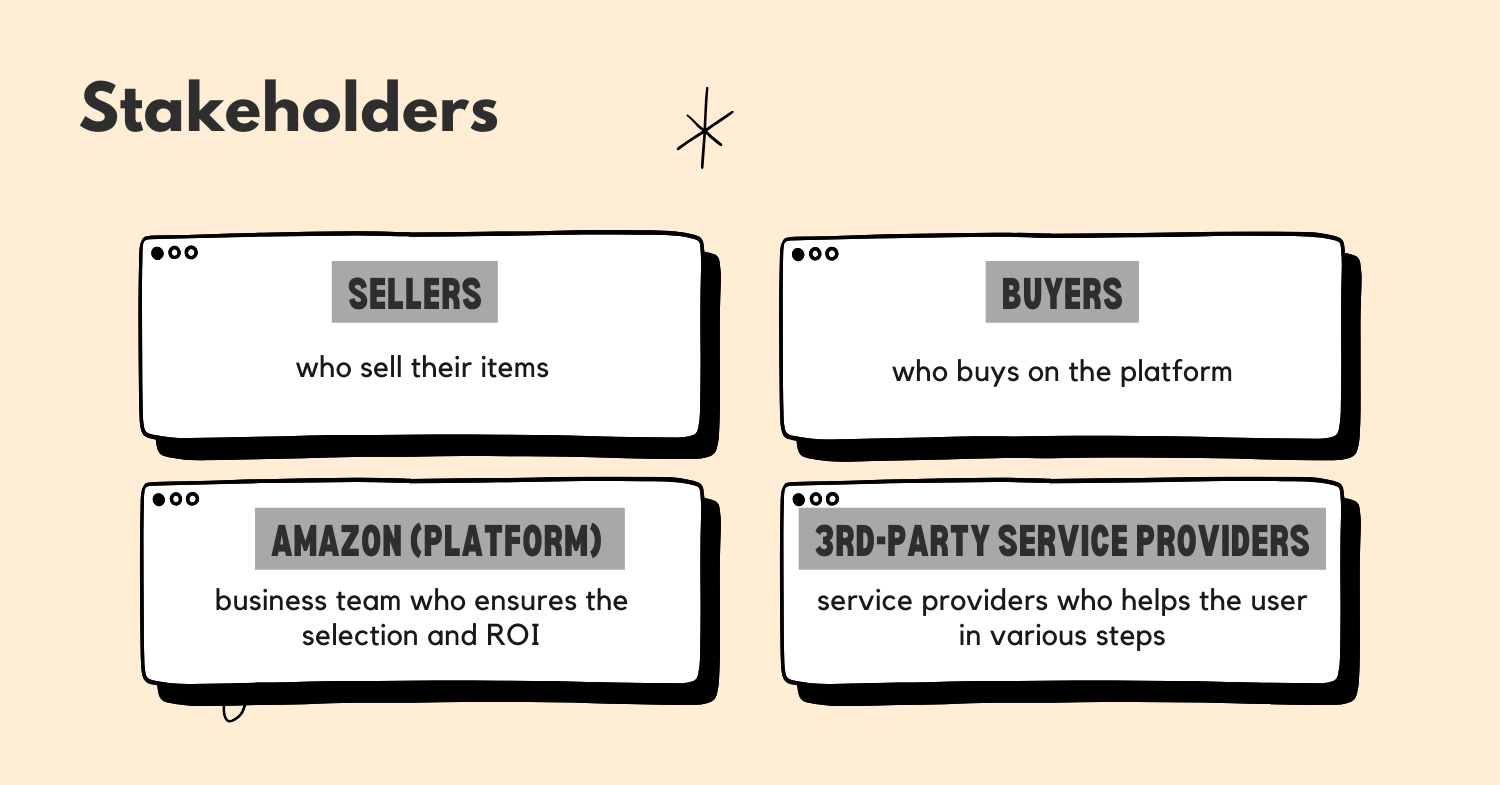
Key Stakeholders
The Amazon Marketplace ecosystem involves several key stakeholders:
- Sellers (our primary focus)
- Buyers/customers
- Amazon itself (platform owner)
- Third-party service providers (logistics, advertising, etc.)
Since the question explicitly asks about improving the marketplace for sellers, I'll focus on this stakeholder group.
Sub-segments
Within the seller ecosystem, we can identify several distinct segments:
- New/Emerging Sellers - Recently joined the platform, typically selling low volumes, learning the system
- Established SMB Sellers - Stable businesses with consistent sales, typically $100K-$5M annual revenue on Amazon
- Enterprise/Brand Sellers - Large companies or established brands, often with dedicated Amazon teams
- Cross-Border Sellers - International merchants selling into different markets, dealing with additional complexity
Let's prioritize these segments based on TAM (Total Addressable Market), Frequency (of platform interaction), and Potential (for growth and revenue impact):
| Sub-Segment | TAM (1-10) | Frequency (1-10) | Potential (1-10) | Total Score |
|---|---|---|---|---|
| New/Emerging Sellers | 9 | 8 | 7 | 504 |
| Established SMB Sellers | 7 | 9 | 9 | 567 |
| Enterprise/Brand Sellers | 5 | 7 | 8 | 280 |
| Cross-Border Sellers | 8 | 8 | 8 | 512 |
Scoring Explanation:
- New/Emerging Sellers: High TAM (9) as there's a constant influx of new sellers; high frequency (8) as they're actively learning and engaging; good potential (7) as they could become long-term sellers but have high churn risk.
- Established SMB Sellers: Good TAM (7) as they represent a substantial portion of the seller base; very high frequency (9) as they manage their business daily; excellent potential (9) as they drive significant volume and have room to grow.
- Enterprise/Brand Sellers: Lower TAM (5) as there are fewer large enterprises; good frequency (7) as they have dedicated teams; high potential (8) due to their volume and strategic importance.
- Cross-Border Sellers: High TAM (8) as global selling is a growth area; high frequency (8) due to complex operations; high potential (8) as international expansion is strategic for Amazon.
Based on this analysis, I'll focus on Established SMB Sellers as they represent the highest total opportunity.
Primary Persona: Established SMB Seller
Meet Sarah:
- 42-year-old owner of a home goods business
- Selling on Amazon for 4 years
- $1.2M annual revenue on Amazon (70% of her total business)
- Has 2 employees helping with operations
- Sells approximately 120 SKUs across 3 related categories
- Uses FBA for 80% of products, merchant fulfillment for 20%
- Spends 3-4 hours daily managing her Amazon business
Motivations:
- Grow business predictably and sustainably
- Maintain healthy profit margins despite rising costs
- Expand product catalog strategically
- Protect brand reputation and product listings
- Reduce time spent on operational tasks
Pain Points:
- Struggles with unpredictable fee changes and profitability calculations
- Finds dispute resolution processes time-consuming and opaque
- Difficulty getting timely support for complex issues
- Challenges with inventory management across FBA and merchant fulfillment
- Concerned about increasing competition and maintaining visibility
Step 3
Pain Points Analysis
User Journey for Established SMB Seller
Let's map Sarah's typical journey managing her Amazon seller business:
-
Business Planning
- Reviews performance metrics and plans inventory
- Sets pricing and promotional strategy
- Allocates marketing budget
-
Inventory Management
- Prepares and ships inventory to FBA
- Manages stock levels across channels
- Handles storage fee considerations
-
Listing Management
- Creates and optimizes product listings
- Responds to customer questions
- Monitors for listing issues/hijackers
-
Order Processing
- Processes merchant-fulfilled orders
- Monitors FBA order fulfillment
- Handles returns and refunds
-
Customer Service
- Responds to buyer messages
- Addresses negative feedback and reviews
- Manages A-to-Z claims
-
Performance Management
- Monitors account health metrics
- Addresses policy violations
- Appeals unfair decisions
-
Growth & Optimization
- Analyzes advertising performance
- Explores new product opportunities
- Optimizes for search visibility
Pain Points at Each Stage
-
Business Planning
- Unpredictable fee changes impact profitability calculations
- Limited visibility into upcoming marketplace changes
- Difficulty forecasting due to inconsistent data
"I never know when Amazon will change a fee structure or policy that completely disrupts my business planning."
-
Inventory Management
- Complex inventory routing requirements
- Unexpected long-term storage fees
- Inventory limits that change without clear explanation
"Last Q4, my inventory limits were suddenly reduced right before Black Friday with no warning or explanation."
-
Listing Management
- Frequent listing suppression without clear reasons
- Difficulty defending against unauthorized sellers
- Inconsistent catalog enforcement
"My best-selling product was suppressed for two weeks due to a 'potential policy violation' that was never explained, and I lost thousands in sales."
-
Order Processing
- Lack of transparency in FBA issues
- Difficulty tracking inventory discrepancies
- Complex return processing
"When customers report they received damaged items, I have no way to verify if it was damaged in Amazon's warehouse or during shipping."
-
Customer Service
- Limited direct communication with customers
- Automated responses that don't address specific issues
- Negative impact from Amazon's customer service decisions
"Amazon gave a full refund to a customer who clearly misused my product, and I had no say in the matter."
-
Performance Management
- Opaque performance metrics
- Inconsistent policy enforcement
- Difficulty appealing automated decisions
"My account was put at risk because of metrics that suddenly changed, and it took weeks to get someone to actually review my appeal."
-
Growth & Optimization
- Rising advertising costs with diminishing returns
- Limited data access for optimization
- Increasing competition from Amazon's own products
"I've had to increase my ad spend by 40% year-over-year just to maintain the same visibility."
Root Causes Analysis
-
System Complexity
- Amazon's scale requires automated systems that can't handle nuance
- Multiple overlapping systems create inconsistencies
-
Misaligned Incentives
- Amazon prioritizes customer experience sometimes at seller expense
- Short-term revenue goals can conflict with seller sustainability
-
Communication Gaps
- Support teams often lack context or authority
- Information silos between Amazon departments
-
Technical Limitations
- Legacy systems not designed for current scale
- Integration challenges across Amazon's ecosystem
Pain Point Prioritization

| Pain Point | Severity (1-10) | Frequency (1-10) | Total Score |
|---|---|---|---|
| Unpredictable policy enforcement | 9 | 8 | 72 |
| Inadequate seller support | 8 | 9 | 72 |
| Lack of business predictability | 9 | 7 | 63 |
| Rising costs with limited control | 7 | 8 | 56 |
| Inventory management complexity | 6 | 9 | 54 |
| Limited data access | 7 | 7 | 49 |
| Listing quality challenges | 6 | 7 | 42 |
Critical Pain Points:
-
Unpredictable policy enforcement - Sellers face inconsistent application of policies, automated enforcement without context, and difficulty appealing decisions. This creates significant business risk and stress.
-
Inadequate seller support - When issues arise, sellers struggle to reach knowledgeable support representatives who can actually solve problems. Cases are often closed without resolution or require escalation through multiple channels.
-
Lack of business predictability - Sudden changes to fees, requirements, inventory limits, or search algorithms make it difficult for sellers to plan and invest with confidence.
-
Rising costs with limited control - Increasing referral fees, FBA costs, and advertising expenses are squeezing margins, while sellers have limited ability to adjust their strategies in response.
These pain points have intensified in recent years as Amazon has grown and competition has increased. The marketplace has become more complex while support resources haven't scaled proportionally. Additionally, Amazon's increasing focus on advertising revenue has shifted the dynamics of visibility and success on the platform.
Now that we've identified the key pain points, let's take a brief moment to organize our thoughts before developing solutions.
Step 4
Solution Generation
Based on the critical pain points identified, I'll develop comprehensive solutions that address the core issues facing established SMB sellers on Amazon Marketplace.
1. Policy Transparency & Consistency System
Core Solution Components:
a) Seller Policy Portal
- Centralized, searchable repository of all policies affecting sellers
- Clear version history showing changes over time
- Plain-language explanations with specific examples
- Personalized policy alerts based on seller's specific business model
b) Policy Change Management System
- Minimum 60-day notice for significant policy changes
- Impact assessment tool showing how changes affect specific seller businesses
- Graduated implementation for major changes with testing periods
- Feedback mechanism for sellers to highlight unintended consequences
c) Policy Simulation & Compliance Tools
- AI-powered listing analyzer to identify potential policy issues before they occur
- "Policy sandbox" to test listings against upcoming policy changes
- Compliance score with specific improvement recommendations
- Appeal case management with status tracking and estimated resolution times
User Flow Example:
- Sarah receives notification about an upcoming policy change affecting product safety documentation
- She accesses the Policy Portal to understand the specific requirements
- Using the simulation tool, she checks her current listings against new requirements
- The system identifies 12 products needing additional documentation
- Sarah uploads new documentation and verifies compliance before the deadline
- The system confirms her listings will remain active when the policy takes effect
Implementation Challenges:
- Requires coordination across multiple Amazon teams that currently operate independently
- Need for significant investment in knowledge management systems
- Potential legal concerns about providing too much specificity in policy guidance
- Technical challenge of creating accurate simulation tools across diverse product categories
2. Enhanced Seller Support Ecosystem
Core Solution Components:
a) Tiered Support Model with Dedicated Resources
- Dedicated account managers for sellers above revenue thresholds
- Industry-specific support teams with product category expertise
- Emergency response team for critical business disruptions
- Support SLAs with guaranteed response times based on issue severity
b) Seller Success Team
- Proactive account monitoring to identify potential issues before they impact business
- Quarterly business reviews for qualifying sellers
- Guided optimization sessions with marketplace experts
- Onboarding specialists for new capabilities and programs
c) Community-Powered Resolution Network
- Peer-to-peer support platform with verified solutions
- Ambassador program featuring experienced sellers
- Issue escalation voting system to identify widespread problems
- Direct feedback loop to product and policy teams
User Flow Example:
- Sarah discovers several of her listings have been incorrectly suppressed
- She opens a support case through her enhanced support portal
- Based on the business impact, the case is assigned to a category specialist
- The specialist identifies a system error affecting similar products
- Sarah receives regular updates as the issue is resolved
- The resolution is documented in the knowledge base to help other sellers
Implementation Challenges:
- Significant investment in hiring and training specialized support staff
- Need for improved internal tools to give support agents more capabilities
- Potential scalability issues for personalized support
- Measuring ROI on support investments
3. Business Predictability Platform
Core Solution Components:
a) Fee Calculator Pro
- Dynamic profitability analysis across all Amazon fee types
- "What-if" scenario planning for potential fee changes
- Competitive fee benchmarking across marketplaces
- Automatic identification of fee anomalies and overcharges
b) Marketplace Roadmap & Planning Tools
- Quarterly business planning calendar with key Amazon dates and deadlines
- Seasonal opportunity forecasting based on category trends
- Capacity planning tools integrated with Amazon's fulfillment network
- Inventory optimization recommendations
c) Early Access Program
- Beta testing opportunities for new seller features
- Gradual rollout options for significant platform changes
- Feedback channels that directly influence product development
- Change impact assessments personalized to seller business model
User Flow Example:
- Sarah accesses her Business Predictability Dashboard in January
- She views the upcoming Q2 marketplace calendar showing key dates
- Using the Fee Calculator Pro, she models profitability for new products
- The system alerts her to upcoming storage fee changes that will impact her business
- She adjusts her inventory strategy based on the recommendations
- Sarah opts into early access for a new listing optimization tool
Implementation Challenges:
- Requires Amazon to commit to more predictable planning cycles
- Need for sophisticated forecasting algorithms
- Potential resistance to sharing roadmap information too far in advance
- Integration with multiple backend systems
4. Cost Control & Revenue Optimization Suite
Core Solution Components:
a) Unified Profitability Dashboard
- Real-time margin analysis across all products
- Cost trend monitoring with alerts for significant changes
- Automatic identification of unprofitable products
- Competitive pricing intelligence with margin impact analysis
b) Advertising Intelligence System
- ROAS optimization recommendations
- Budget allocation tools across campaigns and products
- Competitor advertising intensity signals
- Automated bid adjustments based on profitability targets
c) Operational Efficiency Tools
- FBA vs. self-fulfillment cost comparison calculator
- Returns analysis and problem product identification
- Automated case management for fee disputes
- Inventory health optimization to minimize storage costs
User Flow Example:
- Sarah logs into her Profitability Dashboard on Monday morning
- She notices decreasing margins on a product line due to increased advertising costs
- The Advertising Intelligence tool shows increased competitive advertising in this category
- She uses the optimization tool to reallocate budget to higher-performing products
- The system suggests bundling options to improve margins
- Sarah implements the changes and sets up alerts to monitor performance
Implementation Challenges:
- Requires integration of data across multiple Amazon systems
- Potential concerns about revealing too much competitive intelligence
- Need for sophisticated machine learning models for recommendations
- Balancing seller profitability against Amazon's revenue goals
Moonshot Idea: Amazon Seller Operating System
A comprehensive reimagining of the seller experience as an integrated operating system for e-commerce businesses:
- Unified Command Center - Single interface for managing all aspects of Amazon business
- AI Business Advisor - Proactive recommendations and insights powered by machine learning
- Digital Twin Testing - Ability to simulate changes before implementing them
- Cross-Marketplace Management - Seamless operation across Amazon's global marketplaces
- Ecosystem Integration - Open APIs for seamless connection with external tools and services
- Predictive Analytics - Forward-looking insights rather than backward-looking reporting
- Voice-Activated Commerce Operations - Alexa integration for hands-free business management
This would transform Amazon from a marketplace into a complete business platform for sellers, significantly increasing lock-in while dramatically improving the seller experience.
Step 5
Solution Evaluation and Prioritization
Let's evaluate our proposed solutions using the RICE framework (Reach, Impact, Confidence, Effort):
| Solution | Reach (1-10) | Impact (1-10) | Confidence (0-100%) | Effort (Person-Months) | RICE Score |
|---|---|---|---|---|---|
| Policy Transparency System | 9 | 8 | 80% | 15 | 38.4 |
| Enhanced Seller Support | 7 | 9 | 90% | 12 | 47.3 |
| Business Predictability Platform | 8 | 7 | 70% | 10 | 39.2 |
| Cost Control Suite | 9 | 8 | 80% | 8 | 72.0 |
| Seller Operating System (Moonshot) | 10 | 10 | 40% | 36 | 11.1 |
RICE Score = (Reach × Impact × Confidence) ÷ Effort
Scoring Rationale:
Policy Transparency System
- Reach: 9 - Would benefit nearly all sellers
- Impact: 8 - Would significantly reduce uncertainty and policy-related issues
- Confidence: 80% - Based on seller feedback and clear need
- Effort: 15 person-months - Requires coordination across multiple teams and systems
Enhanced Seller Support
- Reach: 7 - Most valuable for established sellers, less impact for new sellers
- Impact: 9 - Direct impact on seller satisfaction and issue resolution
- Confidence: 90% - Support improvements consistently drive satisfaction
- Effort: 12 person-months - Requires hiring and training but has clear implementation path
Business Predictability Platform
- Reach: 8 - Valuable across most seller segments
- Impact: 7 - Improves planning but doesn't solve immediate pain points
- Confidence: 70% - Depends on Amazon's willingness to provide forward-looking information
- Effort: 10 person-months - Moderate technical complexity
Cost Control Suite
- Reach: 9 - Relevant to virtually all sellers
- Impact: 8 - Direct impact on seller profitability
- Confidence: 80% - Clear connection between tools and outcomes
- Effort: 8 person-months - Leverages existing data and systems
Seller Operating System (Moonshot)
- Reach: 10 - Would transform experience for all sellers
- Impact: 10 - Complete reimagining of seller experience
- Confidence: 40% - Ambitious vision with significant uncertainty
- Effort: 36 person-months - Major investment across organization
Implementation Roadmap
Based on the RICE analysis and considering business impact, I recommend the following implementation roadmap:
Phase 1 (0-6 months): Quick Wins
- Cost Control Suite - Highest RICE score and addresses immediate profitability concerns
- Enhanced Support Triage - Initial improvements to support response times and quality
Phase 2 (6-12 months): Foundation Building 3. Policy Transparency Portal - First version focusing on searchability and clarity 4. Business Predictability Dashboard - Core fee calculator and planning tools
Phase 3 (12-18 months): Advanced Capabilities 5. Policy Simulation Tools - Building on the transparency portal 6. Seller Success Program - Expanding the support improvements 7. Early Access Program - For new features and changes
Phase 4 (18+ months): Transformation 8. Begin Seller Operating System - Starting with unified command center 9. Advanced AI capabilities - Across all solutions
This phased approach delivers immediate value while building toward the more transformative long-term vision.
Step 6
Metrics and Measurement
To measure the success of our improvements to Amazon Marketplace for Sellers, I would establish the following metrics framework:
Primary Success Metrics
-
Seller Retention Rate - Percentage of sellers who remain active on the platform year-over-year, segmented by seller size and category
- Target: Improve retention by 15% for established SMB sellers within 12 months
-
Seller Satisfaction Score (SSS) - Comprehensive satisfaction metric based on regular surveys and feedback
- Target: Increase from current baseline to 8.5/10 within 18 months
-
Average Revenue Per Seller - Measure of seller business growth on the platform
- Target: 12% year-over-year growth for established sellers
Secondary Success Metrics
-
Support Resolution Rate - Percentage of seller issues resolved on first contact
- Target: Improve from current baseline to 85% within 12 months
-
Policy Appeal Success Rate - Percentage of seller appeals that result in favorable outcomes
- Target: Improve transparency and consistency to achieve 40% successful appeal rate
-
Seller Feature Adoption - Percentage of sellers utilizing new tools and capabilities
- Target: 70% adoption of key features within 6 months of launch
-
Time to Resolution - Average time to resolve seller issues by severity level
- Target: 50% reduction in resolution time for high-severity issues
Guardrail Metrics
-
Customer Experience Metrics - Ensure improvements for sellers don't negatively impact the customer experience
- Monitor: Order defect rate, delivery time, customer satisfaction
-
Marketplace Growth - Ensure focus on existing sellers doesn't hamper new seller acquisition
- Monitor: New seller registration and activation rates
-
Platform Health - Ensure policy improvements don't increase policy violations
- Monitor: Product quality metrics, policy violation rates
I would establish a regular cadence of measurement and reporting, with quarterly business reviews to assess progress and make adjustments to our strategy as needed. For each initiative, we would establish specific success criteria and leading indicators to track progress before the lagging indicators show results.
Step 7
Summary and Next Steps
To improve Amazon Marketplace for Sellers, I've proposed a comprehensive approach focused on addressing the most critical pain points for established SMB sellers, who represent our highest-value opportunity.
The key pain points identified were:
- Unpredictable policy enforcement
- Inadequate seller support
- Lack of business predictability
- Rising costs with limited control
To address these challenges, I've proposed four major solution areas:
- Policy Transparency & Consistency System - Making Amazon's policies clearer, more predictable, and more consistently enforced
- Enhanced Seller Support Ecosystem - Providing more personalized, knowledgeable support resources
- Business Predictability Platform - Giving sellers better tools for planning and managing their Amazon business
- Cost Control & Revenue Optimization Suite - Helping sellers maintain profitability despite rising costs
Based on RICE prioritization, I recommend starting with the Cost Control Suite and initial support improvements, followed by policy transparency and business predictability tools. Success will be measured primarily through seller retention, satisfaction, and revenue growth.
Next Steps
- Validate with Seller Research - Conduct in-depth interviews with 20-30 established SMB sellers to validate pain points and proposed solutions
- Form Cross-Functional Team - Assemble team with representatives from product, engineering, support, and policy teams
- Develop Detailed Requirements - For Phase 1 initiatives (Cost Control Suite and Enhanced Support Triage)
- Create Success Metrics Baseline - Establish current performance on key metrics to measure improvement
- Build Rapid Prototype - Of the Cost Control Suite for seller feedback
- Develop Phased Rollout Plan - With clear milestones and success criteria
By taking this approach, we can deliver meaningful improvements to the seller experience that will drive increased satisfaction, retention, and growth - ultimately strengthening Amazon's marketplace ecosystem and competitive position.
.png)