Introduction
To improve Amazon Shopping/Retail, I'll focus on identifying key user segments, understanding their pain points, and developing strategic solutions that enhance the shopping experience while driving business growth. I'll approach this by examining the current state of Amazon's retail platform, identifying opportunities for improvement, and proposing data-driven solutions that align with Amazon's customer-centric philosophy.
Step 1
Clarifying Questions
- Why it matters: This helps narrow our focus to areas with the highest impact potential.
- Expected answer: Focus on the core shopping experience across platforms.
- Impact on approach: If focused on core experience, I'd prioritize discovery and conversion; if specific features, I'd go deeper on those particular elements.
- Why it matters: Different user segments have different needs and represent different value opportunities.
- Expected answer: Prime members are our highest value customers, but we want solutions that benefit all users.
- Impact on approach: If Prime-focused, I'd emphasize loyalty and premium experiences; if broader, I'd focus on accessibility and conversion.
- Why it matters: This determines which levers we should pull in our solution design.
- Expected answer: Increasing purchase frequency and average order value among existing customers.
- Impact on approach: Would focus on engagement and cross-selling vs. acquisition and first-purchase conversion.
- Why it matters: This shapes whether our approach should be defensive, reactive, or forward-looking.
- Expected answer: A mix of addressing known pain points while innovating for the future.
- Impact on approach: Would balance immediate fixes with longer-term strategic innovations.
I'd like to take a minute to organize my thoughts before diving into the user segmentation.
Step 2
User Segmentation
Key Stakeholders
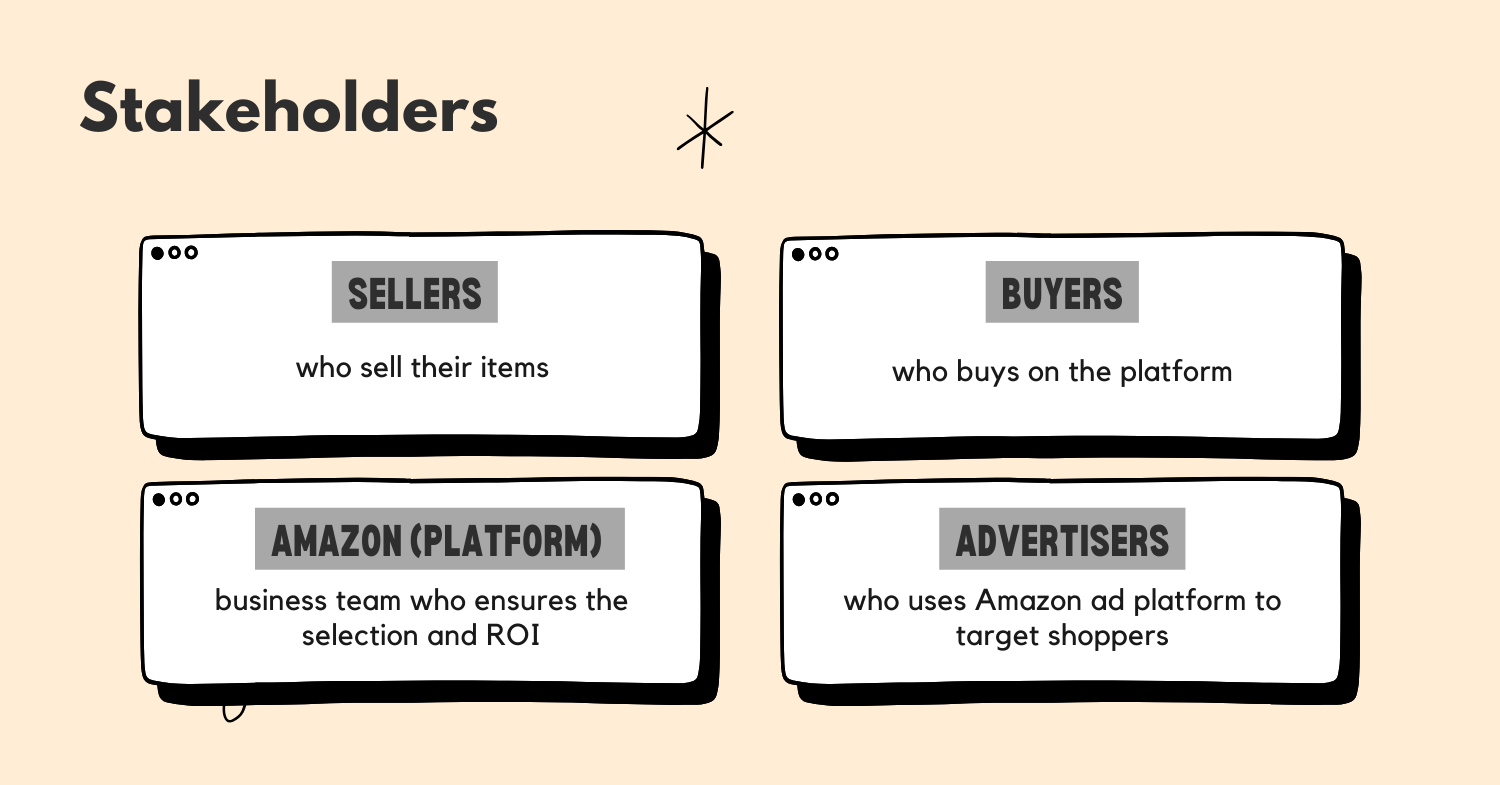
In the Amazon ecosystem, the key stakeholders include:
- Shoppers (consumers)
- Sellers (third-party and first-party)
- Advertisers
- Logistics partners
For this analysis, I'll focus on shoppers as they're the primary users of the retail experience and their satisfaction directly impacts Amazon's core business metrics.
Sub-segments
Within the shopper segment, I can identify several behavioral sub-segments:
- Prime Power Shoppers: Frequent purchasers who are Prime members, shop across multiple categories, and heavily utilize Prime benefits.
- Category Specialists: Shoppers who primarily use Amazon for specific categories (e.g., electronics, books) but may shop elsewhere for other needs.
- Deal Hunters: Price-sensitive shoppers who primarily purchase during sales events or when they find competitive prices.
- Occasional Shoppers: Infrequent Amazon users who typically have specific purchase needs rather than browsing habits.
Prioritization Table
| Sub-Segment | TAM (1-10) | Frequency (1-10) | Potential Value (1-10) | Total Score |
|---|---|---|---|---|
| Prime Power Shoppers | 8 | 10 | 10 | 800 |
| Category Specialists | 9 | 7 | 7 | 441 |
| Deal Hunters | 10 | 6 | 5 | 300 |
| Occasional Shoppers | 10 | 3 | 4 | 120 |
Explanation of scores:
- Prime Power Shoppers: While not the largest segment (8), they have the highest frequency (10) and value (10) as they generate consistent revenue across categories.
- Category Specialists: Larger segment (9) with good frequency (7) and value (7), representing significant growth potential if we can expand their category engagement.
- Deal Hunters: Very large segment (10) but lower frequency (6) and value (5) as they're primarily price-motivated.
- Occasional Shoppers: Largest segment (10) but lowest frequency (3) and limited value (4) per customer.
Based on this analysis, I'll focus on Prime Power Shoppers as they represent the highest value opportunity.
Prime Power Shopper Persona
Sarah, 38, Urban Professional
- Demographics: Married, household income $120K+, tech-savvy
- Behaviors:
- Orders 3-5 times per week across multiple categories
- Heavily uses Prime delivery, Prime Video, and Subscribe & Save
- Shops on both mobile app (70%) and desktop (30%)
- Often researches products through reviews and comparisons
- Motivations:
- Convenience and time-saving
- Quality and reliability
- Value (not necessarily lowest price)
- Pain Points:
- Information overload when comparing similar products
- Inconsistent product quality from unknown sellers
- Difficulty discovering new products aligned with preferences
- Managing multiple subscriptions and delivery schedules
Step 3
Pain Points Analysis
User Journey for Prime Power Shoppers
- Discovery: Browsing categories, receiving recommendations, searching for specific items
- Research: Reading reviews, comparing options, checking prices
- Decision: Selecting products, choosing delivery options
- Purchase: Adding to cart, checkout process
- Fulfillment: Tracking orders, receiving deliveries
- Post-Purchase: Managing returns, writing reviews, reordering
Pain Points at Each Stage
Discovery
- Information Overload: Too many similar products with subtle differences
- "I searched for 'bluetooth headphones' and got over 10,000 results. How am I supposed to know which ones are actually good?"
- Recommendation Relevance: Recommendations often based on one-time purchases
- "I bought a baby gift once, and now my recommendations are filled with baby products I'll never need."
Research
- Review Trustworthiness: Difficulty identifying authentic vs. fake reviews
- "I don't know which reviews to trust anymore. Some seem suspiciously positive."
- Comparison Complexity: No easy way to compare multiple products side-by-side
- "I had to open five different tabs just to compare features across similar products."
Decision
- Analysis Paralysis: Too many options without clear differentiation
- "I spent 45 minutes trying to decide between seemingly identical products."
- Inconsistent Quality Signals: Unclear indicators of product quality beyond star ratings
- "A product has 4.5 stars but many recent reviews mention quality issues."
Purchase
- Subscription Management: Difficult to manage multiple Subscribe & Save items
- "I have to go to a separate page to manage all my subscriptions, and it's not intuitive."
- Delivery Consolidation: Multiple items arriving in separate packages on different days
- "I ordered 5 items and got 5 separate deliveries over 3 days."
Fulfillment
- Delivery Transparency: Limited visibility into exact delivery timing
- "The package says 'arriving today' but that could mean 9am or 9pm."
- Package Security: Concerns about package theft
- "I worry about expensive items sitting on my doorstep when I'm not home."
Post-Purchase
- Return Friction: Multi-step process for returns
- "I have to print a label, find packaging, and drop it off somewhere."
- Reordering Complexity: No easy way to reorder combinations of frequently purchased items
- "I buy the same 10 household items every month but have to search for each one."
Pain Point Prioritization

| Pain Point | Severity (1-10) | Frequency (1-10) | Total Score |
|---|---|---|---|
| Information Overload | 8 | 10 | 80 |
| Review Trustworthiness | 9 | 8 | 72 |
| Delivery Consolidation | 7 | 9 | 63 |
| Subscription Management | 8 | 7 | 56 |
| Reordering Complexity | 6 | 9 | 54 |
| Comparison Complexity | 7 | 7 | 49 |
| Delivery Transparency | 6 | 8 | 48 |
| Package Security | 9 | 5 | 45 |
| Return Friction | 7 | 6 | 42 |
| Recommendation Relevance | 5 | 8 | 40 |
| Analysis Paralysis | 6 | 6 | 36 |
| Inconsistent Quality Signals | 7 | 5 | 35 |
Critical Pain Points:
- Information Overload: Highest score due to extreme frequency and high severity, affecting almost every shopping session.
- Review Trustworthiness: High severity as it undermines a critical decision-making tool.
- Delivery Consolidation: Frequent issue that affects customer satisfaction and environmental impact.
- Subscription Management: High severity for Prime Power Shoppers who rely heavily on subscriptions.
- Reordering Complexity: Very frequent issue that creates unnecessary friction for loyal customers.
These pain points have increased in recent years due to:
- Explosive growth in third-party sellers and product options
- Increased competition driving review manipulation
- Greater environmental consciousness making package waste more concerning
- Higher customer expectations for seamless digital experiences
Now that we've identified the key pain points, let's take a brief moment to organize our thoughts before developing solutions.
Step 4
Solution Generation
Based on the prioritized pain points, I'll develop solutions that address the core issues while enhancing the overall Amazon shopping experience.
1. Smart Product Discovery
AI-Powered Comparison Tool
- Create an interactive comparison tool that automatically groups similar products and highlights key differences
- Allow users to select 3-5 products for detailed side-by-side comparison with standardized specs
- Implement "difference highlighting" that automatically identifies and emphasizes meaningful differences between products
- Include a "decision assistant" feature that asks simple questions to narrow options based on user preferences
Visual Search Enhancements
- Expand visual search capabilities to allow users to take photos of products they like and find similar items
- Implement AR functionality to visualize products in their home environment
- Create visual filters that allow browsing by appearance, style, and design elements
Personalized Category Experts
- Develop AI shopping assistants specialized in specific product categories
- Allow users to "chat" with these assistants to get personalized recommendations
- Provide curated "best of" lists based on the user's price range, preferences, and usage patterns
2. Trust & Authenticity
Review Verification System
- Implement a tiered review system with "Verified Purchase," "Verified User," and "Expert Reviewer" badges
- Create a "Review Highlights" feature that uses NLP to extract key insights from reviews
- Develop a "Review Timeline" that shows how product ratings have changed over time
- Allow users to filter reviews by specific use cases or user profiles similar to theirs
Quality Indicators Framework
- Create a comprehensive quality score that incorporates return rates, customer satisfaction, durability metrics, and seller history
- Implement a "Product Confidence" indicator that reflects consistency in product quality
- Develop category-specific quality metrics (e.g., fabric quality for clothing, durability for electronics)
Trusted Tester Program
- Create a program where highly reliable reviewers get products to test and provide in-depth reviews
- Implement video reviews from trusted testers embedded directly in product pages
- Develop comparison content from trusted testers when evaluating similar products
3. Delivery Experience
Delivery Preference Center
- Create a centralized hub where customers can set default delivery preferences
- Allow scheduling of "delivery days" to consolidate multiple orders
- Implement AI that learns optimal delivery patterns based on when customers are typically home
- Provide carbon footprint information and incentives for choosing consolidated delivery options
Smart Package Consolidation
- Develop an algorithm that identifies orders that can be logically grouped
- Offer incentives (small discounts, Amazon credits) for selecting consolidated shipping
- Create a "Package Planner" that visually shows upcoming deliveries and allows rescheduling
- Implement a "Delivery Calendar" view that helps customers plan around their schedule
Secure Delivery Options
- Expand Amazon Locker and Key programs with more flexible options
- Create partnerships with local businesses for secure pickup locations
- Develop a "Delivery Guardian" feature that provides real-time notifications and photos when packages arrive
- Implement precise delivery time windows (2-hour windows instead of full-day estimates)
4. Subscription & Reordering
Household Dashboard
- Create a visual dashboard showing all household essentials and their status
- Implement predictive reordering that learns consumption patterns
- Allow easy management of all recurring purchases in one interface
- Develop "household profiles" that can be shared among family members
Smart Subscription Management
- Create a calendar view of upcoming subscription deliveries
- Implement one-click adjustments for delivery frequency
- Develop "subscription bundles" that arrive together
- Provide dynamic recommendations for adding relevant items to subscriptions
One-Click Basket Reordering
- Create "Shopping Lists" that can be saved and reordered with one click
- Implement "Smart Lists" that automatically update based on purchase frequency
- Develop a "Quick Reorder" feature that suggests commonly purchased items
- Create a voice-activated reordering system for Alexa devices
Implementation Challenges
-
Technical Complexity
- The AI-powered comparison tool would require significant machine learning resources to accurately identify meaningful differences between products
- Solution: Start with high-volume categories where comparison is most valuable, then expand gradually
-
Seller Resistance
- Enhanced quality indicators and review verification might face pushback from sellers concerned about visibility
- Solution: Provide sellers with detailed insights and improvement paths; highlight how authentic sellers benefit from increased trust
-
Operational Logistics
- Package consolidation requires significant changes to warehouse operations and delivery scheduling
- Solution: Begin with a pilot program in select regions; develop new incentive structures for fulfillment centers
-
Data Privacy Concerns
- Personalized recommendations and household consumption tracking raise privacy questions
- Solution: Implement transparent opt-in processes with clear user benefits; provide granular privacy controls
Moonshot Idea: Amazon Predictive Commerce
Develop a fully predictive commerce platform that anticipates needs before customers even search:
- Create an opt-in "Predictive Pantry" that automatically orders household essentials before you run out
- Implement "Life Event Detection" that sensitively identifies major life changes (moving, new baby, etc.) and provides relevant recommendations
- Develop "Taste Profile" technology that learns preferences across categories to make cross-category recommendations
- Create a "Digital Twin" of each household that simulates consumption patterns and optimizes ordering
This would transform Amazon from a reactive shopping platform to a proactive household management system, dramatically reducing the cognitive load of shopping while increasing customer loyalty and share of wallet.
Step 5
Solution Evaluation and Prioritization
RICE Analysis
| Solution | Reach (1-10) | Impact (1-10) | Confidence (0.1-1.0) | Effort (1-10) | RICE Score |
|---|---|---|---|---|---|
| AI-Powered Comparison Tool | 9 | 8 | 0.8 | 7 | 8.2 |
| Review Verification System | 10 | 9 | 0.9 | 6 | 13.5 |
| Smart Package Consolidation | 8 | 7 | 0.7 | 8 | 4.9 |
| Household Dashboard | 7 | 8 | 0.8 | 5 | 8.9 |
| Delivery Preference Center | 9 | 7 | 0.9 | 4 | 14.2 |
Explanation:
- Review Verification System: Highest RICE score due to universal reach, high impact on purchase decisions, high confidence in effectiveness, and moderate effort.
- Delivery Preference Center: Strong score due to broad reach, good impact on satisfaction, high confidence, and relatively low implementation effort.
- Household Dashboard: Good balance of impact and effort, though slightly lower reach as it primarily benefits frequent shoppers.
- AI-Powered Comparison Tool: High reach and impact but requires significant technical effort.
- Smart Package Consolidation: Valuable but requires substantial operational changes, resulting in a lower RICE score.
Implementation Roadmap
Phase 1 (0-3 months):
- Delivery Preference Center - Quick win with high impact
- Review Verification System (initial version) - Address critical trust issues
Phase 2 (3-6 months):
- Household Dashboard - Build on existing subscription infrastructure
- Enhanced Review Verification features - Expand initial implementation
Phase 3 (6-12 months):
- AI-Powered Comparison Tool - Requires more development time
- Smart Package Consolidation (pilot) - Begin testing in select markets
Phase 4 (12+ months):
- Full rollout of Smart Package Consolidation
- Begin development of Predictive Commerce features
Validation Approach
For each solution, I would implement:
- User Research: Conduct usability testing with prototypes before full development
- A/B Testing: Test features with limited user groups to measure impact
- Phased Rollout: Gradually expand to larger user segments based on performance
- Feedback Loops: Create mechanisms for continuous user feedback and iteration
Step 6
Metrics and Measurement
Primary Success Metrics
-
Conversion Rate: Measure the percentage of product page views that result in purchases
- Target: 5-10% improvement in conversion rate for products with comparison tools and enhanced reviews
-
Average Order Value (AOV): Track changes in the average dollar amount spent per order
- Target: 8-12% increase in AOV through better product discovery and confidence
-
Purchase Frequency: Measure how often customers make purchases
- Target: 15-20% increase in purchase frequency for users engaging with the Household Dashboard
-
Customer Satisfaction (CSAT): Track satisfaction scores specifically for shopping experience
- Target: 10-point improvement in CSAT scores related to product discovery and delivery
Secondary Metrics
-
Time to Purchase: Measure reduction in time from initial search to completed purchase
- Target: 20% reduction in decision time for categories with comparison tools
-
Review Engagement: Track how many users engage with the new review features
- Target: 30% increase in review reading time with higher conversion
-
Subscription Adoption: Measure increase in subscription services usage
- Target: 25% increase in subscription items per household
Guardrail Metrics
-
Return Rate: Ensure improvements don't lead to higher returns
- Threshold: No more than 0.5% increase in return rate
-
Customer Service Contacts: Monitor for any increase in support needs
- Threshold: No more than 5% increase in customer service contacts during rollout
-
Seller Satisfaction: Track seller sentiment around new features
- Threshold: Maintain seller satisfaction above 80% approval
I would establish a measurement framework that tracks these metrics weekly, with quarterly deep-dive analyses to identify trends and opportunities for optimization.
Step 7
Summary and Next Steps
I've approached improving Amazon Shopping by focusing on Prime Power Shoppers, who represent the highest value segment with specific pain points around product discovery, trust, delivery experience, and subscription management.
The key pain points identified were:
- Information overload during product discovery
- Review trustworthiness concerns
- Delivery consolidation issues
- Subscription management complexity
- Reordering friction
My prioritized solutions address these issues through:
- A Review Verification System to build trust
- A Delivery Preference Center to improve fulfillment experience
- A Household Dashboard to simplify reordering and subscription management
- An AI-Powered Comparison Tool to reduce information overload
- Smart Package Consolidation to improve delivery efficiency
These solutions align with Amazon's customer-centric philosophy while driving key business metrics including conversion rate, average order value, and purchase frequency.
.png)