Introduction
The decrease in Google Ads conversion tracking accuracy to 85% represents a significant product issue that requires systematic investigation. Conversion tracking is fundamental to Google Ads' value proposition, as it directly impacts advertisers' ability to measure ROI and optimize campaigns effectively. A 15% gap in accuracy could mean substantial revenue misattribution and diminished advertiser confidence.
I'll approach this analysis methodically, examining both technical and user-facing aspects of the conversion tracking system to identify the root cause and develop appropriate solutions.
This analysis follows a structured approach covering issue identification, hypothesis generation, validation, and solution development to restore conversion tracking accuracy.
Clarifying Questions (3 minute)
- Why it matters: A larger drop indicates a more significant issue that likely occurred suddenly rather than gradually.
- Expected answer: Previously at 95-98% accuracy.
- Impact on approach: A sudden large drop would point to a specific change or event rather than gradual degradation.
- Why it matters: Sometimes metric changes reflect measurement changes rather than actual performance issues.
- Expected answer: No change in measurement methodology.
- Impact on approach: If methodology changed, we'd need to normalize data before proceeding.
- Why it matters: Timing often correlates with product changes, external events, or market shifts.
- Expected answer: Decline began approximately 4-6 weeks ago and stabilized at 85%.
- Impact on approach: This would help narrow down potential causes to changes made in that timeframe.
- Why it matters: Segment-specific issues require targeted solutions rather than system-wide changes.
- Expected answer: More pronounced in retail and e-commerce sectors, less in B2B.
- Impact on approach: Would focus investigation on tracking methods most commonly used by affected segments.
- Why it matters: Product changes are often the most direct cause of performance shifts.
- Expected answer: Several updates including a new tag manager version and browser cookie handling changes.
- Impact on approach: Would prioritize investigating these specific changes first.
Rule Out Basic External Factors (3 minutes)
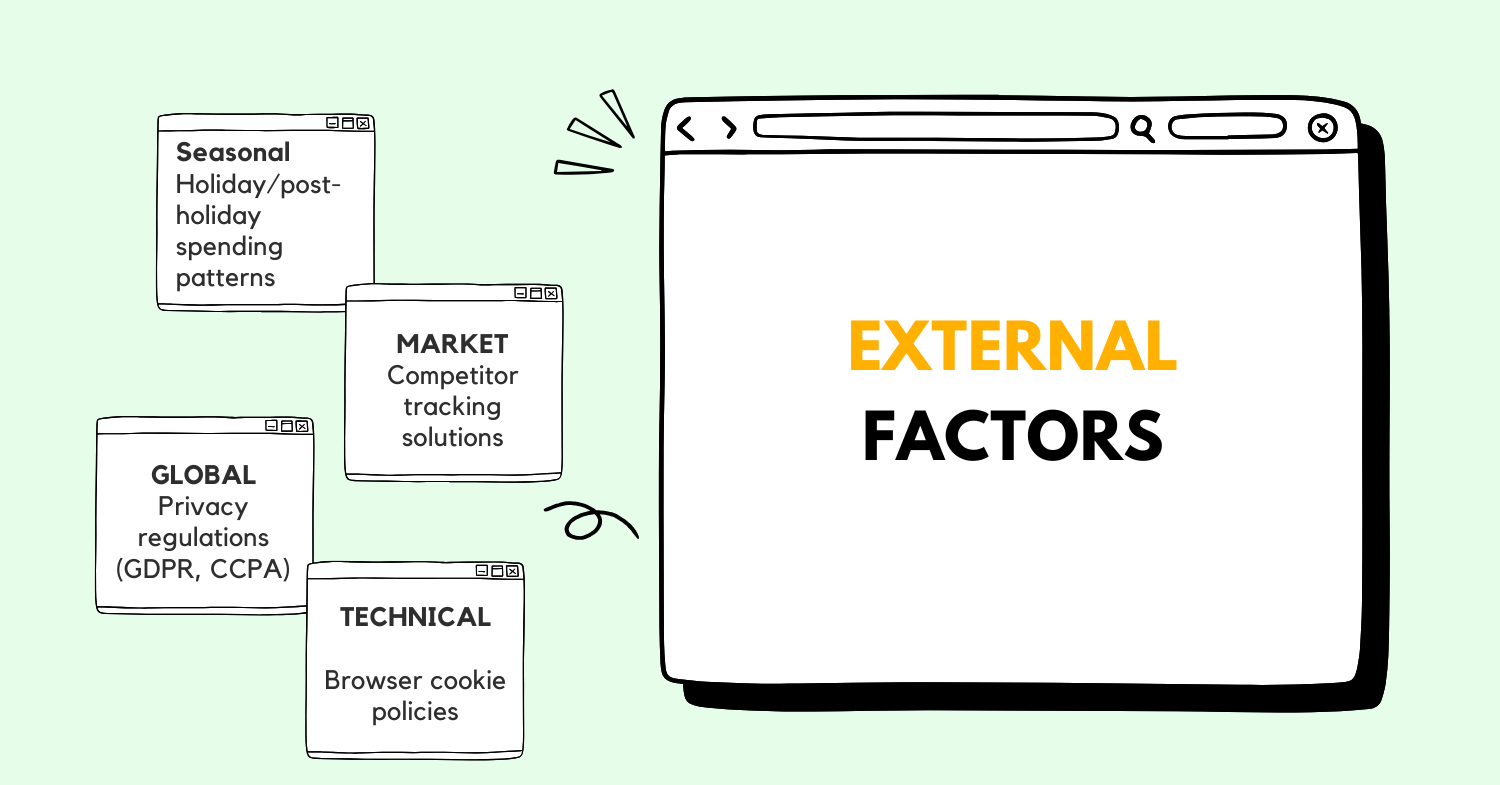 Before diving into internal factors, let's quickly assess potential external causes for the conversion tracking accuracy decline:
| Category | Factors | Impact Assessment | Status |
|---|---|---|---|
| Natural | Seasonal shopping patterns | Low - would affect volume but not accuracy | Rule out |
| Market | Competitor tracking solutions | Medium - could cause advertisers to implement multiple tags | Consider |
| Global | Privacy regulations (GDPR, CCPA) | High - directly impacts tracking capabilities | Consider |
| Technical | Browser cookie policies | High - directly impacts tracking mechanisms | Consider |
| Technical | Ad blockers prevalence | Medium - blocks tracking scripts | Consider |
The most likely external factors worth considering are privacy regulations and browser changes. Chrome, Safari, and Firefox have all implemented stricter cookie policies and tracking prevention measures in recent years. These changes directly impact how conversion tracking functions.
Additionally, the increasing use of ad blockers and privacy tools by users could be preventing Google Ads tracking pixels from firing properly, leading to missed conversions.
However, these external factors alone typically don't cause sudden 10%+ drops in accuracy unless there was a major browser update or regulation that went into effect during the timeframe in question.
Product Understanding and User Journey (3 minutes)
Google Ads conversion tracking is a system that allows advertisers to measure what happens after a customer interacts with their ads. The core value proposition is enabling advertisers to understand which ads, keywords, and campaigns are driving valuable customer actions.
A typical conversion tracking journey involves:
- Setup phase: Advertiser defines conversion actions in Google Ads (purchases, sign-ups, etc.)
- Implementation phase: Advertiser adds Google's tracking code to their website or app
- User interaction phase: User clicks on an ad and is directed to the advertiser's site
- Conversion phase: User completes a desired action (purchase, form submission)
- Tracking phase: Google's code detects the conversion and sends data back to Google Ads
- Attribution phase: Google Ads attributes the conversion to the appropriate ad interaction
- Reporting phase: Conversion appears in the advertiser's Google Ads reports
The 85% accuracy metric likely means that for every 100 actual conversions occurring, Google Ads is only recording 85 of them correctly. This gap could occur at multiple points in this journey:
- During the tracking phase (code not firing)
- During the attribution phase (conversion not linked to the correct ad click)
- During cross-device conversions (user switches devices between click and conversion)
- During server-to-server tracking (API calls failing)
The accuracy of this system is critical because advertisers make budget allocation decisions based on this data, and Google's automated bidding systems rely on it to optimize campaign performance.
Metric Breakdown (3 minutes)
Let's define conversion tracking accuracy more precisely and break it down into its components:
Conversion tracking accuracy = (Correctly tracked conversions / Actual conversions) × 100%
The 85% accuracy could be affected by issues in any of these components:
-
Tracking Code Implementation:
- Client-side tracking: JavaScript errors, ad blockers, cookie restrictions
- Server-side tracking: API failures, incorrect implementation
-
Data Processing Pipeline:
- Data collection: Network issues, rate limiting, dropped events
- Data processing: Processing delays, data corruption
-
Attribution Logic:
- Click-to-conversion matching: Cookie expiration, incorrect matching logic
- Cross-device attribution: Failures in user identity resolution
To properly diagnose the issue, we need to segment the data by:
- Conversion tracking method (JavaScript pixel, Google Tag Manager, server-to-server API)
- Browser type (Chrome, Safari, Firefox, etc.)
- Device type (desktop, mobile, tablet)
- Advertiser industry and size
- Geographic region (to identify regulatory impacts)
Data Gathering and Prioritization (3 minutes)
To investigate this issue thoroughly, I would request the following data:
| Data Type | Purpose | Priority | Source |
|---|---|---|---|
| Accuracy by tracking method | Identify if specific implementation methods are affected | High | Data Warehouse |
| Accuracy by browser | Detect browser-specific issues | High | Analytics Platform |
| Error logs from tracking code | Identify JavaScript errors or execution failures | High | Error Monitoring System |
| Conversion validation study | Compare tracked vs. actual conversions | High | Manual audit |
| Recent code changes | Identify potential bugs in tracking code | High | Version Control |
| Browser policy changes | Identify external factors affecting tracking | Medium | Browser Release Notes |
| Advertiser feedback | Gather qualitative insights | Medium | Support Tickets |
| Network performance metrics | Identify connectivity issues | Medium | Infrastructure Monitoring |
| Server processing latency | Detect backend processing delays | Medium | Performance Monitoring |
| Ad blocker prevalence | Measure impact of ad blockers | Low | Market Research |
I would prioritize data that helps us quickly narrow down whether this is a technical issue with our tracking implementation, a browser/privacy issue, or a data processing problem. The highest priority would be understanding if the accuracy drop varies by tracking method or browser, as this would immediately point us toward specific areas to investigate.
For validation, I'd ensure we're using consistent measurement methodologies across systems and that our baseline accuracy metrics are reliable.
Hypothesis Formation (6 minutes)
 Based on the nature of conversion tracking and common failure points, I've developed four primary hypotheses:
-
Technical Hypothesis: Browser Privacy Changes
- Evidence points:
- Major browsers have been implementing stricter cookie policies
- ITP (Intelligent Tracking Prevention) in Safari blocks third-party cookies
- Chrome's planned deprecation of third-party cookies
- Impact assessment: High - Could directly prevent tracking code from functioning
- Validation approach: Compare accuracy rates across browsers, with special attention to Safari vs. Chrome
- Evidence points:
-
User Behavior Hypothesis: Multi-device Journey Breakage
- Evidence points:
- Increasing use of multiple devices in consumer purchase journeys
- Cross-device tracking relies on user being logged into Google services
- Mobile app conversions often lack proper tracking implementation
- Impact assessment: Medium - Would affect specific user journeys
- Validation approach: Analyze accuracy differences between single-device and cross-device conversion paths
- Evidence points:
-
Product Change Hypothesis: Recent Tag Manager or Pixel Update
- Evidence points:
- Google frequently updates tracking code and tag manager
- Code changes can introduce bugs or compatibility issues
- New features might have unintended consequences
- Impact assessment: High - Could directly cause tracking failures
- Validation approach: Compare accuracy before and after recent code releases, analyze error logs
- Evidence points:
-
External Factor Hypothesis: Ad Blocker Adoption Increase
- Evidence points:
- Ad blocker usage continues to grow
- More sophisticated blockers now target tracking pixels
- Browser extensions specifically block Google tracking
- Impact assessment: Medium - Would affect a subset of users
- Validation approach: Analyze correlation between ad blocker prevalence and tracking accuracy
- Evidence points:
Based on the evidence and impact assessment, I would prioritize investigating the Browser Privacy Changes and Product Change hypotheses first, as they have the highest potential impact and are most likely to cause a sudden drop in accuracy.
Root Cause Analysis (5 minutes)
Let's apply the "5 Whys" technique to our top two hypotheses:
Hypothesis 1: Browser Privacy Changes
-
Why has conversion tracking accuracy decreased?
- Because some conversions aren't being recorded properly.
-
Why aren't some conversions being recorded properly?
- Because the tracking code can't store or access cookies needed for attribution.
-
Why can't the tracking code access necessary cookies?
- Because browsers are blocking or limiting third-party cookies.
-
Why are browsers blocking these cookies now when they weren't before?
- Because browser vendors have implemented new privacy features or policies.
-
Why is this affecting us now?
- Because a major browser (likely Safari or Chrome) released an update that strengthened privacy protections without adequate mitigation from our side.
Hypothesis 2: Recent Tag Manager or Pixel Update
-
Why has conversion tracking accuracy decreased?
- Because some conversions aren't being recorded properly.
-
Why aren't some conversions being recorded properly?
- Because the tracking code isn't executing correctly in some environments.
-
Why isn't the tracking code executing correctly?
- Because there might be bugs or compatibility issues in a recent code update.
-
Why would a code update cause these issues?
- Because the update might not have been thoroughly tested across all browser/device combinations.
-
Why wasn't it tested thoroughly?
- Because our testing process might not cover all real-world scenarios, or we might have rushed a release.
To differentiate between correlation and causation, I would:
- Look for direct temporal correlation between browser updates or code releases and the accuracy drop
- Analyze if the accuracy drop follows patterns consistent with browser usage (e.g., higher impact on Safari users)
- Test reverting code changes in controlled environments to see if accuracy improves
- Implement A/B tests with different tracking methods to isolate variables
Based on my experience with tracking systems, I believe the most likely root cause is a combination of browser privacy changes and inadequate adaptation of our tracking methods. The timing and magnitude of the drop (to exactly 85%) suggests a specific browser update or policy change that's affecting a consistent portion of our user base.
Validation and Next Steps (5 minutes)
To validate our hypotheses and move toward a solution, I propose the following:
| Hypothesis | Validation Method | Success Criteria | Timeline |
|---|---|---|---|
| Browser Privacy Changes | A/B test with server-side tracking vs. client-side | Clear difference in accuracy rates | 1 week |
| Tag Manager Update | Roll back recent changes for a sample of advertisers | Accuracy improvement in test group | 3 days |
| Multi-device Journey | Compare single-device vs. multi-device accuracy | Significant difference between groups | 1 week |
| Ad Blocker Impact | Implement detection script to measure blocker prevalence | Correlation between blockers and missed conversions | 1 week |
Immediate actions I would take:
- Technical investigation: Deploy diagnostic code to capture detailed information about tracking failures
- Advertiser communication: Notify major advertisers about the issue and set expectations
- Alternative tracking: Fast-track server-side tracking options for critical advertisers
Short-term solutions:
- Enhanced server-side tracking: Accelerate migration to server-side conversion APIs
- First-party cookie implementation: Update tracking to leverage first-party cookies where possible
- Consent mode optimization: Ensure tracking respects user choices while maximizing allowable data collection
Long-term strategies:
- Privacy-centric measurement: Develop new measurement approaches using aggregated data and modeling
- Machine learning attribution: Implement ML models to fill gaps in direct measurement
- First-party data integration: Create tools for advertisers to safely leverage their first-party data
To measure success, I would track:
- Conversion tracking accuracy (target: return to 95%+)
- Advertiser satisfaction with measurement solutions
- Adoption rate of new tracking methods
- Reduction in support tickets related to tracking issues
Decision Framework (3 minutes)
Here's a decision framework for addressing the root cause based on our validation findings:
| Condition | Action 1 | Action 2 |
|---|---|---|
| Browser privacy changes confirmed as primary cause | Accelerate server-side tracking API adoption | Develop browser-specific workarounds where possible |
| Tag Manager update identified as cause | Roll back problematic code | Release fixed version with enhanced testing |
| Multiple factors contributing equally | Prioritize fixes by advertiser impact | Implement parallel workstreams for each factor |
| No clear single cause identified | Implement comprehensive monitoring system | Develop redundant tracking methods |
| Server-side tracking shows significant improvement | Fast-track migration for all advertisers | Provide implementation support resources |
| First-party cookies resolve most issues | Update best practice documentation | Create automated migration tools |
| Machine learning models effectively fill gaps | Scale ML attribution to all accounts | Communicate new measurement approach to advertisers |
This framework ensures we have clear action paths regardless of what our validation reveals, allowing us to move quickly once we have more information.
Resolution Plan (2 minutes)
-
Immediate Actions (24-48 hours)
- Deploy enhanced error logging to conversion tracking code
- Implement temporary workarounds for Safari users (first-party cookie bridge)
- Establish war room with cross-functional team (Engineering, Product, Support)
- Create dashboard to monitor accuracy improvements in real-time
- Communicate transparently with top advertisers about the issue and timeline
-
Short-term Solutions (1-2 weeks)
- Release updated tracking code with browser-specific optimizations
- Accelerate rollout of server-side conversion API to top advertisers
- Provide implementation support for critical accounts
- Update documentation with new best practices
- Implement consent mode improvements to maximize allowable tracking
-
Long-term Prevention (1-3 months)
- Redesign conversion tracking architecture for privacy-first world
- Develop machine learning models to supplement direct measurement
- Create automated testing system that catches tracking issues before release
- Build browser policy monitoring system to anticipate future changes
- Establish cross-functional privacy working group to stay ahead of trends
This approach addresses both the immediate accuracy issue while building toward a more resilient tracking system that can withstand future privacy changes and browser updates.
.png)