
Introduction
Should we allow users to check out on Instagram Shopping without logging in first? This is a fundamental product trade-off question that balances conversion optimization against user identity and data collection. The decision impacts our revenue potential, user experience, and platform integrity.
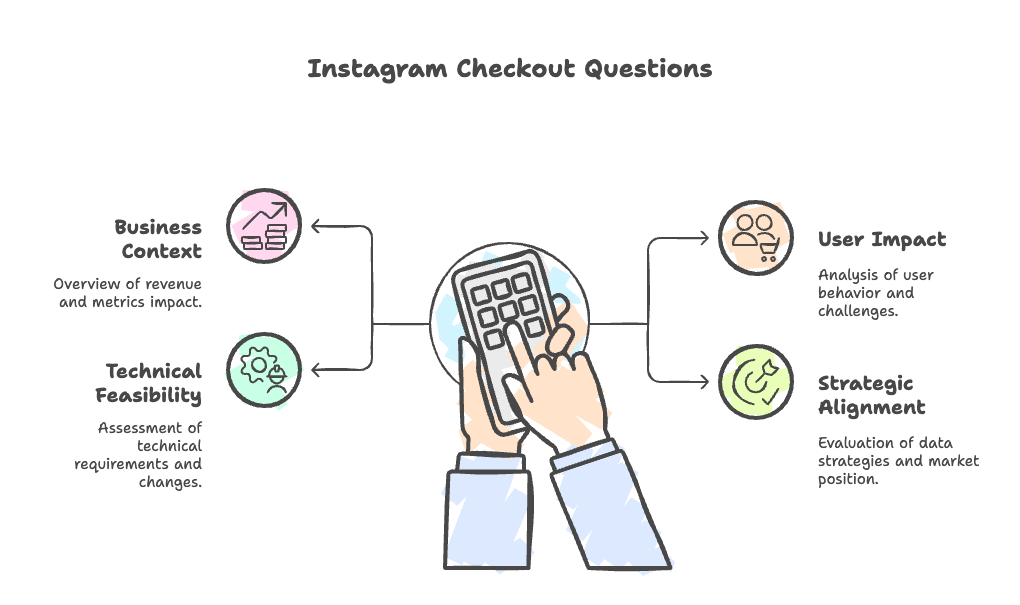
I'll analyze this trade-off by examining the business context, user impacts, technical considerations, and strategic alignment before recommending an approach with appropriate metrics and experiments.
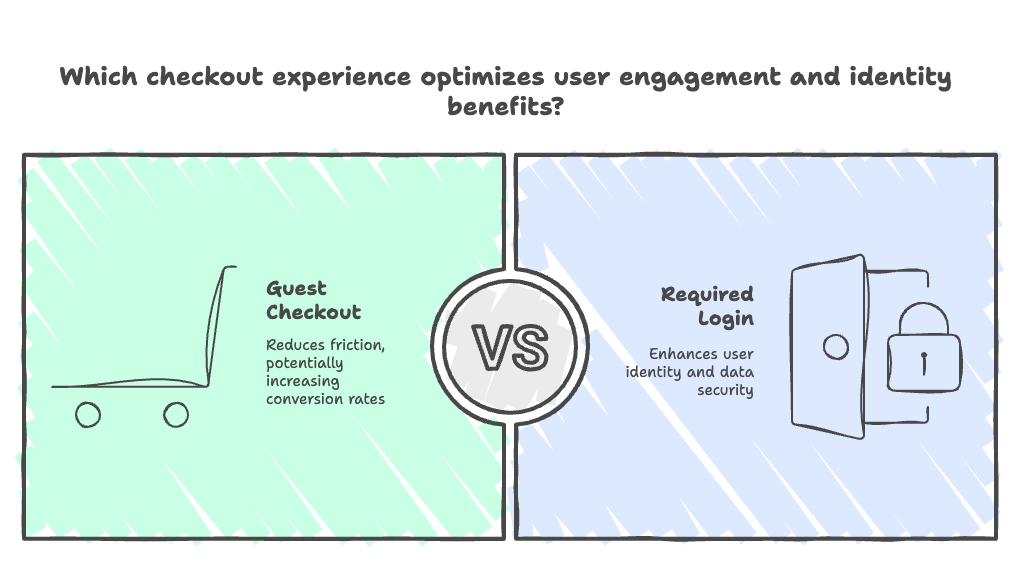
I'd like to start by asking a few clarifying questions to ensure my analysis addresses the right business needs and user scenarios. Then I'll walk through a structured framework to evaluate this trade-off.
Step 1
Clarifying Questions (3 minute)
Why it matters: Helps quantify the potential revenue impact of this change Expected answer: High abandonment rates (20-30%) at login prompt Impact on approach: Higher abandonment would strengthen the case for guest checkout
Why it matters: Helps identify if this is a widespread issue or specific to certain segments Expected answer: New or casual Instagram users face the most friction Impact on approach: Would focus solution on new user onboarding rather than all users
Why it matters: Determines feasibility and implementation timeline Expected answer: Significant but manageable changes to authentication flow and payment systems Impact on approach: Would influence phasing strategy and technical requirements
Why it matters: Ensures alignment with company-wide strategic priorities Expected answer: User data is valuable for ad targeting and personalization Impact on approach: Would need to balance conversion gains against potential data loss
Why it matters: Provides industry benchmarks and learnings Expected answer: Mixed approaches with trend toward reducing friction Impact on approach: Would inform best practices and potential differentiation points
Step 2
Trade-off Type Identification (1 minute)
This is primarily a Type B trade-off: Same product with different variations. We're considering two variations of the Instagram Shopping checkout experience - one requiring login and one allowing guest checkout.
This identification is crucial because it frames our analysis around optimizing a single product experience rather than managing cannibalization or surface allocation. The core question becomes how to balance the friction reduction of guest checkout against the user identity benefits of required login within the same product flow.
This trade-off type suggests we should focus on:
- User journey optimization
- Conversion funnel metrics
- Authentication value exchange
- Consistent experience across variations
Let me take a moment to organize my thoughts on Instagram Shopping's core functionality before diving deeper.
Step 3
Product Understanding (5 minutes)
Instagram Shopping is a commerce feature that transforms Instagram's visual discovery platform into a shopping destination. Here's a breakdown of its core components:
-
Core Features:
- Product discovery through posts, Stories, Explore, and Shop tab
- Product detail pages with pricing, descriptions, and variants
- Shopping cart functionality
- Checkout process (currently requiring login)
- Order management and tracking
- Payment processing and security
-
Key Stakeholders:
- Users/Shoppers: Want convenient, frictionless shopping
- Merchants/Brands: Need sales conversion and customer data
- Instagram/Meta: Requires revenue, user engagement, and data
- Payment processors: Need secure, compliant transactions
- Advertisers: Value attribution and targeting data
-
Value Proposition:
- For users: Seamless discovery-to-purchase in a familiar environment
- For merchants: Access to Instagram's massive user base with visual merchandising
- For Instagram: Revenue diversification beyond advertising
- For Meta ecosystem: Enhanced commerce data across platforms
-
Alignment with Company Mission: Instagram Shopping supports Meta's mission to connect people by extending connections to commerce relationships. It creates economic opportunity for businesses while enhancing user experience through personalized shopping.
-
User Journey Flow:
- Discovery: User sees shoppable content (post, story, ad)
- Consideration: User taps product tag to view details
- Decision: User adds item to cart
- Authentication: User logs in (current requirement)
- Checkout: User enters shipping/payment info
- Confirmation: Order placed and confirmed
- Post-purchase: Order tracking and support
Step 4
Trade-off Agreement and Hypothesis (5 minutes)
The core trade-off we're considering is whether to allow users to complete purchases on Instagram Shopping without requiring them to log in first.
Hypothesis: Removing the login requirement for Instagram Shopping checkout will increase conversion rates and revenue by reducing friction in the purchase flow, but may decrease the quality and quantity of user data available for personalization, targeting, and attribution.
This trade-off is being considered because:
- We likely see significant drop-off at the login step in our conversion funnel
- Competitors may be offering more frictionless checkout experiences
- The business needs to maximize commerce revenue potential
- Users increasingly expect streamlined checkout processes similar to dedicated e-commerce sites
Potential impacts
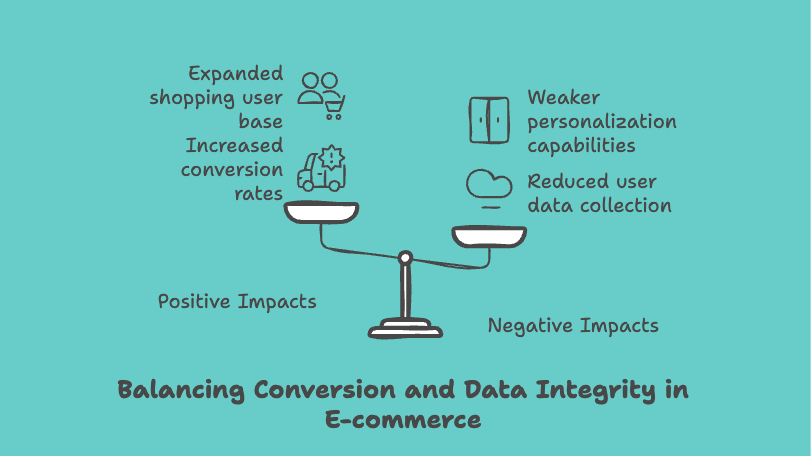
| Impact | Positive Impacts | Negative Impacts |
|---|---|---|
| Short-term | Increased conversion rates (potentially 15-25% based on e-commerce benchmarks) Higher revenue per session Improved user satisfaction Competitive parity with other shopping platforms |
Reduced user data collection Less accurate ad attribution Potential increase in fraud/returns Fragmented user purchase history |
| Long-term | Expanded shopping user base Increased merchant satisfaction Higher shopping feature adoption Potential to convert guest users to logged-in users over time |
Weaker personalization capabilities Reduced cross-platform targeting efficiency Potentially lower customer lifetime value Challenges in building cohesive user profiles |
Effects on different user types:
- New/casual Instagram users: Significant positive impact by removing a major barrier
- Existing engaged users: Minimal impact as they're already logged in
- Privacy-conscious users: Positive impact by allowing transactions without full account creation
- Merchants: Mixed impact - higher sales but potentially less customer data
Extreme outcomes: If we permanently removed login requirements without any mitigations:
- We could see a substantial increase in one-time purchases but struggle to build lasting customer relationships
- Our advertising effectiveness could degrade over time as user identity becomes more fragmented
- We might face increased fraud and security challenges without persistent user identity
If we maintain strict login requirements indefinitely:
- We may lose significant market share to competitors with more frictionless experiences
- Our commerce business growth could be artificially constrained
- We'd maintain strong data integrity but at the cost of potential revenue
Step 5
Key Metrics Identification (4 minutes)
North Star Metric: Shopping Gross Merchandise Value (GMV) This metric aligns with our higher-level goal of building a successful commerce business within Instagram while capturing value for all ecosystem participants - revenue for merchants, convenience for shoppers, and platform growth for Instagram.
Supporting Metrics:
-
Checkout Conversion Rate
- Why it's important: Directly measures the effectiveness of the checkout flow
- Stakeholder relevance: Critical for merchants (sales), Instagram (revenue), and users (experience)
- Type: Leading indicator of GMV growth
-
Cart Abandonment Rate
- Why it's important: Identifies specific friction points in the purchase journey
- Stakeholder relevance: Highlights user experience issues and lost revenue opportunities
- Type: Leading indicator of conversion problems
-
Average Order Value (AOV)
- Why it's important: Measures transaction quality, not just quantity
- Stakeholder relevance: Impacts merchant satisfaction and platform economics
- Type: Lagging indicator of shopping experience quality
-
User Return Rate (for shopping)
- Why it's important: Indicates long-term shopping behavior, not just one-time purchases
- Stakeholder relevance: Critical for sustainable commerce growth and merchant retention
- Type: Lagging indicator of shopping experience quality
-
Fraud Rate / Return Rate
- Why it's important: Measures potential downside of reduced authentication
- Stakeholder relevance: Impacts merchant satisfaction and platform costs
- Type: Lagging indicator of potential negative consequences
-
User Identity Coverage
- Why it's important: Tracks our ability to maintain user profiles for personalization
- Stakeholder relevance: Critical for advertising business and cross-platform strategy
- Type: Leading indicator of long-term data strategy success
-
Guest-to-Account Conversion Rate
- Why it's important: Measures our ability to eventually convert guest shoppers to logged-in users
- Stakeholder relevance: Balances short-term conversion with long-term user relationship
- Type: Leading indicator of sustainable user growth
Step 6
Experiment Design (3 minutes)
Experiment Hypothesis: Allowing users to check out without logging in will increase overall checkout conversion rate by at least 15% without significantly increasing fraud rates or decreasing return shopping behavior.
Test Design:
- Control Group: Current experience requiring login before checkout
- Treatment Group: Modified experience allowing guest checkout with email
Target Audience:
- Size: 5% of Instagram users (gradually increasing if no negative signals)
- Characteristics: Balanced mix of new and existing users, across geographies
- Focus on users who have viewed products but not completed purchases
Duration: 4 weeks minimum to account for:
- Full purchase cycle including delivery
- Return period
- Repeat purchase opportunities
Randomization Method: User ID-based assignment to ensure consistent experience
Sample Size Considerations:
- Power analysis based on expected 15% lift in conversion
- Minimum detectable effect calculated for statistical significance
- Stratified sampling to ensure representation across user segments
Novelty Effect Mitigation:
- Extended test duration beyond initial novelty period
- Cohort analysis comparing early vs. late test period behavior
- Holdback group for long-term impact assessment
Guardrail Metrics:
- Fraud rate (must not increase by more than 0.5 percentage points)
- Return rate (must not increase by more than 1 percentage point)
- User identity coverage (must not decrease by more than 5%)
- Overall platform engagement (must not decrease)
Step 7
Data Analysis Plan (3 minutes)
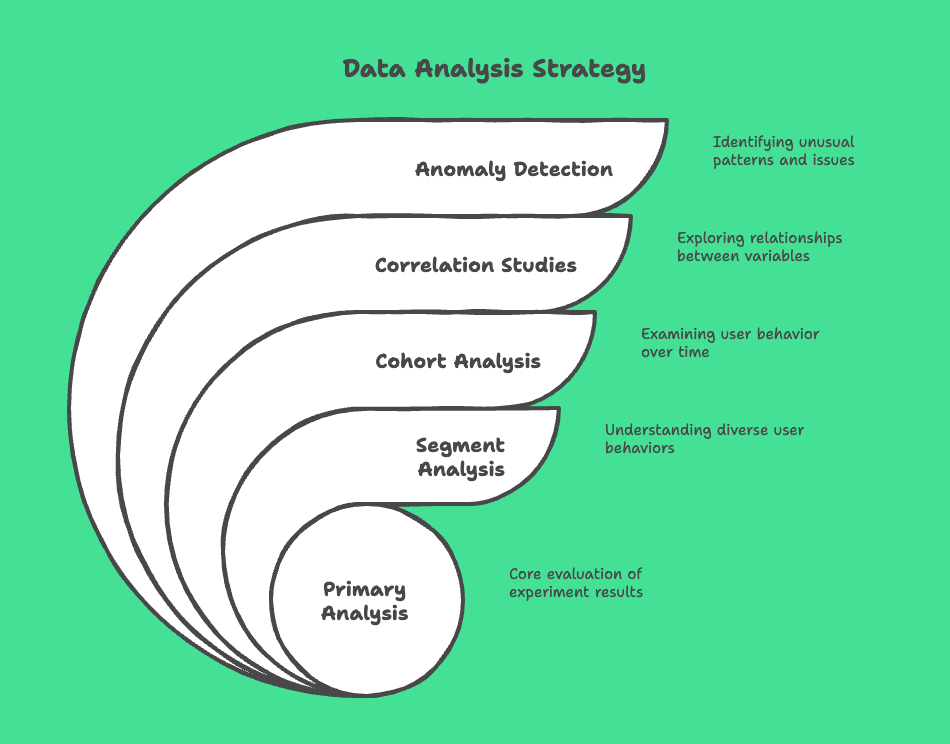
To evaluate the experiment results effectively, I would analyze:
Primary Analysis:
- Conversion funnel analysis comparing control vs. test group
- Step-by-step conversion rates through the entire funnel
- Abandonment points and time spent at each step
- Overall funnel efficiency (entry-to-purchase rate)
Segment Analysis:
- New vs. existing Instagram users
- High vs. low engagement users
- Geographic regions (to identify cultural/market differences)
- Device types and platforms
- Product categories and price points
Cohort Analysis:
- First-time vs. repeat purchasers
- Guest checkout users' return behavior
- Long-term retention and engagement patterns
- Guest-to-logged-in conversion over time
Correlation Studies:
- Relationship between checkout method and:
- Average order value
- Return rates
- Customer support contacts
- Post-purchase engagement
- Cross-platform activity
Anomaly Detection:
- Unusual patterns in fraud attempts
- Unexpected changes in user behavior
- Platform performance issues during checkout
- Payment processing success rates
Interpreting Mixed Results: If metrics move in opposite directions (e.g., higher conversion but lower AOV), I would:
- Calculate the net revenue impact to determine overall business effect
- Segment the analysis to identify which user groups benefit most
- Evaluate long-term vs. short-term trade-offs
- Consider hybrid approaches that might capture benefits while minimizing downsides
For unexpected patterns, I'd investigate:
- Technical issues that might be skewing results
- External factors (sales, seasonality, competitor actions)
- Interaction effects between guest checkout and other features
- Potential data collection or attribution gaps
Step 8
Decision Framework (4 minutes)
To make a clear decision based on our experiment results, I'll use the following framework:
Primary Decision Criteria:
- GMV impact: Does guest checkout increase overall transaction volume?
- User experience: Does it reduce friction and improve satisfaction?
- Data strategy alignment: Can we maintain sufficient user identity coverage?
- Platform integrity: Are fraud and return rates manageable?
| Condition | Action 1 | Action 2 |
|---|---|---|
| Conversion rate increases >15%, no negative impacts on guardrail metrics | Full rollout with current implementation | Enhance with progressive identity collection |
| Conversion rate increases 5-15%, minor negative impacts on guardrails | Limited rollout to high-impact segments | Modify implementation to address guardrail concerns |
| Conversion rate increases <5%, significant negative impacts on guardrails | No rollout, explore alternative solutions | Test modified approach with stronger identity incentives |
| Mixed results across segments | Segment-specific implementation | Further testing with refined targeting |
| Technical issues or data quality concerns | Pause rollout, fix implementation | Retest with improved instrumentation |
Red Flags / Deal-Breakers:
- Fraud rate increases >1 percentage point
- Significant decrease in return purchase behavior
- Major technical issues affecting payment processing
- Regulatory compliance concerns in specific markets
- Substantial merchant dissatisfaction with customer data
Mixed Results Decision Approach: If target metrics improve but guardrails are affected, I would:
- Quantify the trade-off in business value terms
- Explore technical solutions to address specific guardrail issues
- Consider a phased approach targeting segments with best results first
- Test hybrid solutions that balance conversion and identity needs
Cross-Functional Alignment:
- Engineering: Ensure technical feasibility and security
- Data Science: Validate statistical significance and segment insights
- Legal/Privacy: Confirm compliance with regulations
- Marketing: Align with user acquisition and retention strategies
- Finance: Validate revenue projections and fraud impact
Step 9
Recommendation and Next Steps (3 minutes)
Based on my analysis of this trade-off, I recommend implementing a hybrid approach that allows guest checkout while strategically incentivizing user identity:
Recommendation: Implement guest checkout with email requirement and progressive identity collection, focusing first on new and casual Instagram users where friction reduction will have the highest impact.
Key Implementation Elements:
- Allow checkout with email address only (no password required)
- Implement post-purchase account creation incentives
- Use persistent cookies to maintain shopping continuity
- Develop robust guest user profiles that can later merge with accounts
Next Steps:
-
Technical Implementation
- Develop authentication flow modifications
- Create secure guest user profile architecture
- Implement cross-device identity resolution capabilities
- Enhance fraud detection for guest transactions
-
User Experience Refinement
- Design seamless guest-to-account transition experiences
- Create compelling value proposition for account creation
- Optimize post-purchase communication strategy
- Develop personalization capabilities with limited identity data
-
Merchant Communication
- Prepare merchant education on guest checkout benefits
- Develop enhanced customer insights despite reduced identity
- Create best practices for engaging guest shoppers
- Set expectations on data availability changes
-
Measurement Framework
- Implement enhanced attribution for guest users
- Create identity coverage dashboards
- Develop guest user lifetime value models
- Establish ongoing monitoring of fraud and returns
-
Phased Rollout Strategy
- Begin with new user segments and high-friction categories
- Expand to additional segments based on performance
- Implement market-specific approaches based on regional results
- Continuously optimize based on data feedback
This approach balances the immediate conversion benefits of guest checkout with our long-term need for user identity and data. By focusing on progressive identity collection, we can capture the revenue upside while mitigating the potential downsides to our data strategy and platform integrity.
.png)