Introduction
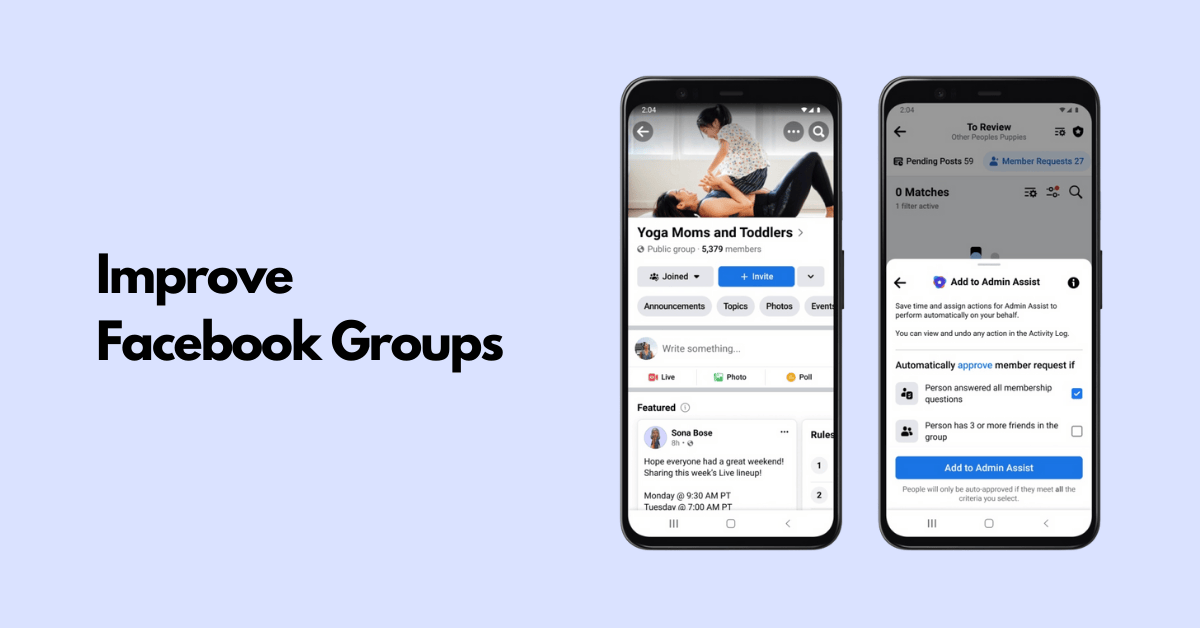
To improve Facebook Groups, we need to enhance user engagement, foster community growth, and streamline the group management experience. I'll approach this challenge by analyzing key user segments, identifying pain points, and proposing innovative solutions that align with Facebook's broader social connectivity goals.
Groups is one of Facebook's core products, supporting its mission to offer tools that empower people to build communities and its vision of bringing people closer together. Groups offer a unique way to bring people together in online communities that reflect the diverse aspects of our lives—our interests, locations, needs, habits, hobbies, religions, sports, music, and more. They enable us to easily and effectively share content and experiences. Beyond social connections, groups are increasingly used for professional networking, local community organizing, and interest-based discussions.
Step 1
Clarifying Questions (5 mins)
- Why it matters: This helps me align my recommendations with company priorities and determine whether to focus on engagement, retention, or new revenue streams.
- Expected answer: Likely a combination of increasing engagement depth and retention in the face of competition from Discord, Slack communities, and other platforms.
- Impact on approach: If engagement is primary, I'd focus on interaction features; if monetization, I'd explore creator tools and commerce opportunities.
- Why it matters: Understanding participation inequality helps determine whether to focus on converting lurkers to contributors or enhancing the experience for power users.
- Expected answer: Likely follows a power law distribution where 10-20% of members generate 80-90% of content.
- Impact on approach: A highly skewed distribution would suggest focusing on creator tools and recognition systems; a more balanced one might indicate broader engagement features.
- Why it matters: Direct user feedback provides critical insight into actual versus perceived problems.
- Expected answer: Likely issues around content discovery, moderation challenges for admins, and notification overload.
- Impact on approach: Would help prioritize which aspects of the Groups experience need immediate attention versus long-term improvement.
- Why it matters: Helps identify competitive gaps and emerging user expectations.
- Expected answer: Users likely expect more real-time interaction options, better organization tools, and more granular privacy controls.
- Impact on approach: Would influence whether we focus on catching up to competitive features or doubling down on Facebook's unique advantages.
I'd like to take a minute to organize my thoughts before moving to the next section.
Step 2
User Segmentation (5 mins)
Key Stakeholders
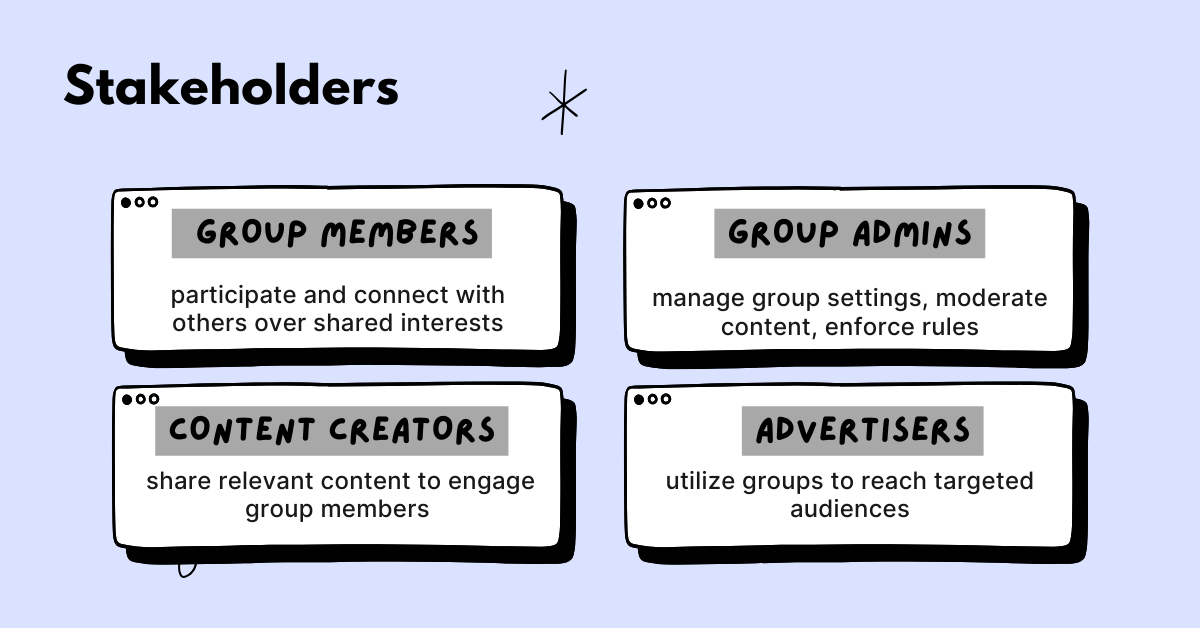
The Facebook Groups ecosystem involves several key stakeholders:
- Group Members - The primary users who join and participate in groups
- Group Admins/Moderators - Those who create and manage communities
- Content Creators - Members who regularly post and drive engagement
- Facebook/Meta - The platform itself with business objectives
I'll focus primarily on Group Admins/Moderators as they are the linchpin of successful communities. Their ability to create engaging, well-managed spaces directly impacts member satisfaction and platform health. Without effective tools for these community leaders, even the best member-facing features will fail to create thriving communities.
Sub-segments
Within Group Admins/Moderators, we can identify several behavioral sub-segments:
- Community Builders - Focused on growing meaningful connections around shared interests
- Professional/Brand Managers - Using groups for business, brand, or professional purposes
- Support Network Facilitators - Running groups centered on mutual support (health issues, life challenges)
- Casual Organizers - Managing smaller, informal groups for friends, family, or local connections
Prioritization Table
| Sub-Segment | TAM (1-10) | Frequency (1-10) | Engagement Potential (1-10) | Total Score | Explanation |
|---|---|---|---|---|---|
| Community Builders | 8 | 9 | 9 | 648 | Large addressable market with high engagement frequency and strong motivation to improve their communities |
| Professional/Brand Managers | 7 | 8 | 7 | 392 | Growing segment with regular engagement but more focused on specific outcomes than community building |
| Support Network Facilitators | 6 | 9 | 8 | 432 | Smaller total market but extremely high engagement and dedication |
| Casual Organizers | 9 | 5 | 4 | 180 | Largest market but with lower engagement frequency and investment |
Based on this analysis, I'll focus on Community Builders as our primary segment.
Primary Persona: Alex, The Community Builder
Demographics:
- 32 years old
- Works in marketing but manages groups as a passion project
- Manages 2-3 groups with 5,000+ members each
- Spends 10+ hours weekly on group management
Motivations:
- Building meaningful connections around shared interests
- Creating safe, engaging spaces for discussion
- Growing their community's impact and reach
- Gaining recognition as a thought leader in their interest area
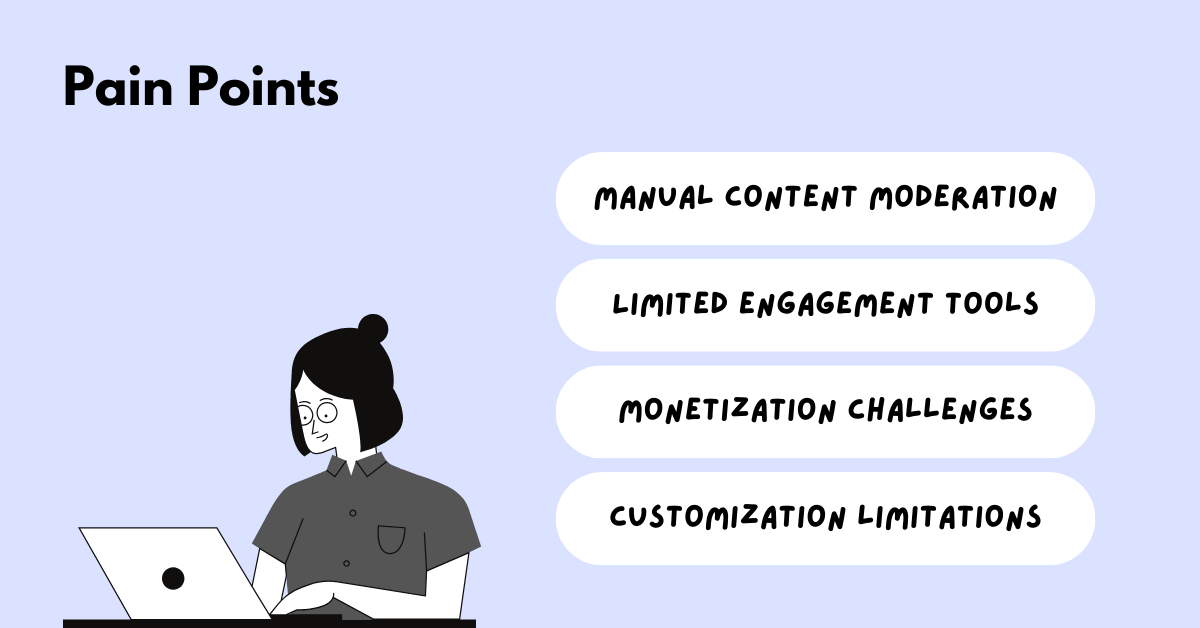
Pain Points:
- Struggles with efficient moderation at scale
- Difficulty maintaining engagement and quality discussions
- Limited tools for organizing content and knowledge
- Challenges in identifying and nurturing potential co-moderators
- Burnout from constant moderation demands
Goals:
- Increase meaningful engagement among members
- Reduce time spent on basic moderation tasks
- Build a sustainable community that can grow without quality degradation
- Create more structured experiences for members
Step 3
Pain Points Analysis (10 mins)
User Journey for Community Builders
-
Community Creation & Setup
- Defining group purpose and rules
- Configuring privacy and moderation settings
- Creating initial content structure
-
Member Acquisition & Onboarding
- Promoting the group to potential members
- Vetting new member requests
- Orienting new members to group norms
-
Content Moderation & Management
- Reviewing flagged content
- Managing problematic members
- Enforcing community guidelines
-
Engagement Facilitation
- Creating discussion prompts
- Highlighting valuable contributions
- Organizing events or special activities
-
Community Growth & Evolution
- Identifying and developing co-moderators
- Adapting rules and structure as the community grows
- Managing community culture shifts
-
Analytics & Optimization
- Understanding what content drives engagement
- Identifying active vs. passive members
- Measuring community health
Pain Point Analysis
| Pain Point | Description | User Quote | Severity (1-10) | Frequency (1-10) | Total Score | Root Cause |
|---|---|---|---|---|---|---|
| Moderation Burnout | Managing rule violations and problematic content becomes overwhelming as groups scale | "I spend hours each day just approving posts and removing spam. It's exhausting." | 9 | 10 | 90 | Limited automation tools; reactive rather than proactive systems |
| Content Organization | Difficulty structuring discussions and maintaining knowledge repositories | "Important information gets buried. New members ask the same questions over and over." | 8 | 9 | 72 | Flat content structure; limited pinning/categorization options |
| Member Engagement Decline | Struggle to maintain consistent participation beyond a core group | "Only about 5% of our members regularly participate. The rest just lurk or have disappeared." | 8 | 8 | 64 | Limited tools to encourage participation; poor notification relevance |
| Co-moderator Development | Difficulty identifying and nurturing potential community leaders | "I can't scale this community alone, but it's hard to find reliable help." | 7 | 7 | 49 | No formal pathways for member advancement; limited delegation tools |
| Limited Analytics | Insufficient insights into community health and engagement patterns | "I have no idea which types of posts actually resonate with my community." | 7 | 6 | 42 | Basic metrics only; no content performance or member behavior insights |
Prioritized Pain Points
-
Moderation Burnout (90) - The most severe and frequent issue that directly impacts community health and admin retention.
-
Content Organization (72) - Creates significant friction for both admins and members, affecting the utility and knowledge-sharing value of groups.
-
Member Engagement Decline (64) - Threatens the long-term viability of communities and reduces the network effect value.
These pain points are interconnected - moderation burnout leads to less time for engagement facilitation, while poor content organization makes it harder for members to find value, leading to engagement decline. The root causes appear to be:
- Tools designed for smaller, simpler communities that haven't scaled with group complexity
- Reactive rather than proactive systems for content moderation
- Limited infrastructure for knowledge management and content discovery
- Insufficient mechanisms for distributing community leadership
These issues have intensified as Facebook Groups have evolved from simple social spaces to complex communities of practice, support networks, and interest-based organizations with more sophisticated needs.
Now that we've identified the key pain points, let's take a brief moment to organize our thoughts before developing solutions.
Step 4
Solution Generation (10 mins)
Based on our analysis, I'll develop solutions that address the three key pain points while considering the needs of our primary persona, Alex the Community Builder.
Solution 1: Intelligent Moderation System
To address Moderation Burnout, I propose developing a multi-layered moderation system that combines AI, community participation, and workflow improvements:
Key Components:
-
Proactive Content Screening - Enhanced AI that pre-screens posts for potential violations before they're published, flagging only genuinely suspicious content for human review.
-
Member Trust Levels - An automated system that assigns trust scores to members based on their history, allowing trusted members' content to bypass review queues while focusing moderation resources on unknown or previously problematic users.
-
Moderation Team Workflows - Tools for admins to distribute moderation tasks among team members with specialized queues (e.g., new member approvals, reported content, keyword alerts) and the ability to "claim" items to prevent duplicate work.
-
Community-Driven Moderation - A system allowing admins to delegate specific moderation powers to trusted members without full admin privileges, creating a "neighborhood watch" approach to community management.
User Flow Example:
- New post is submitted and instantly analyzed by AI
- Based on content and member trust score, post is either:
- Auto-approved (high trust, safe content)
- Placed in priority review queue (new member or flagged content)
- Auto-rejected with feedback (clear violation)
- Moderation team members receive notifications based on their assigned areas
- Admins can view a dashboard showing moderation activity and community health metrics
Technical Challenges:
- Ensuring AI moderation doesn't create false positives that frustrate legitimate members
- Building trust systems that can't be easily gamed
- Creating interfaces that simplify rather than complicate the moderation experience
Solution 2: Knowledge Architecture System
To address Content Organization, I propose creating a structured knowledge management system within groups:
Key Components:
-
Topic Categorization - Allow admins to create custom categories and sub-categories for posts, with the ability to require categorization during posting.
-
Dynamic FAQs - An AI-assisted system that identifies frequently asked questions from group discussions and automatically compiles them into a searchable, admin-editable FAQ section.
-
Content Collections - Enable admins and members to curate collections of valuable posts and resources around specific themes, creating persistent knowledge repositories.
-
Enhanced Search & Discovery - Implement semantic search capabilities that understand the context of queries, not just keywords, and surface relevant past discussions.
User Flow Example:
- New member joins and sees prominent "Start Here" collection with essential information
- When creating a post, member is prompted to select relevant category
- After typing question, member sees suggested similar past discussions
- Member can browse topic collections created by admins and other members
Technical Challenges:
- Balancing structure with ease of use
- Creating intuitive categorization systems that don't overwhelm users
- Developing effective semantic search for diverse community contexts
Solution 3: Engagement Catalyst System
To address Member Engagement Decline, I propose features that recognize contribution, create participation pathways, and personalize the community experience:
Key Components:
-
Contribution Recognition - A customizable achievement system that acknowledges different types of valuable community contributions (not just quantity of posts).
-
Micro-participation Options - Low-friction ways for "lurkers" to contribute value (polls, reactions, simple Q&As) that gradually lead to deeper engagement.
-
Community Challenges - Tools for admins to create time-bound activities that drive focused engagement around specific topics or goals.
-
Personalized Content Surfacing - Smart algorithms that show members content most relevant to their interests based on past engagement patterns.
User Flow Example:
- Member receives weekly digest highlighting discussions matching their interests
- Upon visiting group, they see personalized "Recommended for You" discussions
- After participating, they receive recognition for their contribution
- They discover a current community challenge related to their interests
Technical Challenges:
- Creating recognition systems that reward quality over quantity
- Developing personalization that doesn't create filter bubbles
- Ensuring challenges and activities feel authentic rather than forced
Moonshot Idea: Community Ecosystem
Looking beyond incremental improvements, I envision transforming Facebook Groups from isolated communities into an interconnected ecosystem:
Key Components:
-
Cross-Group Discovery - AI-powered recommendations for complementary groups based on member interests and engagement patterns.
-
Community Partnerships - Tools for admins to create formal relationships between related groups, enabling cross-posting, shared events, and collaborative moderation.
-
Community Marketplace - A platform for community builders to offer premium content, courses, or experiences to members, with revenue-sharing between creators and Facebook.
-
Real-world Integration - Seamless connections between online community activities and offline gatherings, including location-based recommendations and event coordination.
This approach would transform Groups from a feature within Facebook to a central pillar of the social experience, creating stronger network effects and deeper engagement.
Step 5
Solution Evaluation and Prioritization (2 mins)
Let's evaluate our proposed solutions using the RICE framework:
| Solution | Reach (1-10) | Impact (1-10) | Confidence (0.1-1.0) | Effort (1-10) | RICE Score | Explanation |
|---|---|---|---|---|---|---|
| Intelligent Moderation | 9 | 9 | 0.8 | 8 | 8.1 | Reaches all admins; high impact on critical pain point; complex AI and workflow development required |
| Knowledge Architecture | 8 | 8 | 0.9 | 6 | 9.6 | Reaches most groups; significant impact on content discovery; moderate technical complexity |
| Engagement Catalysts | 10 | 7 | 0.7 | 7 | 7.0 | Reaches all members; moderate impact per feature; requires personalization systems |
| Community Ecosystem | 10 | 10 | 0.5 | 10 | 5.0 | Highest potential impact but lowest confidence and highest effort |
Based on this analysis, I recommend the following implementation roadmap:
-
Knowledge Architecture (RICE: 9.6) - Highest RICE score with relatively lower technical complexity. This provides immediate value to both admins and members.
-
Intelligent Moderation (RICE: 8.1) - Addresses the most severe pain point. While complex, the high impact justifies prioritization.
-
Engagement Catalysts (RICE: 7.0) - Builds on the foundation of better organized content and reduced admin burden to drive deeper engagement.
-
Community Ecosystem (RICE: 5.0) - Long-term strategic initiative to be developed incrementally after establishing the core improvements.
This approach balances immediate pain point relief with strategic platform evolution.
Step 6
Metrics and Measurement (2 mins)
To measure the success of our improvements, I propose the following metrics framework:
Primary Success Metrics
-
Admin Retention Rate - Percentage of group admins who remain active in their role over time. Target: 15% improvement in 6 months.
-
Moderation Efficiency - Average time spent on moderation tasks per 1,000 members. Target: 30% reduction in 3 months.
-
Member Participation Rate - Percentage of group members who contribute content monthly. Target: 20% increase in 6 months.
Secondary Metrics
-
Content Discovery - Percentage of members who engage with content more than 7 days old. Target: 25% increase.
-
New Member Integration - Percentage of new members who post/comment within first 2 weeks. Target: 30% increase.
-
Admin Satisfaction - Measured through quarterly surveys. Target: 20-point NPS improvement.
Guardrail Metrics
-
Content Quality - Member-reported satisfaction with group content. Should not decrease.
-
Group Growth Rate - New member additions should maintain or improve.
-
Platform Time Spent - Overall Facebook engagement should not decrease as a result of more efficient group experiences.
I would implement A/B testing for each major feature, starting with a small percentage of groups before full rollout, and conduct regular qualitative research with admins to identify emerging needs and issues.
Step 7
Summary and Next Steps
To improve Facebook Groups, I've focused on addressing the critical pain points faced by Community Builders, our highest-priority admin segment. The three key pain points identified were Moderation Burnout, Content Organization, and Member Engagement Decline.
My prioritized solutions are:
-
Knowledge Architecture System - Creating structured ways to organize and discover content, making groups more valuable as knowledge repositories.
-
Intelligent Moderation System - Reducing admin burden through AI assistance, trust levels, and distributed moderation workflows.
-
Engagement Catalyst System - Driving deeper participation through recognition, personalization, and structured community activities.
These solutions directly address our primary persona's needs while supporting Facebook's strategic objectives of increasing meaningful engagement and strengthening communities against competitive threats.
The most innovative aspect of my proposal is the long-term vision of a Community Ecosystem that transforms Groups from isolated spaces into an interconnected network with clear pathways for growth, collaboration, and even monetization.
To measure success, I'll focus on admin retention, moderation efficiency, and member participation rates as primary metrics, with appropriate guardrails to ensure we're not sacrificing quality for engagement.
Next steps would include:
- Validate these concepts through user research with diverse group admins
- Develop detailed specifications for the Knowledge Architecture system as our first priority
- Create an MVP for testing with a small percentage of groups
- Establish baseline metrics for our success criteria
.png)