Product snapshot reviewed August 2, 2026 against Meta’s public Help Center and product announcements. Public facts are cited below. The proposed diagnosis, prioritization, features and metrics are a worked interview example, not Meta internal research.
Direct answer
I would improve Facebook Dating by helping a mutual match become a safe, mutually wanted next step. My first test would be an optional “intent and pace” card inside a matched conversation. Each person privately chooses whether they want to keep chatting, have a video conversation, meet in a public place or are not ready. The product reveals only an overlapping choice.
This targets a clear post-match uncertainty without promising that a match is trustworthy, exposing private preferences or optimizing for time spent. I would validate the problem with funnel, research and safety evidence before building it, then run a controlled experiment with reports, blocks, privacy complaints and unwanted-contact signals as launch guardrails.
What Facebook Dating offers today
These are public product facts, not assumptions for the case:
- Facebook Dating is an opt-in experience for eligible adults using the Facebook app. Meta describes its current eligibility requirements in Who can use Facebook Dating.
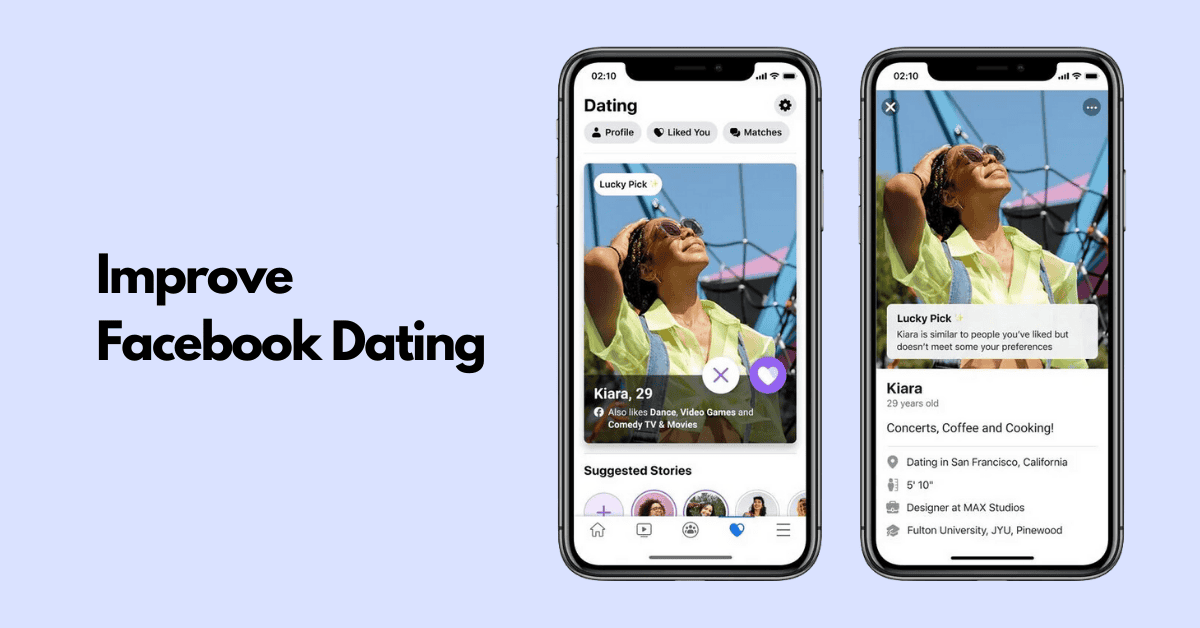
- A Dating profile is separate from a person’s main Facebook profile. Meta says Dating activity does not appear in the main Facebook Feed, and friends are not notified that someone joined Dating. The current separation is explained in How Facebook Dating is different from a Facebook profile and Privacy Matters: Facebook Dating.
- Suggested matches can use stated preferences, information from Dating and Facebook profiles, and signals such as hometown, schools, Groups and Events. People can also control whether friends of friends are suggested. Meta documents this in How Facebook Dating suggests matches.
- Dating Assistant provides personalized match help, custom searches, profile help and dating ideas. Meta says assistant conversations are private and describes availability as a gradual rollout in About Dating Assistant.
- Meta introduced Dating Assistant and Meet Cute in September 2025. Meet Cute provides an algorithmic surprise match that a person can chat with or unmatch, and users can opt out. Meta also reported that hundreds of thousands of people aged 18 to 29 in the United States and Canada were creating Dating profiles each month, with matches among young adults growing year over year. Those figures describe activity, not user satisfaction or the size of any particular problem. See Facebook Dating Adds Features to Address Swipe Fatigue.
- Meta provides blocking, reporting, age or identity checks and other safety guidance. It also warns that it does not conduct criminal background or sex-offender registry searches on Dating users. These limits matter when designing any trust feature. See Facebook Dating safety guidance.
- Meta announced Facebook Verified in July 2026 as a free, selfie-based way to confirm that a real person is behind a profile. It said the badge would appear in Dating as its phased rollout expands. Meta explicitly says the badge is not an endorsement and does not guarantee that a person is trustworthy. See Introducing Facebook Verified.
Everything below is a worked product-sense answer. It should not be read as a claim about Meta’s internal data, roadmap or users.
Clarifying questions
Before choosing a solution, I would ask:
- Does “improve” mean more successful connections, better retention, safer interactions or growth in Dating adoption?
- Where is the largest verified loss in the journey: profile creation, discovery, matching, first message, reciprocal conversation or progression beyond chat?
- Do outcomes differ by entry point, such as suggested matches, Dating Assistant or Meet Cute?
- Which safety signals are most concerning today, and which cannot be measured reliably?
- Are there privacy, policy or regional constraints on using Facebook signals inside Dating?
- What does existing research say people want after matching, and how often do both people want the same pace?
Without those answers, I would avoid presenting a broad redesign as a conclusion.
Worked-example scope and goal
For this practice answer, I will focus on people aged 18 to 29 in the United States and Canada who have already formed a mutual match but have not yet reached a next step that both people want.
This is a practice scope, not a claim that this cohort is Meta’s most valuable audience or has the worst experience. I selected it because Meta publicly disclosed meaningful activity and recent product investment for this group. In a real interview, internal evidence could point to a different cohort.
The goal is:
Help more mutual matches progress toward a safe, mutually wanted connection.
I would not use total messages, session length or time spent as the main goal. More activity can reflect uncertainty, harassment or an interaction that neither person wants to continue.
Journey for this worked example
I would map the journey as follows:
- Eligibility and setup: An eligible adult opts into Dating and creates a separate profile.
- Discovery: The person receives suggested matches or uses Dating Assistant. Meet Cute can also introduce a surprise match.
- Evaluation: The person decides whether a profile appears relevant and comfortable enough to engage with.
- Mutual match: Both people express interest.
- Conversation: One person starts a conversation and the other decides whether to reply.
- Shared next step: Both decide whether to keep chatting, have a video conversation, meet in a public place or stop.
- Safety and reflection: Either person may unmatch, block, report or provide feedback about the experience.
The current public sources describe several discovery and safety capabilities. They do not establish that the largest opportunity is post-match. That must be tested.
Evidence needed before committing to the problem
I would ask the team to build one evidence packet rather than jump directly to feature ideas.
First, I would inspect the privacy-safe funnel from match to first message, reciprocal reply and mutually acknowledged next step. I would compare cohorts by discovery source, geography, profile age and other policy-approved dimensions. I would look for repeated drop-off patterns, not a single aggregate conversion rate.
Second, I would review existing opt-in research and run new interviews or surveys if needed. The research should include people who had a positive outcome, people whose conversations stalled, people who chose not to reply and people who used block or report controls. I would ask what information or control was missing, without leading participants toward a proposed feature.
Third, I would review safety evidence: reports, blocks, rapid unmatches, scam classifications, repeated unwanted contact and privacy complaints. These signals need context because an increase in reporting can sometimes mean harm increased, but it can also mean reporting became easier.
Finally, I would confirm that event definitions, experiment assignment and sample size are reliable before interpreting any result. If the evidence points to discovery quality or safety enforcement instead, I would change the hypothesis.
Prioritized hypothesis
For the worked example, my hypothesis is:
Some mutual matches stall because the two people cannot tell whether their intent and preferred pace are compatible. A private, mutual next-step control could reduce that uncertainty and improve wanted progression without increasing pressure or safety harm.
This is deliberately falsifiable. It could be wrong. Matches may instead stall because of poor recommendations, low-effort profiles, abuse, notification problems or a healthy decision not to continue.
Three solution concepts
1. “Why this match” explanation and controls
Suggested matches already use preferences and other Facebook or Dating signals. This concept would show a short, consent-safe explanation such as a shared stated interest or matching preference, followed by a control to make that reason more or less important.
It should not expose private activity, sensitive attributes or membership information that a person did not choose to share. The explanation must also avoid implying that the system has proven compatibility.
This concept could improve confidence before a conversation starts, but it is less direct for the selected post-match hypothesis.
2. Private intent and pace card
Inside a mutual match, each person could privately select a current preference:
- Keep chatting
- Have a video conversation
- Meet in a public place
- Not ready yet
The product would reveal a next step only when the choices overlap. If they do not overlap, neither person would see the other person’s private selection. “Not ready” would remain easy to choose, and either person could dismiss the card without explanation.
Dating Assistant could explain the control or help someone phrase a respectful invitation, but it should never send a message, infer consent or pressure the other person automatically.
This is my preferred first test because it directly addresses the hypothesis, requires no new public profile field and is reversible.
3. Safety-aware planning support
When both people express interest in meeting, Dating could surface a neutral checklist through the conversation or Dating Assistant. It could encourage a public location, independent transportation, clear boundaries and use of current block and report controls.
The guidance must not say that following a checklist makes a meeting safe. A Facebook Verified badge must also remain what Meta says it is: confirmation that a real person completed selfie verification, not an endorsement or guarantee of trustworthiness.
This concept has strong relevance to the goal, but it needs deeper safety, privacy, policy and abuse review than the narrow intent card.
Qualitative prioritization
I would start with the private intent and pace card.
- User value: It addresses a specific decision both people already face after matching.
- Evidence confidence: Confidence is provisional until the funnel and research confirm the problem.
- Safety: Mutual reveal and easy dismissal reduce pressure compared with a public intent label.
- Privacy: The choice can remain conversation-specific instead of becoming a persistent profile attribute.
- Implementation scope: It can be tested within existing matched conversations without redesigning discovery.
The “why this match” concept should move first only if evidence shows poor recommendation understanding is the larger problem. Safety-aware planning support should proceed with specialist review even if it is not the first experiment.
MVP and experiment
The minimum useful version would include:
- An optional card for eligible matched pairs in the selected practice cohort.
- A small set of neutral next-step choices.
- Private selection with only a compatible choice revealed.
- A clear dismiss action and a persistent “not ready” option.
- Direct access to existing unmatch, block and report controls.
- No automatic messages, location sharing, public profile label or trust score.
- Clear copy explaining that agreement does not equal consent to any later action.
I would run a randomized experiment against the current conversation experience. Both groups would receive the same neutral outcome check so the team can compare whether a match progressed in a way both people wanted, rather than counting only card interactions.
Before launch, I would define the analysis window, minimum detectable effect, sample size and guardrail thresholds from real baselines and statistical power. I would not invent a percentage improvement or calendar deadline in the interview.
A result would support expansion only if the primary outcome improves credibly, the finding is not driven by one narrow segment and no pre-defined safety or privacy guardrail materially worsens.
Metrics
Primary outcome
Safe, mutually wanted progression rate: the share of eligible matches where both participants independently confirm that the connection moved to a next step they wanted.
The same outcome prompt should be available in treatment and control. Response rate and non-response bias must be reported with the result.
Diagnostic metrics
- Reciprocal conversation rate
- Conversation continuation, used as a diagnostic rather than the goal
- Card view, opt-in, completion, dismissal and overlap rates
- Stated “not ready” rate
- Dating Assistant use related to the control
- User-reported clarity, comfort and usefulness
Guardrails
- Blocks, reports and rapid unmatches
- Scam, impersonation and harassment signals
- Unwanted-contact and coercion feedback
- Privacy complaints or confusion about how selections are used
- Notification muting and feature opt-out
- Unequal outcomes across policy-approved demographic and accessibility slices
- Misunderstanding of Facebook Verified as a safety guarantee
I would also review qualitative report details with appropriate privacy protections. A flat aggregate rate can hide a severe problem affecting a smaller group.
Risks and rollout
The first risk is pressure. A visible individual choice could make someone feel obligated to agree. Private input, mutual reveal, neutral language and easy dismissal reduce that risk.
The second is sensitive-data exposure. Intent and pace should remain specific to the conversation, use the minimum necessary retention and not become an advertising, ranking or public-profile signal without a separate review.
The third is false assurance. Product copy must distinguish a mutually selected next step from consent, compatibility or safety. Facebook Verified must never be described as proof that a person is safe.
The fourth is assistant quality. Dating Assistant should not invent facts about a match, generate manipulative messages or make safety judgments. Advice needs safety testing, reporting paths and constrained behavior.
The fifth is uneven impact. The team should test whether the control works for different communication styles, accessibility needs, orientations and cultural expectations rather than treating the aggregate result as universal.
I would roll out in stages: validate the problem, complete privacy and safety review, verify instrumentation, run a limited randomized test in the selected eligible cohort, examine quantitative and qualitative evidence, and expand only when the evidence supports it. Any serious safety regression should stop the rollout while the team investigates.
Interview takeaway
A strong answer does not begin with a feature. It establishes the current product, asks where the verified problem occurs, chooses an explicit practice scope, states a falsifiable hypothesis and protects safety and privacy in the success criteria.
My recommendation is a narrow post-match experiment, not a claim that Facebook Dating lacks discovery features or that internal research has already proven the problem. If the evidence contradicts the hypothesis, the right product decision is to change course.
Sources
- Facebook Dating Adds Features to Address Swipe Fatigue
- Introducing Facebook Verified
- Privacy Matters: Facebook Dating
- How Facebook Dating suggests matches
- About Dating Assistant
- Facebook Dating safety guidance
- Who can use Facebook Dating
- How Facebook Dating is different from a Facebook profile
.png)