
Introduction
I'd like to explore how Facebook could build a feature to help people find roommates. This is an interesting opportunity that sits at the intersection of Facebook's social graph, trust mechanisms, and local community focus. I'll approach this by understanding the user needs, market opportunity, and potential implementation strategies.
I plan to walk through clarifying questions, analyze the market opportunity, identify key user segments and their pain points, develop potential solutions, and establish success metrics. Does this approach sound good to you?
Clarifying Questions (3 minutes)
- Why it matters: Determines whether we leverage Facebook's existing social graph and infrastructure
- Expected answer: Yes, integrated within Facebook
- Impact on approach: Would focus on integration points with News Feed, Groups, Marketplace, etc.
- Why it matters: Helps prioritize rollout strategy and feature development
- Expected answer: Yes, likely major cities and college towns first
- Impact on approach: Would tailor features to these demographics and their specific needs
- Why it matters: Affects core positioning and feature prioritization
- Expected answer: Likely a hybrid approach leveraging both aspects
- Impact on approach: Would balance transactional features with community-building elements
Propose the Goal
Given Facebook's focus on connecting people and building communities, I believe the goal is to create a trusted environment where people can find compatible roommates within their extended networks and local communities. Does this align with your vision?
Define the Scope
For this discussion, I'll focus on developing a roommate-finding feature within Facebook's existing ecosystem, targeting primarily urban areas and college markets in the US initially. I'll assume we have access to Facebook's full platform capabilities including social graph, Marketplace infrastructure, and Groups functionality.
Based on our discussion, I'll proceed with these assumptions for the rest of my solution.
Why build this? (5 minutes)
Analyze Macro Trends and Opportunities:
Several macro trends make this an opportune time for Facebook to enter the roommate-finding space:
-
Housing affordability crisis - In major cities, rent has increased 30-40% faster than wages over the past decade, driving more people to seek shared living arrangements.
-
Remote work flexibility - Post-pandemic, approximately 25-30% of workers are in hybrid or remote arrangements, allowing people to relocate and creating new roommate-seeking behaviors.
-
Trust deficit - Studies show 78% of people trust recommendations from people they know over anonymous listings, giving Facebook's social graph a significant advantage.
-
Digital-first housing search - Over 70% of renters now begin their housing search online, but the roommate-finding process remains fragmented across multiple platforms.
Competitor Analysis:
Current solutions in the market include:
-
Craigslist - High volume but low trust, minimal verification, and basic functionality. No social integration.
-
Roomster/Roomi - Purpose-built apps with better UX, but limited user base and trust mechanisms.
-
Facebook Groups - Already used informally for roommate finding, but lacks structured data, search capabilities, and verification features.
-
Apartment listing sites (Zillow, Apartments.com) - Focus on properties, not roommates, with limited social features.
Facebook's strengths include its massive user base (2.9B monthly active users), established identity verification, rich social graph data, and existing Marketplace infrastructure. Its primary weakness is potential privacy concerns and the perception that Facebook is entering too many service categories.
Case study: Facebook Marketplace grew to 1B+ monthly users by leveraging the social graph for trust in local transactions. A similar approach could work for roommate matching.
Value Chain Analysis:
In the roommate-finding process, several pain points remain unsolved:
- Trust verification (partially solved by review systems)
- Compatibility matching (mostly unsolved)
- Seamless communication (partially solved)
- Lease management (largely unsolved)
Facebook has a competitive advantage in the trust and communication aspects of this value chain due to its social graph and messaging capabilities. By entering this space, Facebook could disrupt the fragmented roommate-finding market while driving increased engagement on its platform.
User Segments (5 minutes)
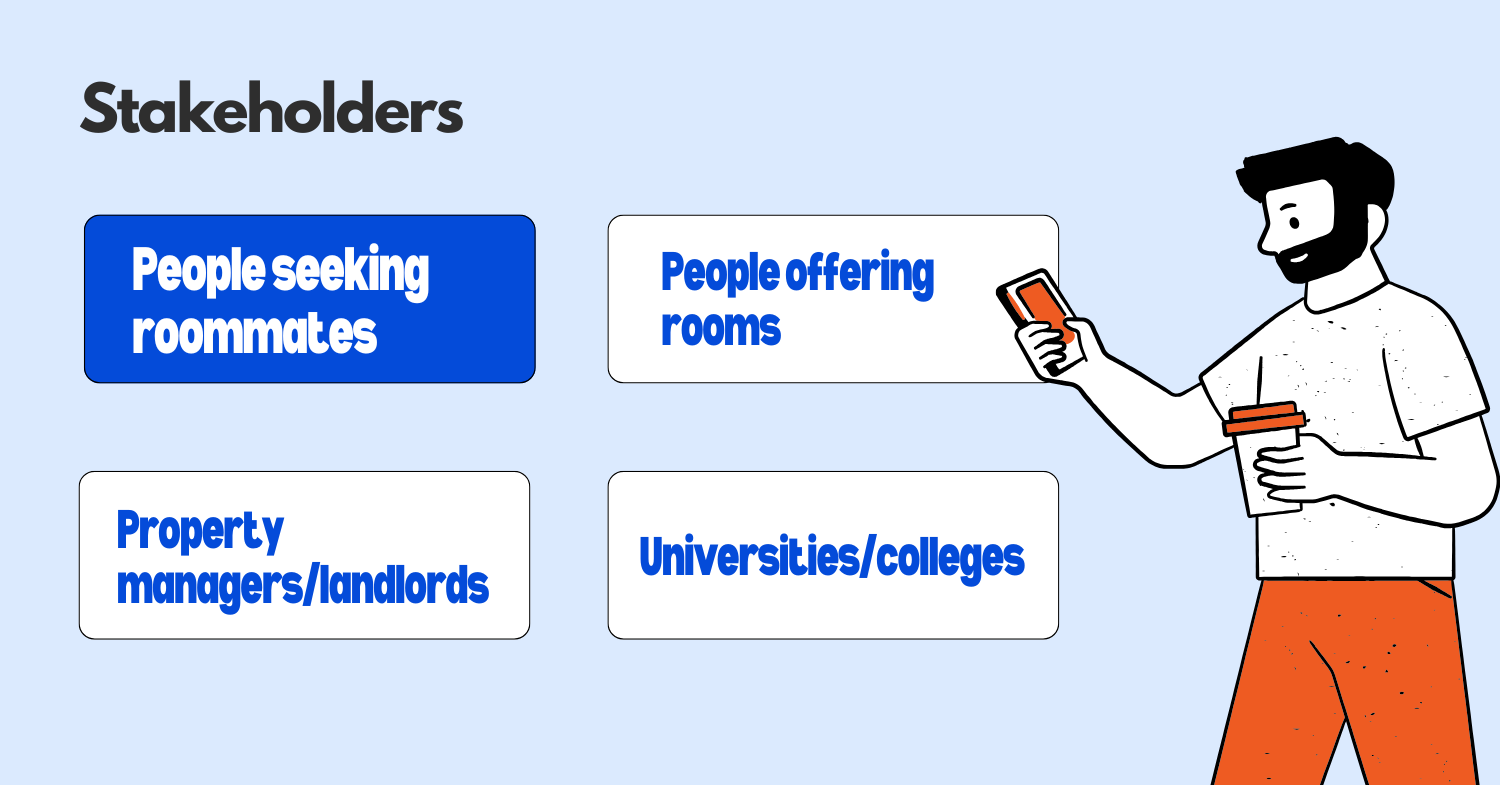
The key stakeholders in the roommate-finding ecosystem include:
- People seeking roommates
- People offering rooms/apartments
- Property managers/landlords
- Universities/colleges (for student housing)
For this feature, I'll focus on people seeking and offering roommate situations, as they represent the core users who would engage with this feature directly.
Within these groups, I can identify several sub-segments:
-
College Students/Recent Grads: 18-24 year-olds transitioning between dorms, first apartments, or relocating for first jobs. Highly price-sensitive, socially active, and comfortable with technology.
-
Young Urban Professionals: 25-35 year-olds in career-building phase, seeking roommates primarily for financial reasons in high-cost cities. Value location, amenities, and compatible lifestyles.
-
Mid-career Movers: 35-50 year-olds experiencing life transitions (divorce, relocation, downsizing) who may be new to roommate situations. Prioritize privacy, stability, and compatibility.
-
Empty Nesters/Retirees: 55+ homeowners with extra space looking to supplement income or avoid isolation. Value security, long-term arrangements, and finding respectful roommates.
Prioritization Table:
| Segment | TAM (millions) | Frequency of Use | Potential for Improvement | Score |
|---|---|---|---|---|
| College Students | 20 | 9 (Seasonal, high turnover) | 8 (Many pain points) | 1440 |
| Young Urban Professionals | 35 | 7 (Moderate turnover) | 9 (High willingness to pay) | 2205 |
| Mid-career Movers | 15 | 4 (Occasional use) | 6 (Moderate pain points) | 360 |
| Empty Nesters | 25 | 3 (Infrequent use) | 5 (Lower tech adoption) | 375 |
Young Urban Professionals score highest because they represent a large market with significant frequency of use and high potential for improvement. They're active Facebook users, financially motivated to find roommates, and face significant trust and compatibility challenges in current solutions. They're also likely to be in dense urban areas where Facebook could achieve network effects quickly.
Pain Points (5 minutes)
For Young Urban Professionals seeking roommates, the key pain points include:
-
Trust Deficit: Difficulty verifying the identity and reliability of potential roommates.
User quote: "I met someone who seemed great online, but they completely misrepresented their job situation and couldn't make rent after the first month."
Potential metric: % of users who report feeling comfortable with matches based on social verification.
-
Compatibility Uncertainty: Challenging to assess lifestyle compatibility before living together.
User quote: "My roommate seemed normal during our coffee meeting, but I had no idea they'd have friends over until 2am three times a week."
Potential metric: % of roommate arrangements that last longer than 6 months.
-
Inefficient Communication: Fragmented conversations across multiple platforms leading to missed connections.
User quote: "I was juggling conversations with 15 potential roommates across email, text, and three different apps. I accidentally ghosted someone I was actually interested in."
Potential metric: Time from initial contact to decision/commitment.
-
Limited Network Reach: Difficulty expanding beyond immediate social circles to find compatible roommates.
User quote: "I know there must be other product managers in the city looking for roommates with similar schedules and interests, but I have no way to find them."
Potential metric: % of users who find roommates outside their first-degree connections.
Prioritization of Pain Points (3 minutes)
Let's prioritize these pain points based on severity and frequency:
| Pain Point | Severity (1-10) | Frequency (1-10) | Score |
|---|---|---|---|
| Trust Deficit | 9 (High risk) | 8 (Common issue) | 72 |
| Compatibility Uncertainty | 7 (Significant impact) | 9 (Nearly universal) | 63 |
| Inefficient Communication | 5 (Moderate impact) | 7 (Common issue) | 35 |
| Limited Network Reach | 6 (Moderate impact) | 5 (Occasional issue) | 30 |
Based on this analysis, I'll focus on addressing the Trust Deficit and Compatibility Uncertainty pain points.
The Trust Deficit scores highest because the consequences of living with an untrustworthy person can be severe (financial loss, safety concerns, legal issues) and this issue occurs frequently. Facebook is uniquely positioned to address this through its social graph and identity verification capabilities.
Compatibility Uncertainty ranks second because while slightly less severe than trust issues, it's even more universal. Almost everyone who's had roommates has experienced some form of compatibility surprise. This represents an opportunity for Facebook to leverage its rich user data to improve matching.
Now that we've identified the key pain points, I'll organize my thoughts before developing solutions to address them.
Solution (10 minutes)
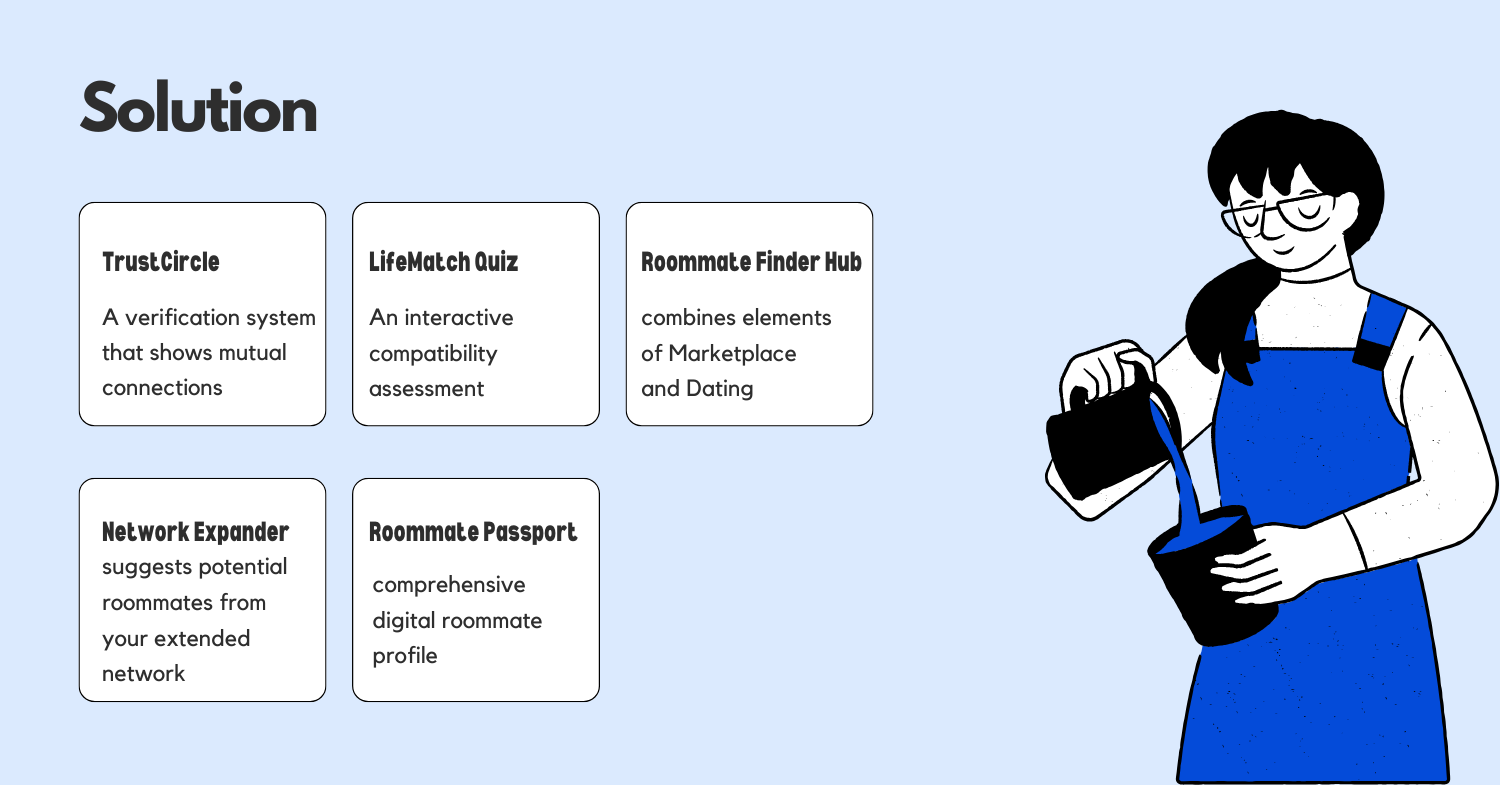 Here are five potential solutions to address our prioritized pain points:
-
TrustCircle: A verification system that shows mutual connections, length of Facebook history, verification badges, and allows previous roommates to provide private references. Leverages Facebook's social graph to create a trust score based on mutual connections, account history, and verification status.
-
LifeMatch Quiz: An interactive compatibility assessment that matches potential roommates based on lifestyle preferences, habits, and values. Uses machine learning to identify compatible pairs based on responses and Facebook behavioral data.
-
RoommateFinder Hub: A dedicated section within Facebook that combines elements of Marketplace and Dating, allowing structured roommate listings with filters for location, price range, timeline, and preferences. Includes in-app messaging and scheduling tools.
-
Network Expander: A feature that suggests potential roommates from your extended network (friends of friends) or based on shared interests, groups, and events. Prioritizes connections with some social proximity for increased trust.
-
Roommate Passport (Moonshot idea): A comprehensive digital roommate profile that includes verified income, rental history, cleanliness preferences, and schedule information. Could eventually integrate with property management systems for seamless applications and rent payments.
Prioritization Table:
| Solution | Reach (1-10) | Impact (1-10) | Effort (1-10) | Score (R×I/E) |
|---|---|---|---|---|
| TrustCircle | 8 (Broad appeal) | 9 (Addresses key pain point) | 6 (Moderate complexity) | 12 |
| LifeMatch Quiz | 7 (Wide appeal) | 8 (Addresses compatibility) | 5 (Relatively straightforward) | 11.2 |
| RoommateFinder Hub | 9 (Platform-wide) | 7 (Comprehensive but not focused) | 9 (High complexity) | 7 |
| Network Expander | 6 (Limited by network) | 6 (Partial solution) | 4 (Leverages existing systems) | 9 |
| Roommate Passport | 8 (High utility) | 9 (Comprehensive solution) | 10 (Very high complexity) | 7.2 |
Based on this analysis, I'll focus on the TrustCircle solution as it provides the highest impact-to-effort ratio and directly addresses our primary pain point of trust.
User Flow for TrustCircle:
The TrustCircle feature would work as follows:
- Users create or update their Roommate Profile with basic information, preferences, and verification elements.
- When browsing listings, users can view a potential roommate's TrustCircle, which shows:
- Mutual friends and connections
- Verified elements (education, employment, phone)
- Length of Facebook history
- References from previous roommates (with privacy controls)
- Groups and interests in common
- A trust score aggregates these elements to provide a quick assessment
- Users can message within the platform and schedule in-person or video meetings
- After becoming roommates, users can provide private feedback that informs future matching
Potential challenges:
-
Privacy concerns: Users may be hesitant to share lifestyle information or have roommate searches visible to their network. Solution: Granular privacy controls and the option for semi-private listings.
-
Verification accuracy: Ensuring employment and income verification without being intrusive. Solution: Partner with third-party verification services that users can opt into.
-
Cold start problem: Initial users won't have roommate references or sufficient data for matching. Solution: Leverage existing Facebook data and start with mutual friend recommendations.
Moonshot idea expansion: The Roommate Passport could eventually become a universal housing credential, accepted by landlords and property managers to streamline the entire rental process. It could include verified income, rental history, credit worthiness, and even integrate with payment systems for seamless rent collection.
Success Metrics (5 minutes)
To evaluate the effectiveness of our TrustCircle solution, I would track the following metrics:
User Metrics:
- Match Quality Rate: Percentage of roommate arrangements that last longer than 6 months. Target: >70% (industry average is approximately 50%)
- Trust Confidence Score: Survey-based metric measuring how confident users feel about their potential roommate matches. Target: Average rating of 8/10 or higher
- Time-to-Match: Average time from creating a profile to confirming a roommate arrangement. Target: 30% reduction compared to current methods
Product Metrics:
- Monthly Active Users: Number of users actively engaging with the roommate feature. Target: 5M users within first year
- Verification Rate: Percentage of users who complete identity and reference verification. Target: >80%
- Conversion Rate: Percentage of roommate searches that result in a confirmed match. Target: >25%
Leading Indicators:
- Profile Completion Rate: Percentage of users who complete their roommate profiles. This would indicate initial interest and engagement.
- Message Response Rate: How quickly and frequently users respond to roommate inquiries, indicating quality of matches and user engagement.
- Social Sharing: Rate at which users invite friends to the platform for verification or as potential roommates, indicating trust in the system.
These metrics align with our goal of creating a trusted environment for finding compatible roommates by measuring both the quality of matches and the efficiency of the process. They directly address our key pain points by tracking trust indicators and match success rates.
Summary
To summarize, I've proposed a roommate-finding feature for Facebook that leverages the platform's unique social graph to solve the trust and compatibility challenges faced by young urban professionals seeking roommates. By focusing on the TrustCircle solution, Facebook can create significant value by reducing the risk and friction in roommate searching.
The solution addresses the critical pain points of trust deficit and compatibility uncertainty through social verification, reference systems, and preference matching. It builds on Facebook's strengths in identity verification and social connections while creating a structured environment specifically for roommate searching.
Success would be measured through metrics focused on match quality, user trust, and platform adoption. This feature aligns with Facebook's mission of building community and could drive increased engagement among a valuable demographic while solving a real-world problem.
Next steps would include user research to validate our assumptions, prototyping the TrustCircle interface, and developing a phased rollout plan targeting high-density urban markets.
.png)