Introduction
I'm considering a significant product trade-off for Instagram: consolidating all content formats (posts, Reels, Stories, etc.) into a single unified feed versus maintaining the current separated tab structure. This decision could fundamentally reshape how users interact with Instagram content and impact creator strategies, engagement patterns, and monetization opportunities.
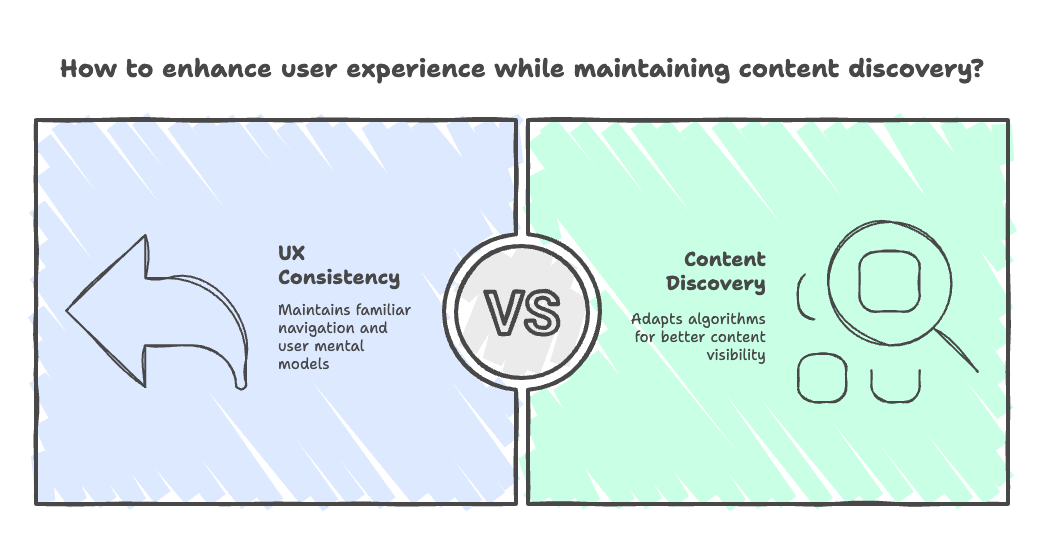
I'll approach this systematically by first understanding the current product structure, identifying key stakeholders, analyzing potential impacts, designing experiments to validate hypotheses, and ultimately providing a recommendation with clear next steps.
Step 1
Clarifying Questions (3 minutes)
- Why it matters: Helps understand the strategic motivation behind this potential change
- Expected answer: Likely a combination of competitive pressure and engagement optimization
- Impact on approach: Would focus analysis on either competitive differentiation or engagement metrics
- Why it matters: Advertising is Instagram's primary revenue source, and format changes directly impact ad placement
- Expected answer: Concern about maintaining ad load and effectiveness in a unified feed
- Impact on approach: Would need to ensure ad performance metrics are key evaluation criteria
- Why it matters: Different user segments may have vastly different usage patterns and preferences
- Expected answer: Likely segmentation data showing varied preferences across demographics
- Impact on approach: Would require segment-specific analysis in any experiment
- Why it matters: The recommendation algorithm is critical to engagement and would need significant adaptation
- Expected answer: Substantial algorithmic challenges in balancing diverse content types
- Impact on approach: Would need to factor in algorithm development timeline and complexity
- Why it matters: Helps prioritize this initiative against other product roadmap items
- Expected answer: Either urgent competitive response or longer-term strategic initiative
- Impact on approach: Would adjust experiment scope and rollout strategy accordingly
Step 2
Trade-off Type Identification (1 minute)
Identify which sub-type of trade-off question you're dealing with:
This is primarily a Type B trade-off: same product with different variations. We're considering a fundamental UX change to Instagram that would alter how users interact with the same core content, not introducing new products or features.
This identification informs our approach by focusing on user experience continuity and content discovery patterns rather than product cannibalization concerns. The key strategic question becomes how this variation might impact different user behaviors and content consumption patterns within the same product ecosystem.
I'll take a moment to organize my thoughts around the current Instagram experience before diving into the analysis.
Step 3
Product Understanding (5 minutes)
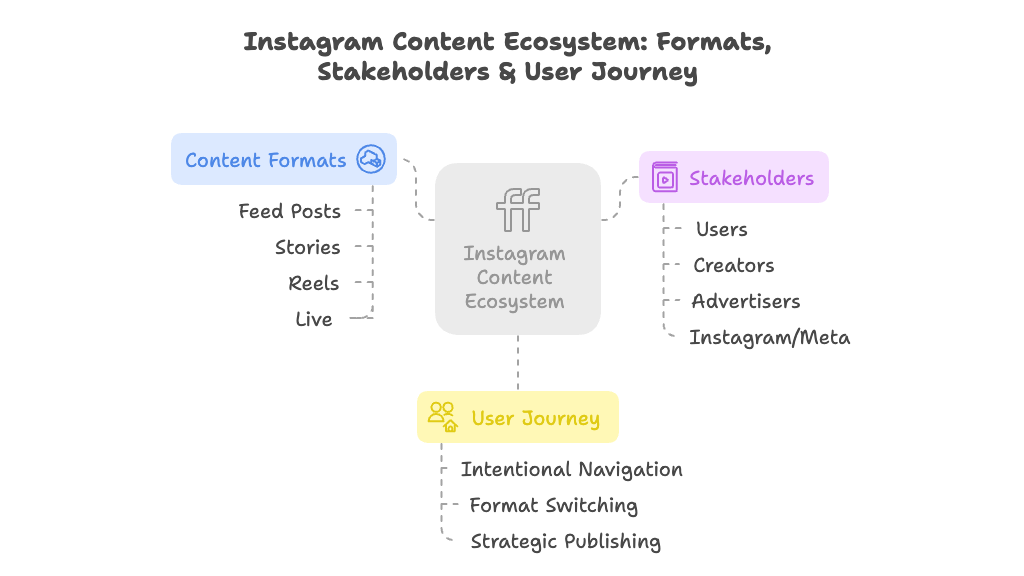
Instagram currently offers multiple content formats, each with distinct characteristics:
- Feed Posts: Traditional photo/carousel content, permanent, high production value
- Stories: Ephemeral 24-hour content, casual, chronological, full-screen
- Reels: Short-form video content, algorithm-driven discovery, TikTok competitor
- Live: Real-time streaming content with audience interaction
Key stakeholders include:
- Users: Consume content across formats based on mood, time available, interests
- Creators: Strategically use different formats for varied content strategies
- Advertisers: Target placements across formats based on campaign objectives
- Instagram/Meta: Optimizing for engagement, session time, and revenue
Instagram's value proposition centers on visual self-expression, content discovery, and community building. The platform's mission aligns with Meta's goal of connecting people through shared experiences.
The current user journey involves intentional navigation between content types:
- Users open Instagram with specific intent (browse feed, check Stories, watch Reels)
- They navigate to the appropriate tab based on content type preference
- They consume content within that format until satisfied
- They may switch to another format tab for a different content experience
- Content creators publish strategically to different formats based on content type
Step 4
Trade-off Agreement and Hypothesis (5 minutes)
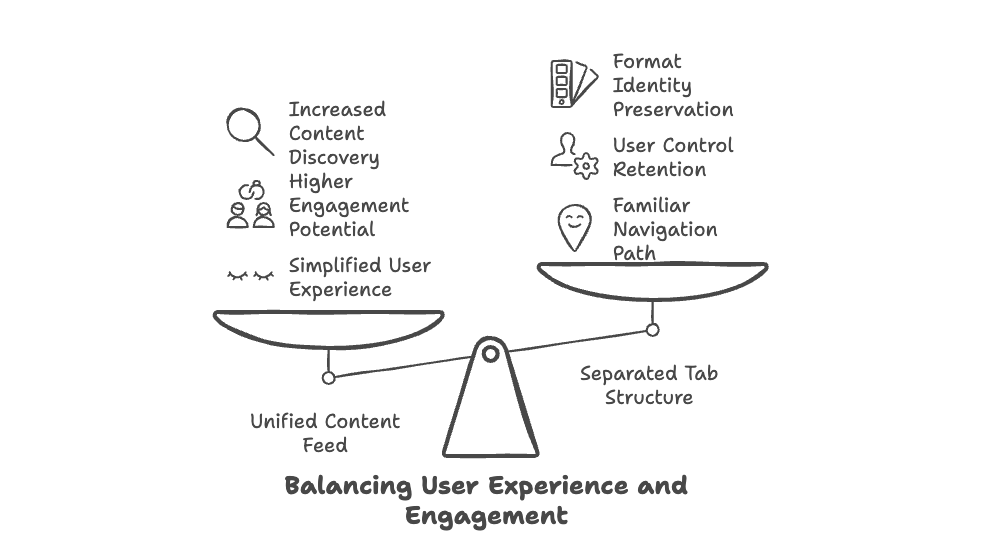 The core trade-off we're considering is between a unified content feed versus the current separated tab structure for different content formats.
My hypothesis for why this change is being considered:
- Simplification of user experience - Reducing cognitive load of switching between tabs
- Algorithmic optimization - Allowing the algorithm to serve the most engaging content regardless of format
- Competitive response - Aligning with TikTok's unified feed approach that has proven highly engaging
- Increased discovery - Exposing users to content formats they might not actively seek out
Potential impacts
| Impact | Positive Impacts | Negative Impacts |
|---|---|---|
| Short-term | Increased discovery of diverse content formats | User confusion and potential backlash from habit disruption |
| Short-term | Higher engagement with previously underutilized formats | Decreased engagement from users who prefer format separation |
| Short-term | Simplified navigation experience | Potential perception of algorithm control vs. user choice |
| Long-term | More balanced creator ecosystem across formats | Creator strategy disruption and adaptation challenges |
| Long-term | Increased overall time spent if algorithm optimizes effectively | Format cannibalization (e.g., Reels dominating photos) |
| Long-term | More flexible advertising opportunities | Potential format identity loss and reduced format innovation |
Different user types would be affected differently:
- Casual browsers might benefit from algorithmic curation across formats
- Power users might feel loss of control and efficiency in content consumption
- Content creators would need to adapt strategies without format-specific targeting
Extreme outcomes could include:
- If unified feed heavily favors one format (e.g., Reels), other formats could decline in usage and creator investment
- If the algorithm fails to balance formats effectively, users might reduce overall engagement due to format mismatch
- If successful, this could lead to higher overall engagement and more diverse content consumption patterns
Step 5
Key Metrics Identification (4 minutes)
North Star Metric: Total Daily Time Spent Per Active User This metric aligns with Instagram's goal of maximizing engagement while capturing value for all ecosystem participants - users find content worth their time, creators get attention, and advertisers reach audiences.
Supporting metrics:
-
Content Format Distribution in Feed
- Why it's important: Ensures balanced representation of different content types
- Stakeholder relevance: Creators need visibility across formats; users need diversity
-
Format-Specific Engagement Rates
- Why it's important: Measures if unified feed maintains or improves engagement with each format
- Stakeholder relevance: Creators need format performance data; business needs engagement
-
Session Frequency and Duration
- Why it's important: Indicates if unified feed encourages more frequent or longer sessions
- Stakeholder relevance: Business values session metrics; users implicitly signal satisfaction
-
Content Discovery Metrics (views of previously unwatched format types)
- Why it's important: Measures cross-format discovery effectiveness
- Stakeholder relevance: Creators benefit from broader exposure; users discover new content
-
Creator Posting Frequency by Format
- Why it's important: Indicates creator adaptation and confidence in the new system
- Stakeholder relevance: Platform health depends on creator participation
-
Advertiser Performance Metrics (CTR, conversion rates across formats)
- Why it's important: Ensures revenue model remains effective
- Stakeholder relevance: Business revenue; advertiser ROI
-
User Retention and Churn Rates
- Why it's important: Captures long-term impact on user satisfaction
- Stakeholder relevance: Business growth; indicator of user value delivery
Step 6
Experiment Design (3 minutes)
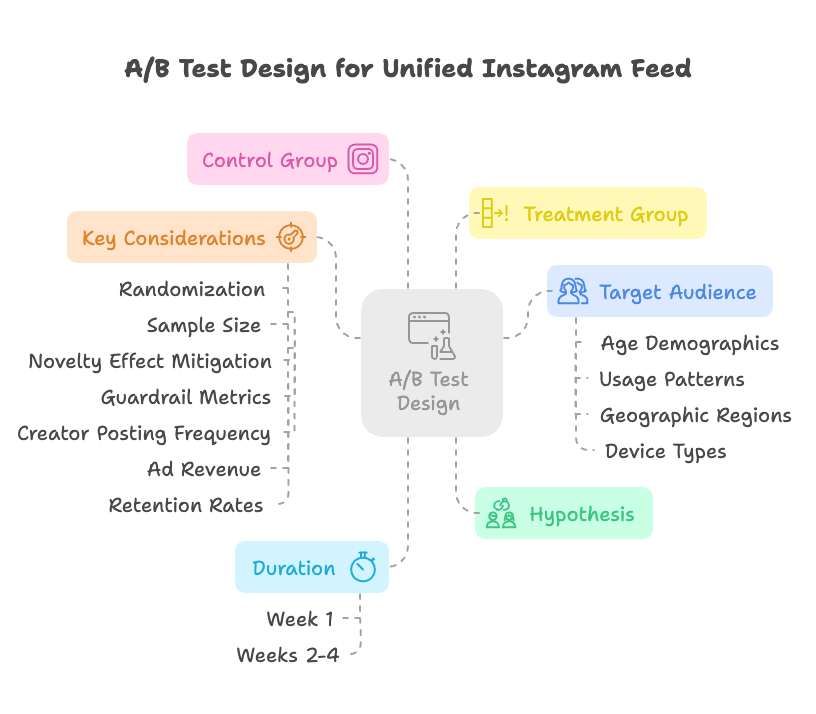 I would design an A/B test with the following structure:
Experiment Hypothesis: A unified feed that algorithmically blends all content formats will increase total time spent on Instagram by improving content discovery and reducing navigation friction.
Control Group (A): Current Instagram experience with separate tabs for Feed, Reels, etc.
Treatment Group (B): Unified feed that algorithmically mixes all content formats in a single scrollable feed
Target Audience:
- 5% of Instagram's user base (large enough for statistical significance)
- Stratified sample ensuring representation across:
- Age demographics
- Usage patterns (heavy/light users)
- Geographic regions
- Device types
Duration: 4 weeks
- Week 1: Initial impact and novelty effects
- Weeks 2-4: Stabilized behavior patterns
Key Considerations:
- Randomization: User-level randomization with persistent assignment
- Sample size: Powered to detect a 2% change in primary metrics
- Novelty effect mitigation: Extended duration and trend analysis over time
- Guardrail metrics:
- Creator posting frequency (to ensure no negative ecosystem impact)
- Ad revenue per user (to protect business model)
- Retention rates (to prevent user attrition)
Step 7
Data Analysis Plan (3 minutes)
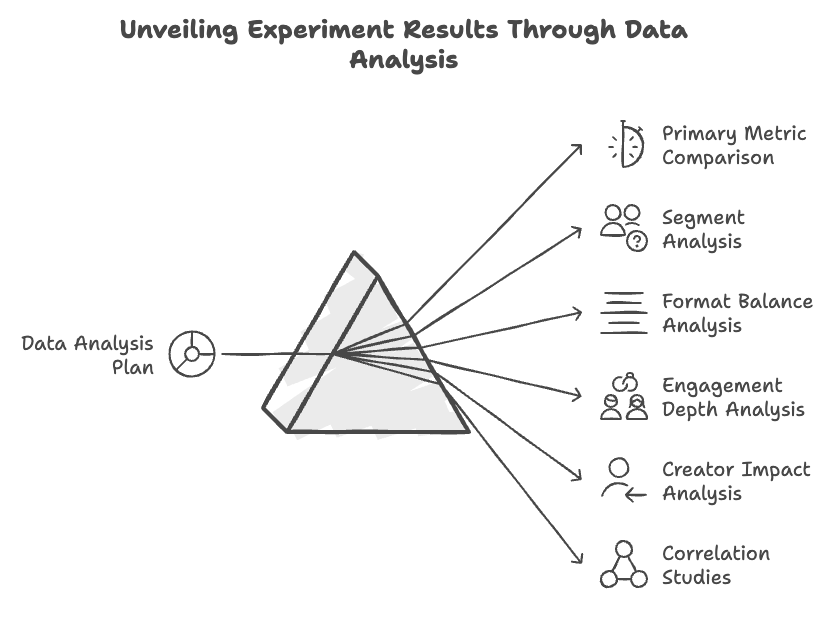 To evaluate the experiment results, I would analyze:
-
Primary metric comparison:
- Compare time spent per user between control and test groups
- Analyze statistical significance and effect size
- Track metric trends over the 4-week period to identify novelty effects
-
Segment analysis:
- Break down results by user segments:
- Age groups (especially Gen Z vs. Millennials)
- Historical content preferences (Reels-heavy vs. Feed-heavy users)
- Creator vs. consumer behavior patterns
- Geographic regions (to identify cultural differences)
- Break down results by user segments:
-
Format balance analysis:
- Measure changes in consumption patterns across formats
- Identify potential cannibalization effects
- Analyze if certain formats dominate the unified experience
-
Engagement depth analysis:
- Compare passive consumption vs. active engagement (likes, comments, shares)
- Analyze if unified feed changes the ratio of passive to active engagement
-
Creator impact analysis:
- Track changes in creator posting behavior
- Measure creator-specific metrics like follower growth and engagement
-
Correlation studies:
- Identify relationships between format exposure and subsequent engagement
- Analyze if increased exposure to varied formats leads to broader engagement
For cases where metrics move in opposite directions, I would:
- Prioritize long-term indicators over short-term reactions
- Weight user retention and satisfaction metrics more heavily than pure engagement
- Consider segment-specific impacts to identify potential targeted approaches
- Analyze qualitative feedback alongside quantitative metrics
I would also look for unexpected patterns such as:
- Time-of-day differences in unified feed performance
- Unusual engagement spikes with specific format combinations
- Changes in content sharing or saving behaviors
- Shifts in notification response patterns
Step 8
Decision Framework (4 minutes)
I would use the following decision framework to evaluate potential results:
| Condition | Action 1 | Action 2 |
|---|---|---|
| Primary metric improves >5%, no negative guardrail impacts | Full rollout with monitoring | Consider segment-specific optimizations |
| Primary metric improves 2-5%, minor guardrail impacts | Limited rollout to optimal segments | Refine algorithm to address guardrail concerns |
| Primary metric flat (±2%), mixed secondary metrics | Test modified versions | Investigate segment-specific impacts |
| Primary metric declines or major guardrail impacts | No ship | Extract learnings for future exploration |
| Strong segment-specific differences | Consider segment-targeted approach | Investigate causes of segment differences |
Red flags that would prevent shipping:
- Significant decline in creator posting frequency
- Material reduction in ad performance metrics
- Negative impact on user retention, especially among high-value segments
- Severe format imbalance leading to format abandonment
For mixed results scenarios:
- If time spent increases but retention decreases: This suggests short-term engagement at the expense of long-term satisfaction. I would not ship without addressing retention concerns.
- If overall metrics improve but key segments show decline: I would consider segment-specific experiences rather than one-size-fits-all.
- If engagement improves but creator metrics decline: This indicates an unsustainable ecosystem impact that must be addressed before shipping.
Cross-functional alignment would involve:
- Product and design teams for UX refinement
- Data science for algorithm optimization
- Creator partnerships for ecosystem impact assessment
- Revenue teams for advertising implications
- Engineering for technical feasibility and scaling considerations
Step 9
Recommendation and Next Steps (3 minutes)
Based on this analysis, my initial recommendation would be to proceed with caution through a phased experimental approach rather than an immediate full rollout. The unified feed represents a fundamental shift in Instagram's core experience that requires careful validation.
Next steps I would recommend:
-
Conduct limited A/B testing with the experimental design outlined above, focusing on measuring both immediate engagement impacts and longer-term behavioral changes.
-
Develop algorithm variations that balance different content formats effectively, potentially testing multiple algorithmic approaches to find the optimal mix.
-
Create creator education materials explaining how the unified feed might impact their content strategy and providing guidance on optimizing for the new experience.
-
Design user onboarding for the test group that clearly explains the change and helps users understand how to navigate the new unified experience.
-
Establish a feedback loop with both users and creators in the test group to gather qualitative insights alongside quantitative metrics.
Broader implications to consider:
- Ecosystem impact: How this change might affect the Instagram creator economy and content diversity
- Competitive positioning: How a unified feed differentiates from or aligns with competitors like TikTok
- Platform identity: Whether this shift fundamentally changes what Instagram means to users
I would ensure alignment across product, engineering, data science, design, marketing, and creator partnerships teams throughout this process, with regular check-ins to assess progress and address concerns.
.png)