
Introduction
To approach this Instagram Verified badge problem effectively, I will follow a simple product success metric framework. I'll follow a structured framework that covers core metrics, supporting indicators, and risk factors while considering all key stakeholders.
I'll follow a simple success metrics framework covering product context, success metrics hierarchy.
Step 1
Product Context
The Instagram Verified badge is a blue checkmark that appears next to an Instagram account's name to indicate that the platform has confirmed the account is the authentic presence of the public figure, celebrity, or global brand it represents. It serves as a trust signal within the ecosystem.
Key Stakeholders:
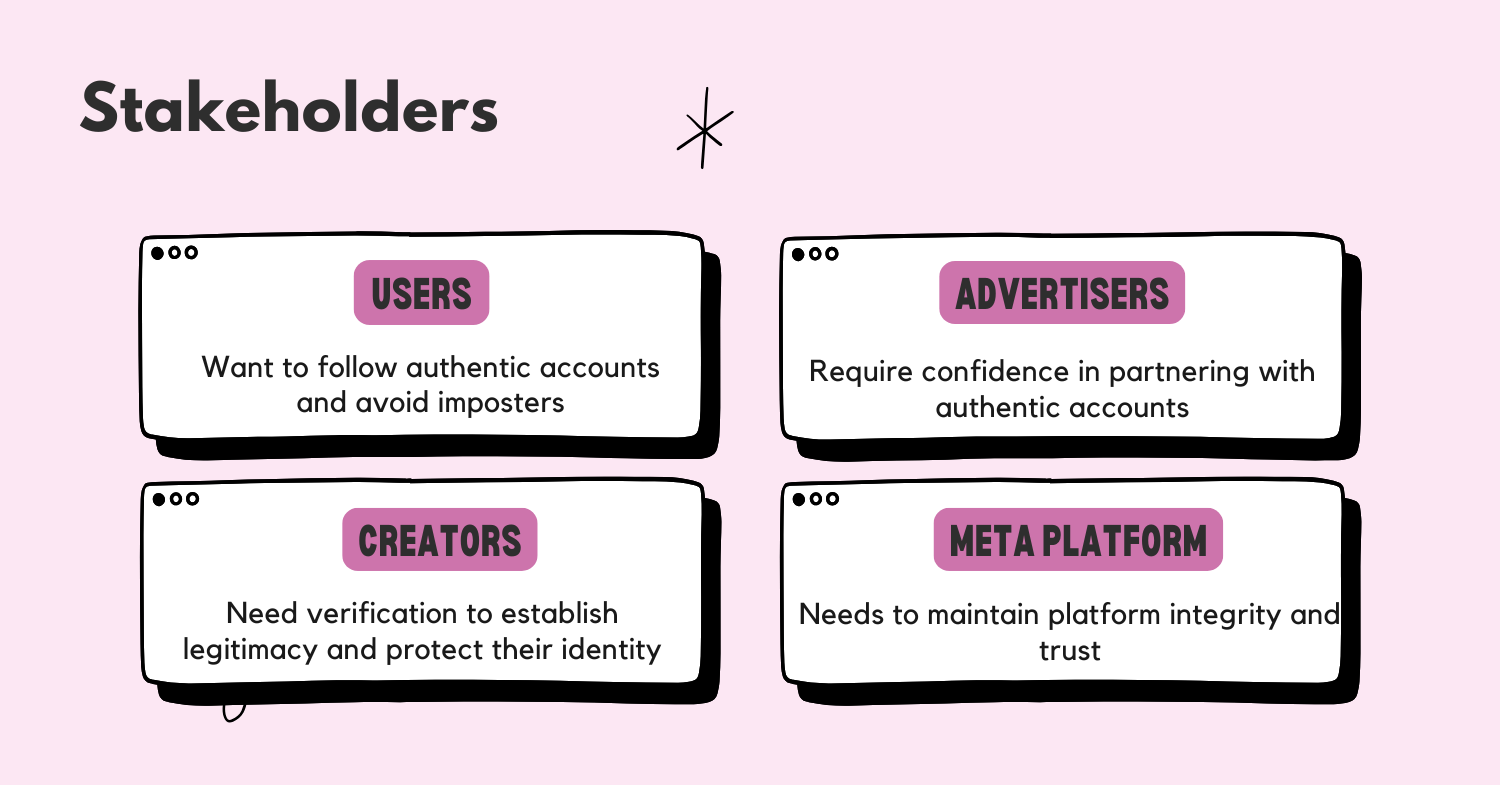
- Users: Want to follow authentic accounts and avoid imposters
- Creators/Public Figures: Need verification to establish legitimacy and protect their identity
- Advertisers: Require confidence in partnering with authentic accounts
- Instagram/Meta: Needs to maintain platform integrity and trust
- Regulatory Bodies: Concerned with identity verification and fraud prevention
User Flow: Users encounter verified badges while browsing Instagram, which helps them identify authentic accounts. Eligible accounts apply for verification by submitting government-issued ID and meeting notability criteria. Instagram's team reviews applications and either approves or rejects verification requests, with successful applicants receiving the blue badge on their profiles.
Strategic Fit: The Verified badge aligns with Instagram's broader strategy of platform safety, trust, and authenticity. It helps combat impersonation and misinformation while creating a more reliable environment for users, creators, and advertisers.
Competitive Landscape: Most major social platforms (Twitter/X, Facebook, YouTube) have similar verification systems, though each has different eligibility criteria and processes. Instagram's approach balances exclusivity with accessibility, positioning it between Twitter's more restrictive system and Facebook's somewhat broader verification program.
Product Lifecycle Stage: The Verified badge is in the maturity stage of its lifecycle. The feature is well-established and widely recognized, but requires ongoing refinement to address evolving challenges like verification fraud and changing user expectations around authenticity signals.
Step 2
Goals
| Core Goals | User Goals | Technical Goals | Business Goals |
|---|---|---|---|
| Increase platform trust and authenticity | Easily identify authentic accounts | Maintain scalable verification system | Reduce impersonation and fraud costs |
| Reduce successful impersonation attempts | Feel confident in account authenticity | Minimize false positives/negatives | Increase advertiser confidence |
| Create clear verification standards | Access verification if eligible | Secure verification database | Drive engagement with high-value accounts |
| Balance exclusivity with accessibility | Protect personal/brand identity | Prevent verification badge spoofing | Support monetization of creator economy |
Step 3
North Star Metric
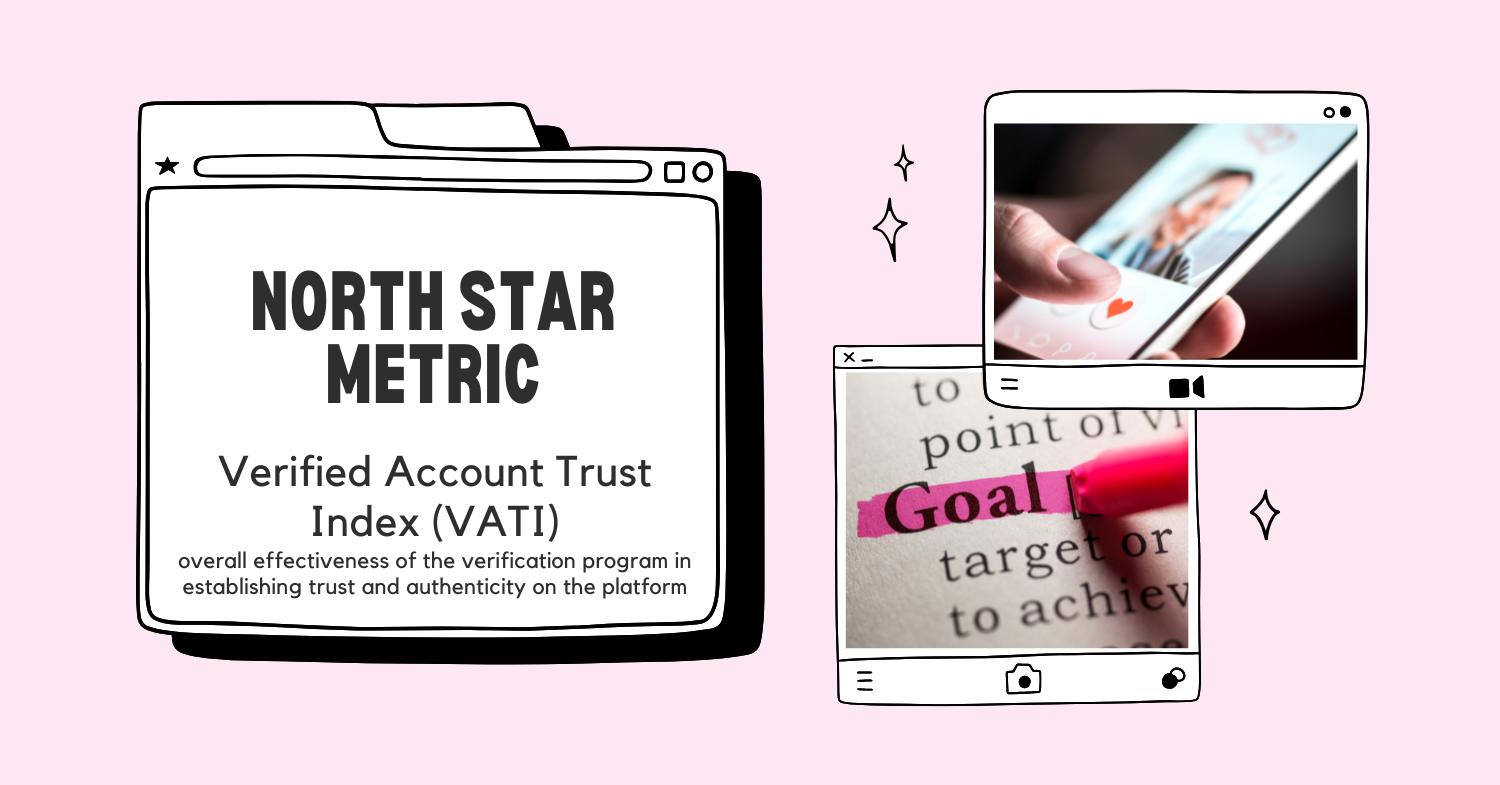 North Star Metric: Verified Account Trust Index (VATI)
The Verified Account Trust Index would be a composite score measuring the overall effectiveness of the verification program in establishing trust and authenticity on the platform.
Definition: VATI = (Verified Account Engagement Rate × 0.4) + (Impersonation Reduction Rate × 0.3) + (Verification Accuracy Rate × 0.3)
This metric captures success because it balances three critical aspects:
- Value creation - Are verified accounts driving higher quality engagement?
- Problem reduction - Is verification reducing impersonation?
- System integrity - Is the verification process accurate and reliable?
All stakeholders benefit from this metric:
- Users gain confidence in account authenticity
- Creators receive recognition and protection
- Advertisers get reliable partnership opportunities
- Instagram builds platform integrity
Hypothetical Data Example: If VATI increases from 72 to 78 over two quarters, it suggests the verification program is improving overall. However, if we see the Engagement Rate component rising while Impersonation Reduction is falling, it might indicate we're verifying popular accounts but not effectively addressing fraud.
Breakdown North Star Metric
The Verified Account Trust Index can be broken down into its component parts:
Formula Breakdown:
- VATI = f(VAER, IRR, VAR)
- VAER = f(Engagement per verified account, Engagement differential)
- IRR = f(Impersonation attempts, Successful takedowns)
- VAR = f(False positive rate, False negative rate)
This is generally the time to take your first 1-2 minutes break to organize your thoughts before diving into the next step.
Step 4
Supporting Metrics
| Metric | Importance | Calculation | Actions |
|---|---|---|---|
| Verification Application Success Rate | Measures accessibility of verification | (Approved applications / Total applications) × 100% | If too low, review criteria; if too high, consider stricter standards |
| Time to Verification | Measures operational efficiency | Average time from application to decision | If increasing, investigate bottlenecks in review process |
| Verified Account Retention | Measures value of verification to account holders | % of verified accounts that remain active monthly | If declining, investigate why verified accounts are becoming inactive |
| Verification Appeal Success Rate | Measures fairness of process | (Successful appeals / Total appeals) × 100% | If too low, review appeal process; if too high, review initial verification standards |
| Verified Account Report Rate | Measures potential misuse of verification | (Reports against verified accounts / Total verified accounts) | If increasing, investigate potential verification abuse |
| Verification Distribution by Category | Ensures balanced representation | % breakdown of verified accounts by category (celebrities, brands, etc.) | If imbalanced, review criteria for underrepresented categories |
Step 5
Guardrail Metrics
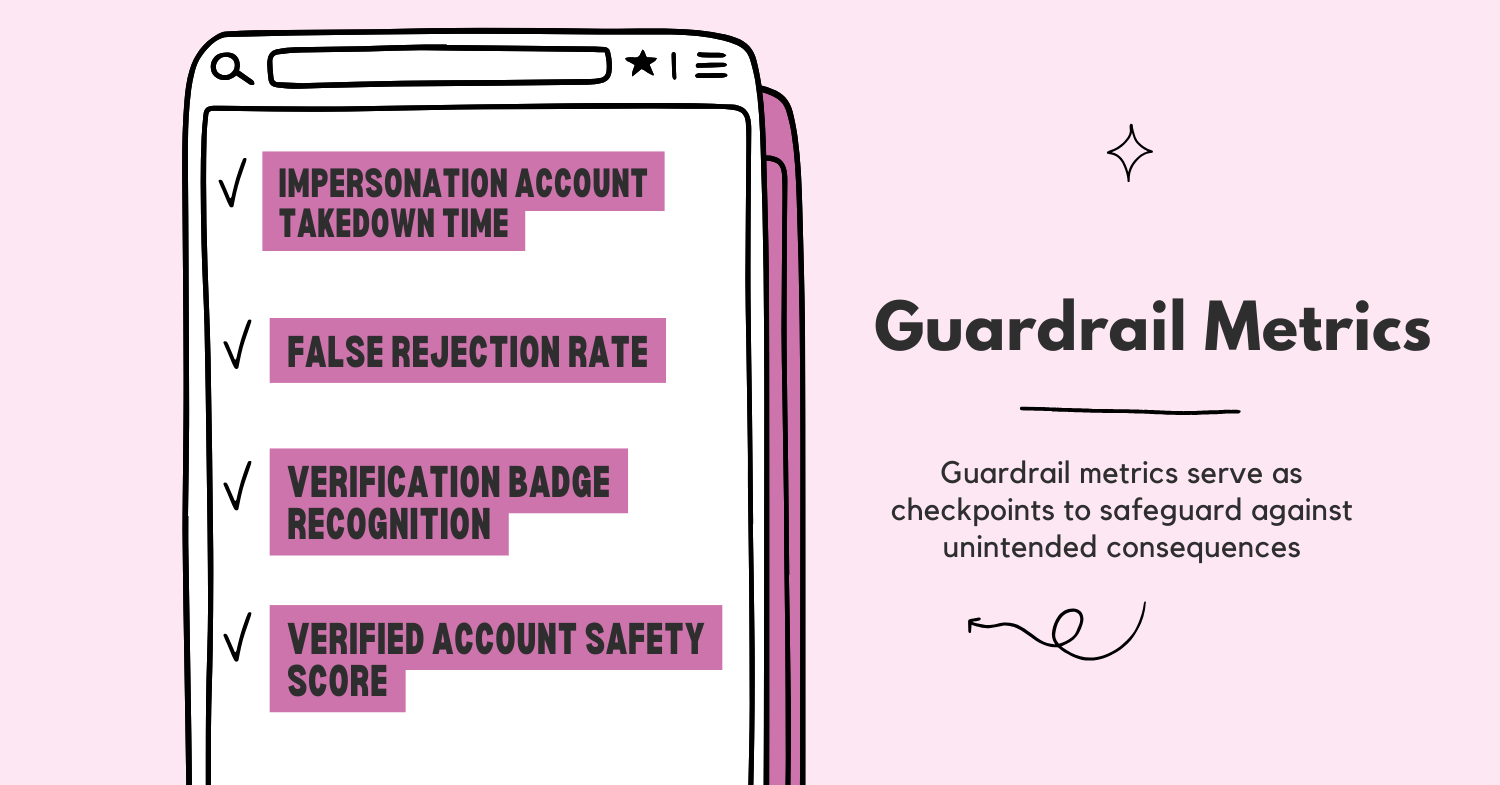
| Key Stakeholder | Metric | Why It Matters | Threshold |
|---|---|---|---|
| Users | Impersonation Account Takedown Time | Protects users from scams | <24 hours for 90% of reports |
| Creators | False Rejection Rate | Ensures legitimate creators can get verified | <15% of eligible applications |
| Verification Badge Recognition | Ensures the badge maintains meaning | >80% of users correctly identify meaning | |
| Advertisers | Verified Account Safety Score | Protects brand safety | <1% of verified accounts violate policies |
Impersonation Account Takedown Time: This metric ensures that when users report impersonation accounts, they're removed quickly. If this exceeds our threshold, users lose trust in the platform's ability to protect authentic identities, directly undermining our North Star Metric's impersonation reduction component.
False Rejection Rate: When legitimate creators who meet verification criteria are rejected, it creates frustration and undermines the credibility of the verification system. This impacts the verification accuracy component of our North Star Metric and can lead to public criticism.
Verification Badge Recognition: If users don't understand what the badge means, its value as a trust signal diminishes. This directly impacts the engagement rate component of our North Star Metric, as users won't preferentially engage with verified accounts if they don't recognize the badge's significance.
Verified Account Safety Score: If verified accounts violate platform policies, it undermines advertiser confidence and can lead to brand safety concerns. This impacts both the engagement and accuracy components of our North Star Metric, as problematic verified accounts damage the entire verification program's credibility.
Step 6
Trade-off Metrics
Exclusivity vs. Accessibility
- Metrics in tension: Verification Approval Rate vs. Verification Badge Value Perception
- Trade-off: Making verification too accessible dilutes its value; making it too exclusive frustrates legitimate users
- Balancing strategy: Implement tiered verification with clear, transparent criteria for each level, allowing more accounts to receive some form of verification while maintaining the exclusivity of full verification
Speed vs. Accuracy
- Metrics in tension: Time to Verification vs. Verification Error Rate
- Trade-off: Faster verification processes typically lead to more errors; more thorough processes take longer
- Balancing strategy: Implement risk-based verification where straightforward cases are processed quickly, while edge cases receive more thorough review
Automation vs. Human Review
- Metrics in tension: Verification Processing Cost vs. Verification Quality Score
- Trade-off: Automated systems are cost-effective but miss nuance; human review is thorough but expensive and slower
- Balancing strategy: Develop a hybrid system where AI handles initial screening and clear cases, while human reviewers focus on edge cases and appeals
Proactive vs. Reactive Verification
- Metrics in tension: Proactive Verification Rate vs. Resource Utilization Efficiency
- Trade-off: Proactively verifying notable accounts improves user experience but consumes resources; waiting for applications is efficient but may leave notable accounts unverified
- Balancing strategy: Implement targeted proactive verification for highest-risk impersonation categories while maintaining application process for others
Step 7
Counter Metrics
1. Verified Account Policy Violation Rate
- Purpose: Ensures verified accounts maintain high standards
- Avoiding pitfalls: Prevents verification from becoming a shield for bad behavior
- Actions if problematic: Implement stricter review for verified accounts with violations; create clearer consequences including potential verification removal
2. Verification Equity Across Demographics
- Purpose: Ensures verification isn't biased toward certain groups
- Avoiding pitfalls: Prevents verification from reinforcing existing platform inequities
- Actions if problematic: Review verification criteria for unintentional bias; implement targeted outreach to underrepresented groups
3. Verification Gaming Attempts
- Purpose: Monitors attempts to artificially meet verification criteria
- Avoiding pitfalls: Prevents verification system manipulation
- Actions if problematic: Refine criteria to be more resistant to gaming; implement monitoring systems for suspicious activity patterns
Strategic Initiatives
1. Verification Transparency Program
- Rationale: Users and creators often don't understand why verification decisions are made
- Potential impact: Could improve Verification Application Success Rate and reduce appeals
- Implementation challenges: Balancing transparency with preventing system gaming; legal considerations around disclosing verification criteria
2. Tiered Verification System
- Rationale: Binary verification (verified/unverified) doesn't capture the spectrum of identity confirmation needs
- Potential impact: Could improve Verification Distribution metrics and Verification Accessibility
- Implementation challenges: Designing clear visual indicators; educating users about different verification levels; managing migration from current system
3. Proactive Verification for At-Risk Accounts
- Rationale: Some accounts face high impersonation risk but don't apply for verification
- Potential impact: Could significantly improve Impersonation Reduction Rate
- Implementation challenges: Identifying at-risk accounts systematically; managing expectations from accounts not selected for proactive verification
Conclusion
The Instagram Verified badge sits at a critical intersection of trust, identity, and platform integrity. As we look to the future, emerging technologies like blockchain-based identity verification and deepfake detection will likely influence how verification evolves. Additionally, as user expectations around authenticity continue to shift, our metrics may need to expand beyond binary verification to more nuanced trust signals.
The success metrics framework I've outlined provides a comprehensive approach to measuring and improving the verification program's effectiveness, balancing the needs of all stakeholders while maintaining the badge's value as a trust signal.
.png)