
Introduction
When launching Facebook Marketplace into a new country, establishing the right success metrics is crucial for evaluating performance and guiding strategic decisions. I'll outline a comprehensive approach to measuring the success of this international expansion.
I'll follow a simple success metrics framework covering product context, success metrics hierarchy, and strategic initiatives.
Step 1
Product Context
Facebook Marketplace is a C2C (consumer-to-consumer) platform within Facebook that enables users to discover, buy, and sell items within their local communities. It leverages Facebook's existing user base, social graph, and communication tools to facilitate transactions between individuals.
Key stakeholders include:
- Buyers seeking local deals and unique items
- Sellers looking to monetize unused possessions
- Facebook (revenue through promoted listings, maintaining user engagement)
- Local businesses (potential expansion to B2C)
- Regulatory bodies in the new country
User flow typically involves sellers listing items with photos, descriptions, and prices, while buyers browse categories, search for specific items, and message sellers to negotiate and arrange transactions. The platform facilitates discovery and communication but generally leaves payment and delivery logistics to the users.
This expansion aligns with Facebook's broader strategy of increasing user engagement, time spent on platform, and creating new monetization opportunities while strengthening the local community aspect of the platform.
In terms of competition, Facebook Marketplace typically competes with established local classifieds platforms, specialized marketplaces, and other horizontal marketplaces like eBay or Amazon. The competitive landscape varies significantly by country.
As a product lifecycle stage, this is an expansion phase for an established product, requiring localization and adaptation to new market conditions rather than building from scratch.
Step 2
Goals
| Core Goals | User Goals | Technical Goals | Business Goals |
|---|---|---|---|
| Build a thriving two-sided marketplace | Find relevant items nearby (buyers) | Maintain platform stability with increased load | Increase user engagement on Facebook |
| Achieve critical mass of listings | Sell items quickly and safely (sellers) | Ensure proper localization (language, currency) | Create new revenue streams |
| Drive meaningful transactions | Build trust in the local marketplace | Prevent fraud and unsafe transactions | Compete with local classified/marketplace apps |
| Establish local network effects | Simplify the buying/selling process | Optimize search and recommendation algorithms | Strengthen Facebook's local community value |
Step 3
North Star Metric
 For Facebook Marketplace's new country launch, the North Star Metric should be Weekly Transacting Users (WTU) - the number of unique users who either initiate or complete a transaction each week.
This metric captures the fundamental value of the marketplace - actual commercial activity occurring between users. It reflects both sides of the marketplace (buyers and sellers) and indicates whether we're building a healthy, active ecosystem rather than just accumulating passive listings or browsers.
WTU directly correlates with user value creation - more transactions mean more buyers finding what they need and more sellers successfully monetizing their items. It also serves as a leading indicator for Facebook's business goals, as transaction activity drives engagement, messaging, and eventually monetization opportunities.
For a hypothetical launch, we might expect to see WTU start low, grow steadily as awareness builds, then accelerate as network effects take hold. A plateau or decline would signal serious marketplace health issues requiring intervention.
Breakdown North Star Metric
Weekly Transacting Users can be broken down into its component parts to better understand the drivers and potential optimization areas:
WTU = f(Buyers, Sellers, Conversion Rate)
- Buyers = f(MAU, Buyer Activation Rate)
- Sellers = f(MAU, Seller Activation Rate)
- Conversion Rate = f(Listing Quality, Search Relevance, Trust Factors)
Step 4
Supporting Metrics
| Metric | Importance | Calculation | Actions |
|---|---|---|---|
| Listing Growth Rate | Measures supply-side health and inventory growth | (New listings - Removed listings) / Total listings per week | If low: Improve listing flow, add seller incentives, target specific categories |
| Buyer-Seller Message Rate | Indicates interest and engagement toward transactions | # of conversations initiated / # of listing views | If low: Improve messaging UI, add suggested messages, reduce friction |
| Category Distribution | Ensures balanced marketplace with diverse offerings | % of listings across major categories compared to benchmarks | If imbalanced: Target underrepresented categories, adjust recommendation algorithms |
| Time-to-First-Transaction | Measures new user activation effectiveness | Median days from account creation to first marketplace transaction | If high: Improve onboarding, add incentives for first transaction, enhance discovery |
| Geographic Penetration | Shows adoption across different regions in the country | % of regions/cities with >X% of population as active users | If concentrated: Target marketing in underperforming regions, localize features |
Step 5
Guardrail Metrics
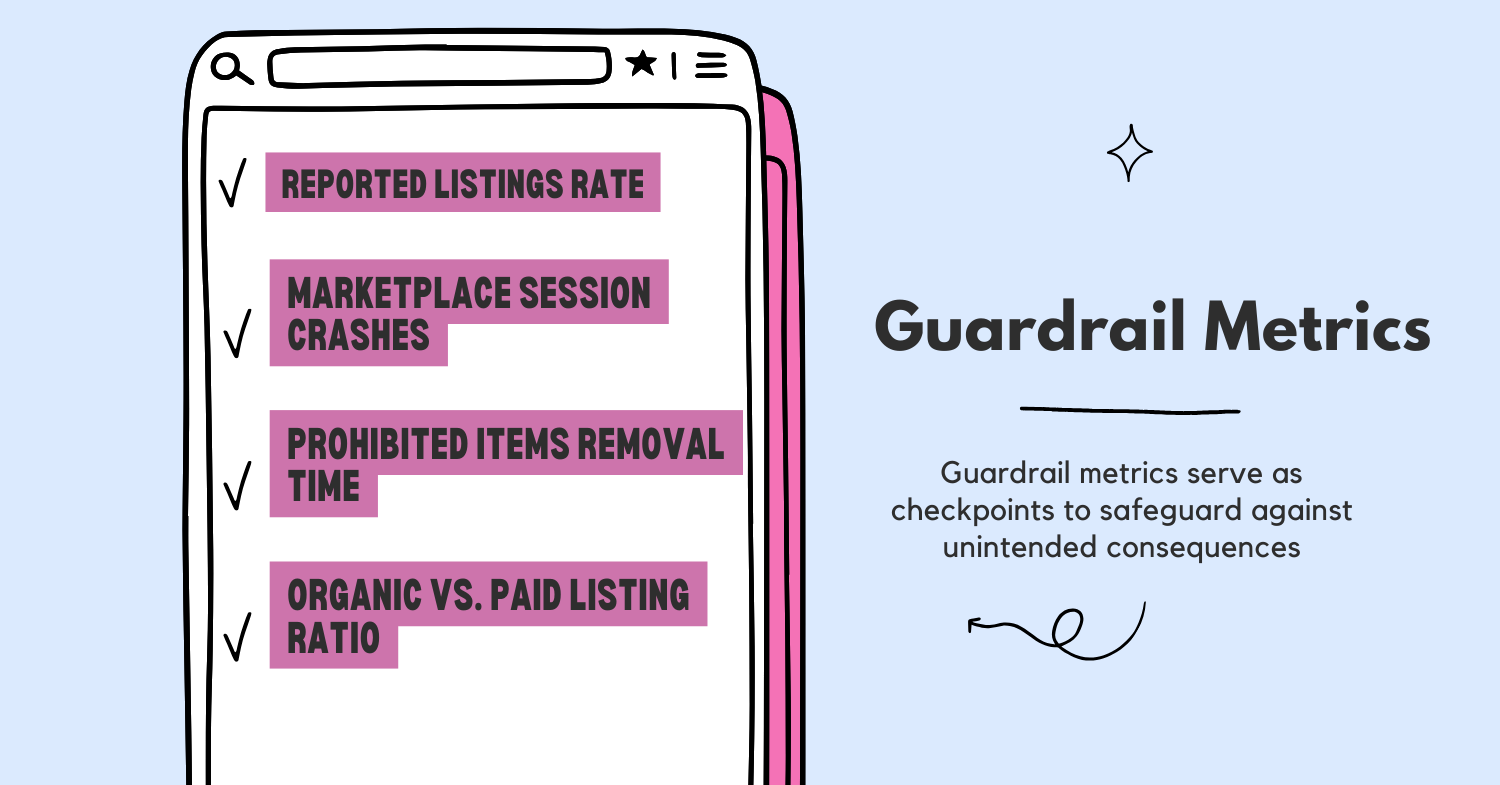
| Key Stakeholder | Metric | Why It Matters | Threshold |
|---|---|---|---|
| Users (Trust & Safety) | Reported Listings Rate | Ensures marketplace quality and safety | <3% of total listings |
| Facebook (Platform Health) | Marketplace Session Crashes | Maintains user experience quality | <0.5% of sessions |
| Regulators | Prohibited Items Removal Time | Demonstrates compliance with local regulations | >95% within 24 hours |
| Business (Monetization) | Organic vs. Paid Listing Ratio | Preserves user experience while enabling monetization | >85% organic listings |
The Reported Listings Rate is particularly critical as it directly impacts our North Star Metric. If users don't trust the marketplace due to fraudulent or inappropriate listings, they won't engage in transactions. We must maintain this below our threshold to ensure marketplace health.
Similarly, if Marketplace Session Crashes exceed our threshold, it creates friction in the user experience that prevents transactions from occurring, directly impacting our WTU metric.
Step 6
Trade-off Metrics
-
Listing Quality vs. Listing Volume
- Trade-off: Stricter listing requirements improve quality but reduce total inventory
- Balance strategy: Implement progressive quality standards that tighten as the marketplace matures, starting with basic requirements and adding more as supply grows
-
User Privacy vs. Transaction Convenience
- Trade-off: More user information facilitates trust but may reduce participation due to privacy concerns
- Balance strategy: Offer optional identity verification features that provide benefits (higher visibility, trust badges) while maintaining basic functionality without extensive personal information
-
Local Relevance vs. Selection Breadth
- Trade-off: Strictly local results improve relevance but limit selection
- Balance strategy: Implement distance-based filtering with user controls, defaulting to local but allowing expanded search when needed
-
Platform Control vs. User Freedom
- Trade-off: More rules and structure reduce problematic content but may stifle organic growth
- Balance strategy: Focus initial restrictions on safety and legal compliance while allowing cultural norms and practices to emerge naturally
Step 7
Counter Metrics
-
Seller Retention Rate
- Purpose: Ensures we're not just acquiring new sellers but keeping existing ones engaged
- Pitfall avoided: Prevents the "leaky bucket" problem where acquisition masks retention issues
- Action if problematic: Investigate seller pain points, improve seller tools and analytics, add incentives for repeat listings
-
Listing-to-Transaction Ratio
- Purpose: Measures marketplace efficiency and listing quality
- Pitfall avoided: Prevents celebrating supply growth that doesn't lead to actual transactions
- Action if problematic: Improve listing quality guidelines, enhance search relevance, provide better pricing guidance to sellers
-
User-Reported Safety Issues
- Purpose: Monitors trust and safety of in-person exchanges
- Pitfall avoided: Prevents focusing on digital metrics while ignoring real-world safety concerns
- Action if problematic: Introduce safe meeting spots, provide transaction safety guidelines, enhance reporting tools
Strategic Initiatives
Based on these metrics, I would propose three strategic initiatives for the new country launch:
-
Local Category Development Program
- Rationale: Different countries have unique category preferences and needs
- Impact: Would improve category distribution metrics and increase listing growth rate
- Implementation challenges: Requires local market research and potentially category-specific features
-
Trust-Building Feature Suite
- Rationale: New marketplaces must overcome initial trust barriers
- Impact: Would improve buyer-seller message rate and reduce time-to-first-transaction
- Implementation challenges: Balancing trust features with privacy concerns and local regulations
-
Regional Expansion Playbook
- Rationale: Most countries have significant regional differences in adoption patterns
- Impact: Would improve geographic penetration metrics
- Implementation challenges: Requires coordination between product, marketing, and local teams
Conclusion
The success of Facebook Marketplace in a new country ultimately depends on creating a vibrant ecosystem where buyers and sellers regularly transact. By focusing on Weekly Transacting Users as our North Star and supporting it with metrics that monitor supply, demand, engagement, and trust, we can effectively measure our progress and make data-informed decisions.
As the marketplace matures, we should expect these metrics to evolve. For example, early focus might be on supply growth and geographic expansion, while later stages might emphasize transaction quality, retention, and monetization. Emerging technologies like AI-powered translation, AR for product visualization, or integrated payment systems could significantly impact how we measure success in the future.
.png)