
To approach this fake news reduction problem effectively, I will follow a simple product success metric framework. I'll follow a structured framework that covers core metrics, supporting indicators, and risk factors while considering all key stakeholders.
Step 1
Product Context
WhatsApp's fake news reduction feature is a multi-faceted initiative designed to limit the spread of misinformation on the platform while preserving user privacy through end-to-end encryption. This creates a unique challenge as WhatsApp cannot directly monitor message content.
Key Stakeholders:
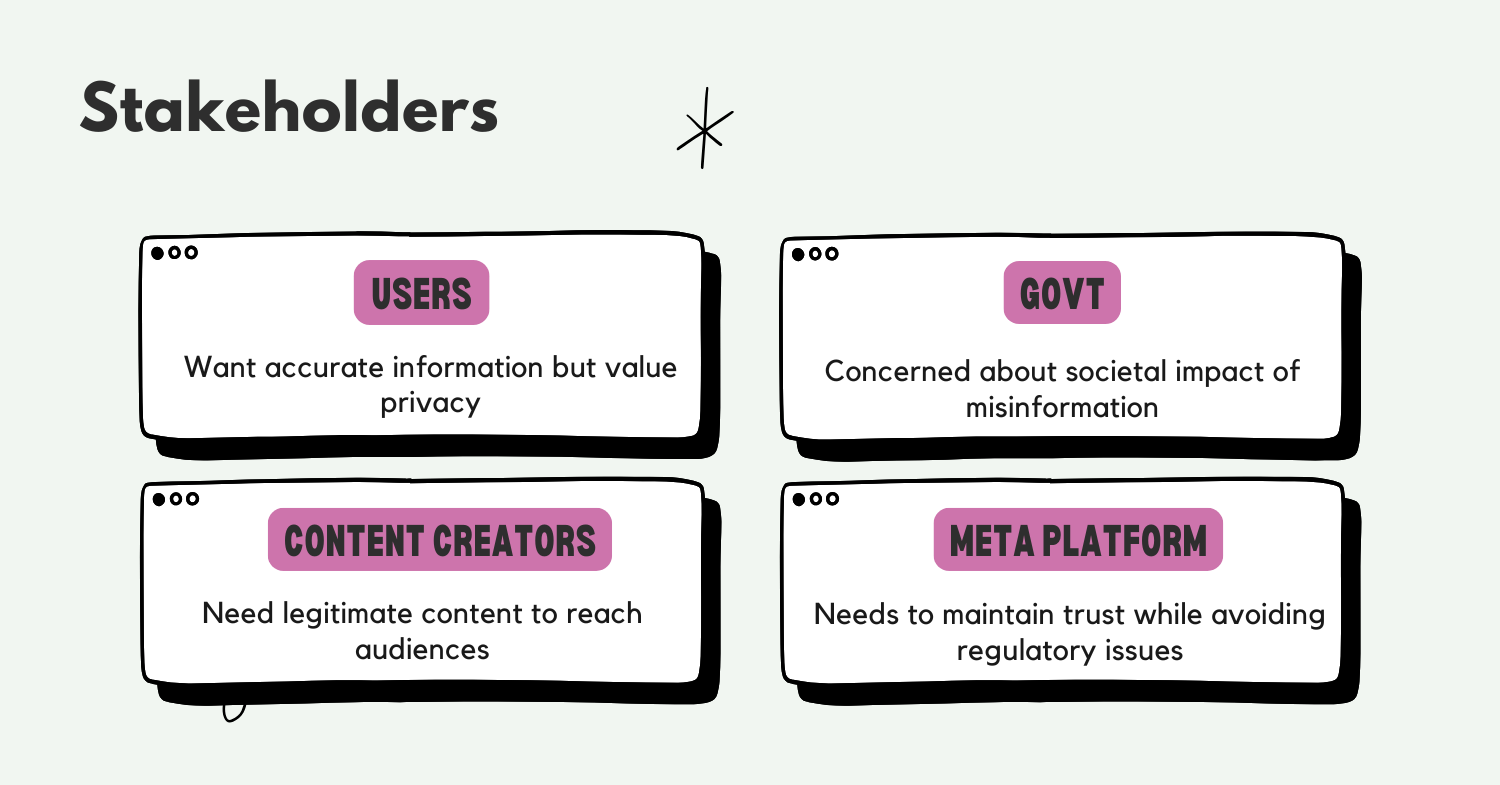
- Users: Want accurate information but value privacy
- Content creators: Need legitimate content to reach audiences
- Platform (WhatsApp/Meta): Needs to maintain trust while avoiding regulatory issues
- Regulators/Governments: Concerned about societal impact of misinformation
- Fact-checking organizations: Partners in verification efforts
User Flow:
- Users receive messages that might contain misinformation
- Platform provides tools to identify potential fake news (forwarded labels, search capabilities)
- Users can report suspicious content or verify through integrated fact-checking
- Platform limits virality of suspicious content through forwarding limits
- Educational resources help users identify misinformation independently
This initiative aligns with Meta's broader strategy of balancing free expression with platform safety, particularly important as WhatsApp serves as a primary information source in many markets.
Competitive Landscape: Unlike Twitter/X's community notes or Facebook's third-party fact-checking, WhatsApp must operate within the constraints of encrypted messaging. Signal offers similar privacy but fewer anti-misinformation tools, while Telegram has minimal content moderation.
Product Lifecycle Stage: The fake news reduction feature is in the growth/maturity phase, having evolved from initial forwarding limits to more sophisticated approaches including in-app fact-checking integration.
Software-Specific Context:
- Platform integration with fact-checking organizations while maintaining E2E encryption
- Client-side detection mechanisms to preserve privacy
- Deployment across multiple OS platforms and regions with varying regulatory requirements
Step 2
Goals
| Core Goals | User Goals | Technical Goals | Business Goals |
|---|---|---|---|
| Reduce fake news spread while preserving privacy | Access accurate information | Maintain E2E encryption while adding safety features | Preserve platform trust and user base |
| Create sustainable detection mechanisms | Easily identify potential misinformation | Scale fact-checking integration globally | Reduce regulatory pressure and potential fines |
| Educate users on information literacy | Share content confidently | Minimize false positives in detection | Differentiate as a responsible messaging platform |
| Balance intervention with user autonomy | Maintain control over sharing | Optimize performance of forwarding limits | Protect brand reputation |
Step 3
North Star Metric
 The North Star Metric for WhatsApp's fake news reduction efforts should be the Misinformation Virality Coefficient (MVC).
Definition: The average number of secondary shares for messages that have been identified as potential misinformation (through reports, fact-checking partnerships, or forwarding patterns) compared to the platform's overall content virality.
Calculation: MVC = (Secondary shares of flagged content) ÷ (Secondary shares of average content)
This metric captures success because it directly measures our ability to reduce the spread of problematic content without requiring content inspection. A successful initiative would show the MVC trending downward over time, approaching or falling below 1.0 (indicating flagged content spreads no more than regular content).
This metric serves all stakeholders:
- Users benefit from reduced exposure to harmful content
- WhatsApp maintains its privacy commitment while demonstrating effectiveness
- Regulators see quantifiable progress against misinformation
- Society benefits from reduced harm without compromising private communication
Hypothetical Data Example:
- Q1 2023: MVC = 3.2 (flagged content spreads 3.2x more than regular content)
- Q2 2023: MVC = 2.7 (after implementing forwarding limits)
- Q3 2023: MVC = 1.9 (after adding "forwarded many times" labels)
- Q4 2023: MVC = 1.4 (after integrating fact-checking resources)
Breakdown North Star Metric
The MVC can be broken down into component parts that help us understand the drivers of misinformation spread:
Formula Breakdown:
- MVC = f(Detection, Intervention, Behavior)
- Detection = f(Report Rate, Identification Accuracy)
- Intervention = f(Forwarding Friction, Educational Effectiveness)
- Behavior = f(Verification Actions, Sharing Decisions)
This is generally the time to take your first 1-2 minutes break to organize your thoughts before diving into the next step.
Step 4
Supporting Metrics
| Metric | Importance | Calculation | Actions |
|---|---|---|---|
| Report-to-Spread Ratio | Measures user participation in fighting misinfo | (# of reports) ÷ (# of shares for flagged content) | Improve reporting UI, add incentives for accurate reporting |
| Forwarding Abandonment Rate | Shows effectiveness of friction points | (# of abandoned forwards after warning) ÷ (total forward attempts of flagged content) | Adjust warning messaging, test different friction designs |
| Fact-Check Engagement | Measures user interest in verification | (# of fact-check link clicks) ÷ (# of users who received flagged content) | Improve fact-check presentation, expand fact-checking partners |
| Time-to-Containment | Measures speed of system response | Average time between first share and effective containment of viral misinfo | Improve detection algorithms, increase moderation resources |
| Cross-Border Spread Reduction | Measures effectiveness across regions | % reduction in cross-country/language spread of flagged content | Enhance language-specific detection, regional partnerships |
| Educational Resource Completion | Measures effectiveness of user education | % of users who complete in-app misinfo literacy resources | Improve educational content, test incentives for completion |
Step 5
Guardrail Metrics
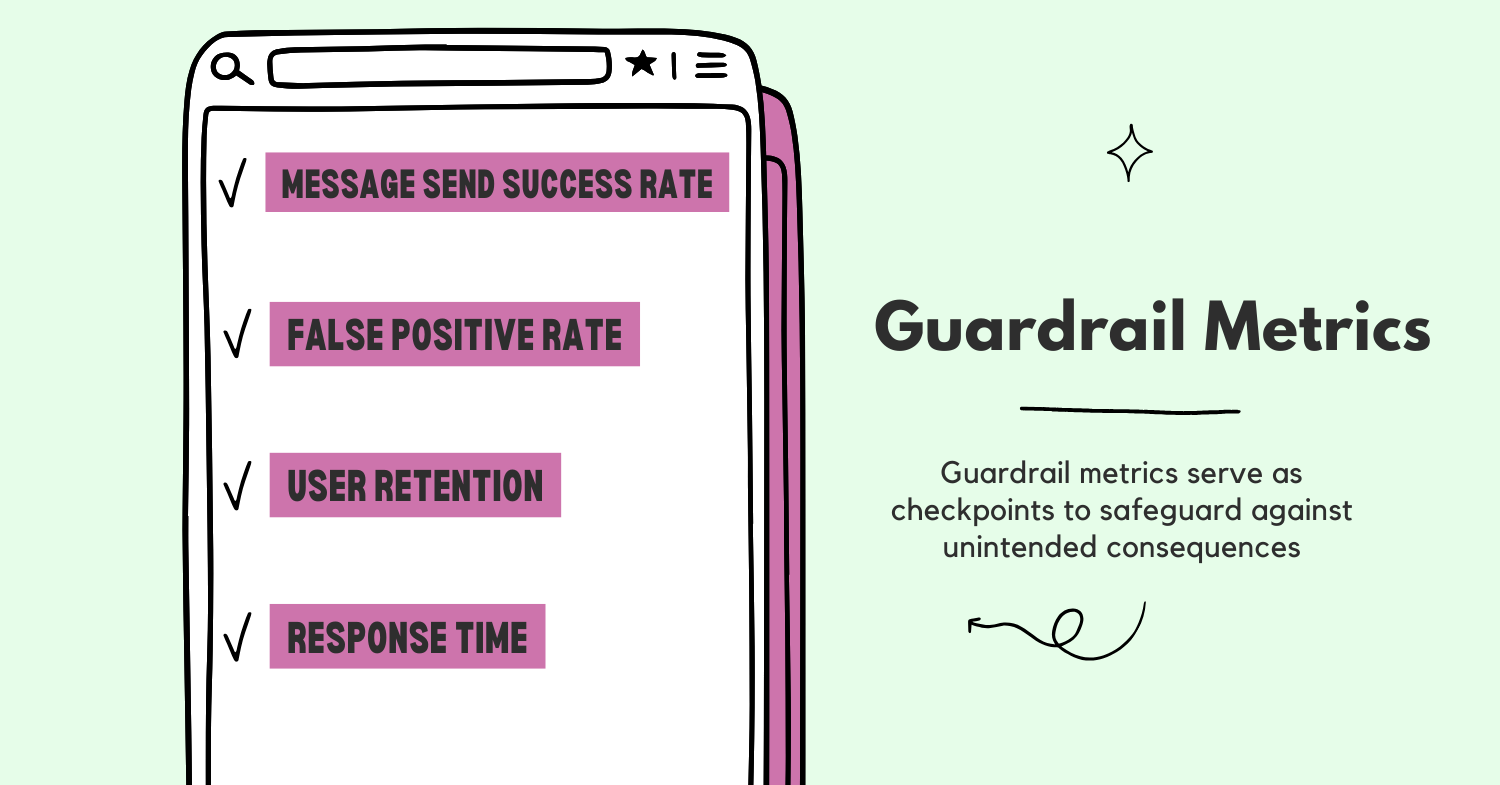
| Key Stakeholder | Metric | Why It Matters | Threshold |
|---|---|---|---|
| Users | Message Send Success Rate | Ensures anti-misinfo measures don't impair core functionality | >99.9% |
| Users | False Positive Rate | Prevents legitimate content from being incorrectly flagged | <2% |
| User Retention | Ensures measures don't drive users to less regulated platforms | <0.5% drop attributable to misinfo features | |
| Fact-checkers | Response Time | Ensures timely verification of viral content | <4 hours for high-velocity content |
| Regulators | Compliance Rate | Demonstrates adherence to regional requirements | 100% compliance with legal requirements |
Message Send Success Rate is critical because any degradation of core messaging functionality could drive users to competitors. If this drops below threshold, we must immediately review and potentially roll back recent changes.
False Positive Rate directly impacts user trust. High false positives could lead to users ignoring all warnings, undermining our entire initiative. We measure this through user feedback and appeals.
User Retention serves as a business guardrail. If our anti-misinformation measures are too intrusive, users may switch to platforms with fewer controls, ultimately increasing misinformation spread globally.
Response Time from fact-checking partners ensures our system can respond to emerging misinformation. Slow responses render the system ineffective during critical periods like elections or health emergencies.
Compliance Rate with regional regulations prevents legal issues while demonstrating our commitment to responsible platform management.
Step 6
Trade-off Metrics
Speed vs. Accuracy:
- Speed of Intervention vs. False Positive Rate
- Faster interventions reduce viral spread but increase false positives
- Balance through tiered approach: apply light friction quickly, escalate gradually as confidence increases
- Use machine learning to improve detection precision over time
Privacy vs. Effectiveness:
- User Privacy Preservation vs. Detection Capability
- More access to message metadata improves detection but compromises privacy
- Balance through client-side processing and anonymous aggregate analysis
- Focus on sharing patterns rather than content inspection
User Autonomy vs. Protection:
- User Freedom vs. Harm Prevention
- More restrictions reduce spread but limit legitimate information sharing
- Balance through education and optional verification tools
- Implement graduated restrictions based on risk level and user history
Global Consistency vs. Local Relevance:
- Platform Consistency vs. Regional Effectiveness
- Uniform policies are simpler but miss regional nuances in misinformation
- Balance through core global standards with regional fact-checking partnerships
- Develop region-specific detection models for high-risk areas
Step 7
Counter Metrics
User Trust Score:
- Measures overall user confidence in WhatsApp's handling of information
- Prevents optimization for spread reduction at expense of platform trust
- If declining, indicates need to review friction points and communication
Information Access Index:
- Measures whether legitimate time-sensitive information (emergency alerts, breaking news) reaches users promptly
- Prevents over-filtering that blocks important information
- If declining, requires adjustment of detection thresholds or whitelist mechanisms
Cross-Platform Migration:
- Tracks user movement to less regulated platforms following interventions
- Prevents "balloon effect" where misinfo simply moves elsewhere
- If increasing, signals need to review user experience and friction levels
Strategic Initiatives
AI-Powered Client-Side Detection:
- Develop on-device ML models to identify potential misinformation patterns without accessing message content
- Impact: Improves Detection Effectiveness while preserving privacy
- Challenges: Model size constraints on mobile devices, keeping models updated
Tiered Verification System:
- Create graduated levels of friction based on risk assessment and content velocity
- Impact: Optimizes balance between User Freedom and Harm Prevention
- Challenges: Designing intuitive UX that doesn't frustrate legitimate sharing
Regional Fact-Checking Network Expansion:
- Expand partnerships with local fact-checking organizations in high-risk regions
- Impact: Improves Time-to-Containment and Regional Effectiveness
- Challenges: Quality control across diverse partners, integration complexity
Conclusion
As digital communication evolves, our metrics for measuring fake news reduction must adapt accordingly. Emerging technologies like more sophisticated AI could enable better client-side detection without compromising encryption. Meanwhile, changing user behaviors and expectations may require us to rebalance our approach to friction and intervention.
The future success of WhatsApp's fake news reduction efforts will likely depend on creating an ecosystem of solutions rather than relying on any single metric or approach. By maintaining our focus on the Misinformation Virality Coefficient while monitoring our supporting and counter metrics, we can continue to reduce harm while preserving what makes WhatsApp valuable to billions of users worldwide.
.png)