Introduction
I'll approach designing a language learning product for the Facebook app by first understanding the strategic rationale, identifying target users, analyzing pain points, developing solutions, and establishing success metrics. My goal is to create a language learning experience that leverages Facebook's social graph and engagement mechanisms while delivering genuine educational value.
Does this approach sound good? I'd like to confirm before diving deeper.
Step 1
Clarifying Questions (3 minutes)
- Why it matters: This affects how deeply we can integrate with Facebook's core features and user data.
- Expected answer: Yes, it's meant to be integrated within the Facebook ecosystem.
- Impact on approach: If integrated, we'd leverage Facebook's social graph, notifications, and feed; if standalone, we'd need different acquisition and engagement strategies.
- Why it matters: This shapes our prioritization of features and success metrics.
- Expected answer: Likely a combination of increasing user engagement and session time.
- Impact on approach: If engagement-focused, we'd emphasize social learning features; if monetization-focused, we'd design premium content paths.
- Why it matters: Different language pairs have vastly different user bases and competitive landscapes.
- Expected answer: Focus on globally popular languages (English, Spanish, Mandarin) or languages relevant to Facebook's growth markets.
- Impact on approach: Would determine content development priorities and initial target audience.
- Why it matters: Helps identify unique advantages we have over standalone language learning apps.
- Expected answer: Social graph, Groups, Watch, user demographic data, etc.
- Impact on approach: Would inform core differentiation strategy and integration points.
Propose the Goal
Given Facebook's focus on connecting people and increasing meaningful interactions, I believe our goal should be to create a language learning experience that leverages social connections to make learning more engaging, effective, and persistent. Does this align with your vision?
Define the Scope
For this discussion, I'll focus on designing a language learning feature that's integrated into the core Facebook app experience rather than a standalone product. I'll assume we're targeting adult casual learners rather than children or professional language acquisition.
Let me take a moment to organize my thoughts before continuing.
Based on our discussion, I'll proceed with these assumptions:
- We're building a native feature within Facebook
- The primary goal is increasing user engagement while providing genuine educational value
- We'll initially focus on globally popular language pairs
- We'll leverage Facebook's social graph as a key differentiator
Step 2
Why build this? (5 minutes)
Analyze Macro Trends and Opportunities:
The language learning market is experiencing significant growth, projected to reach $25 billion by 2025, driven by several key trends:
- Globalization of work - Remote work has created demand for cross-cultural communication skills
- Travel renaissance post-pandemic - People are traveling internationally again and seeking language skills
- Content consumption across borders - K-pop, international streaming shows, and global content are driving interest in new languages
- AI and personalization advancements - Technology now enables more effective personalized learning experiences
Facebook is uniquely positioned to capitalize on these trends due to its massive user base of 2.9+ billion users and rich social data that can enhance the language learning experience.
Competitor Analysis:
The language learning space has several established players:
Duolingo:
- Strengths: Gamification, bite-sized lessons, free tier
- Weaknesses: Limited social features, questionable long-term efficacy
- Metrics: 40M+ monthly active users, strong retention through streaks and gamification
Babbel:
- Strengths: Structured curriculum, conversation focus
- Weaknesses: Subscription-only model, limited community
- Metrics: 10M+ subscribers, higher completion rates than free apps
Tandem/HelloTalk:
- Strengths: Native speaker connections, conversation practice
- Weaknesses: Limited structured learning, safety concerns
- Metrics: Smaller user base but higher engagement per session
Facebook's competitive advantages include:
- Existing social connections that could become language partners
- Rich data for personalization
- Multiple engagement surfaces (Feed, Groups, Watch, Messenger)
- No need for separate user acquisition
Value Chain Analysis:
In the language learning value chain, several areas remain underserved:
- Content creation: Most apps rely on professional content creation, missing opportunities for user-generated and culturally relevant material
- Practice opportunities: Finding consistent conversation partners remains difficult
- Motivation and accountability: High drop-off rates plague the industry
- Cultural context: Language learning often lacks authentic cultural immersion
Facebook can address these gaps by connecting learners with native speakers in their network, facilitating group learning among friends, and providing cultural context through relevant content from regions where the target language is spoken.
Step 3
User Segments (5 minutes)
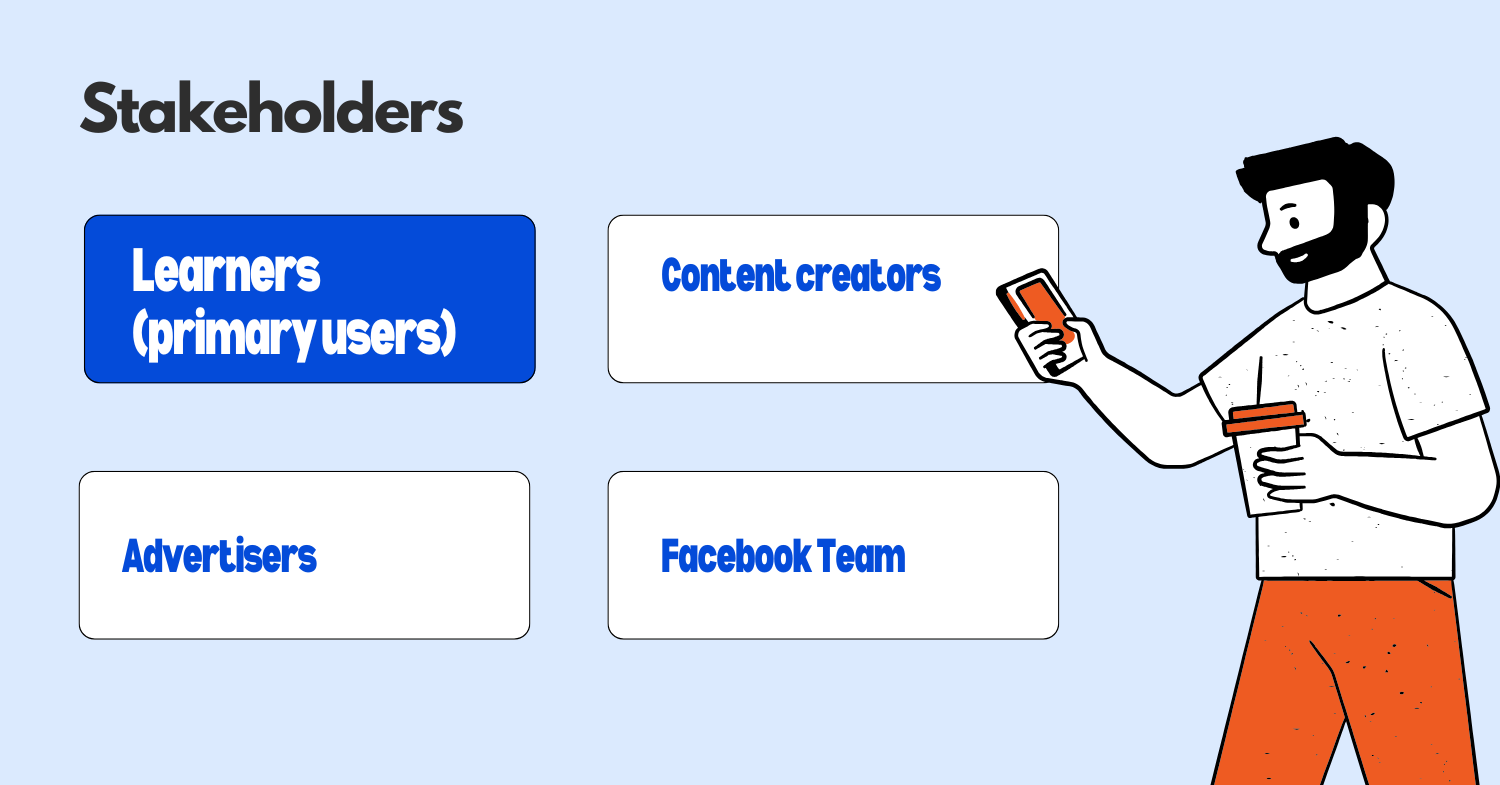 The key stakeholders in our language learning ecosystem include:
- Learners (primary users)
- Content creators (including professional educators and native speakers)
- Advertisers interested in reaching language learners
- Facebook itself (platform sustainability)
Since we're focusing on learners as our primary users, I'll segment them further:
Learner Segments
-
Social Travelers: Users learning a language for upcoming travel or tourism
- Characteristics: Short-term goals, phrase-focused, destination-specific interest
- Needs: Basic conversation skills, cultural norms, travel-specific vocabulary
-
Career Advancers: Users learning for professional development
- Characteristics: Focused on specific industries, formal language, certification
- Needs: Business vocabulary, professional communication, credentials
-
Cultural Enthusiasts: Users learning to connect with content, media, or heritage
- Characteristics: Interest in entertainment, culture, or family connections
- Needs: Conversational skills, cultural context, authentic materials
-
Connection Seekers: Users learning to communicate with specific people
- Characteristics: Highly motivated by personal relationships (partners, in-laws, friends)
- Needs: Conversational practice, everyday vocabulary, direct application
Prioritization Table
| Segment | TAM (1-10) | Engagement Potential (1-10) | Alignment with FB Strengths (1-10) | Total Score |
|---|---|---|---|---|
| Social Travelers | 7 | 6 | 8 | 336 |
| Career Advancers | 8 | 5 | 4 | 160 |
| Cultural Enthusiasts | 8 | 9 | 9 | 648 |
| Connection Seekers | 6 | 10 | 10 | 600 |
Scoring Explanation:
- Social Travelers: Large market but temporary engagement; good fit with Facebook's location and event features
- Career Advancers: Large market but Facebook isn't positioned as a professional development platform
- Cultural Enthusiasts: Large market with ongoing engagement potential; excellent fit with Facebook's content discovery
- Connection Seekers: Smaller but highly motivated segment; perfect alignment with Facebook's core value proposition
Based on this analysis, I'll focus on Cultural Enthusiasts as our primary segment, with Connection Seekers as a close secondary focus. These segments align best with Facebook's strengths in content discovery and social connections, while offering strong engagement potential.
Step 4
Pain Points (5 minutes)
For our Cultural Enthusiasts segment, I've identified these key pain points:
1. Lack of Authentic Cultural Context
"I've been studying Spanish for months, but I still don't understand the references in the Netflix shows I'm watching."
Cultural Enthusiasts want to understand not just the language but the cultural references, slang, and nuances that make content meaningful. Traditional language apps focus on formal language rather than the colloquial expressions used in popular media.
Potential metrics: Percentage of users who report feeling confused by cultural references in target language content; time spent searching for explanations of cultural references.
2. Inconsistent Practice
"I practice Spanish for a week, then get busy and forget about it for a month. By then, I've lost my progress."
Language learning requires consistent practice, but most users struggle to maintain habits without external accountability. Unlike fitness or diet goals, language learning progress is less visible to others on social platforms.
Potential metrics: Average days between learning sessions; percentage of users who return after a 7-day break; completion rate of learning sequences.
3. Disconnect Between Learning and Application
"I complete all my lessons but freeze up when trying to actually use the language in real situations."
Many learners experience a gap between theoretical knowledge and practical application. They may score well on in-app exercises but struggle to apply their skills in authentic contexts.
Potential metrics: Self-reported confidence in using the language; time between learning new vocabulary and successfully using it in conversation; comprehension rate when consuming authentic content.
4. Isolation in Learning Journey
"None of my friends are learning Japanese, so I have no one to practice with or share my progress."
Language learning can be a solitary experience, reducing motivation and opportunities for practice. Even on social platforms, learners may not know which connections share their language interests.
Potential metrics: Number of learning-related social interactions; retention rate for solo learners vs. those with connections learning the same language; reported satisfaction with learning community.
Step 5
Prioritization of Pain Points (3 minutes)
Let's prioritize these pain points based on severity (impact on learning outcomes) and frequency (how often users experience them):
| Pain Point | Severity (1-10) | Frequency (1-10) | Score | Rationale |
|---|---|---|---|---|
| Lack of Authentic Cultural Context | 8 | 9 | 72 | High impact on comprehension and motivation; experienced nearly every time users encounter authentic content |
| Inconsistent Practice | 9 | 10 | 90 | Critical impact on learning outcomes; affects virtually all casual learners |
| Disconnect Between Learning and Application | 7 | 8 | 56 | Significant impact on perceived value; common but not universal |
| Isolation in Learning Journey | 6 | 7 | 42 | Moderate impact on motivation; affects many but not all learners |
Based on this analysis, I'll focus on addressing these top two pain points:
-
Inconsistent Practice (Score: 90) - This is the most critical issue to solve because language acquisition fundamentally depends on regular practice. Without consistency, even the best-designed learning experiences will fail.
-
Lack of Authentic Cultural Context (Score: 72) - This is our second priority because it directly addresses our Cultural Enthusiasts segment's core need and represents a significant gap in existing solutions.
The prioritization reflects both the critical nature of habit formation in language learning and our target segment's specific desire for cultural relevance. By addressing these two pain points, we can create a differentiated experience that leverages Facebook's unique strengths in social connection and content discovery.
Now that we've identified the key pain points, I'll take a moment to organize my thoughts before developing solutions.
Step 6
Solution (10 minutes)
Potential Solutions
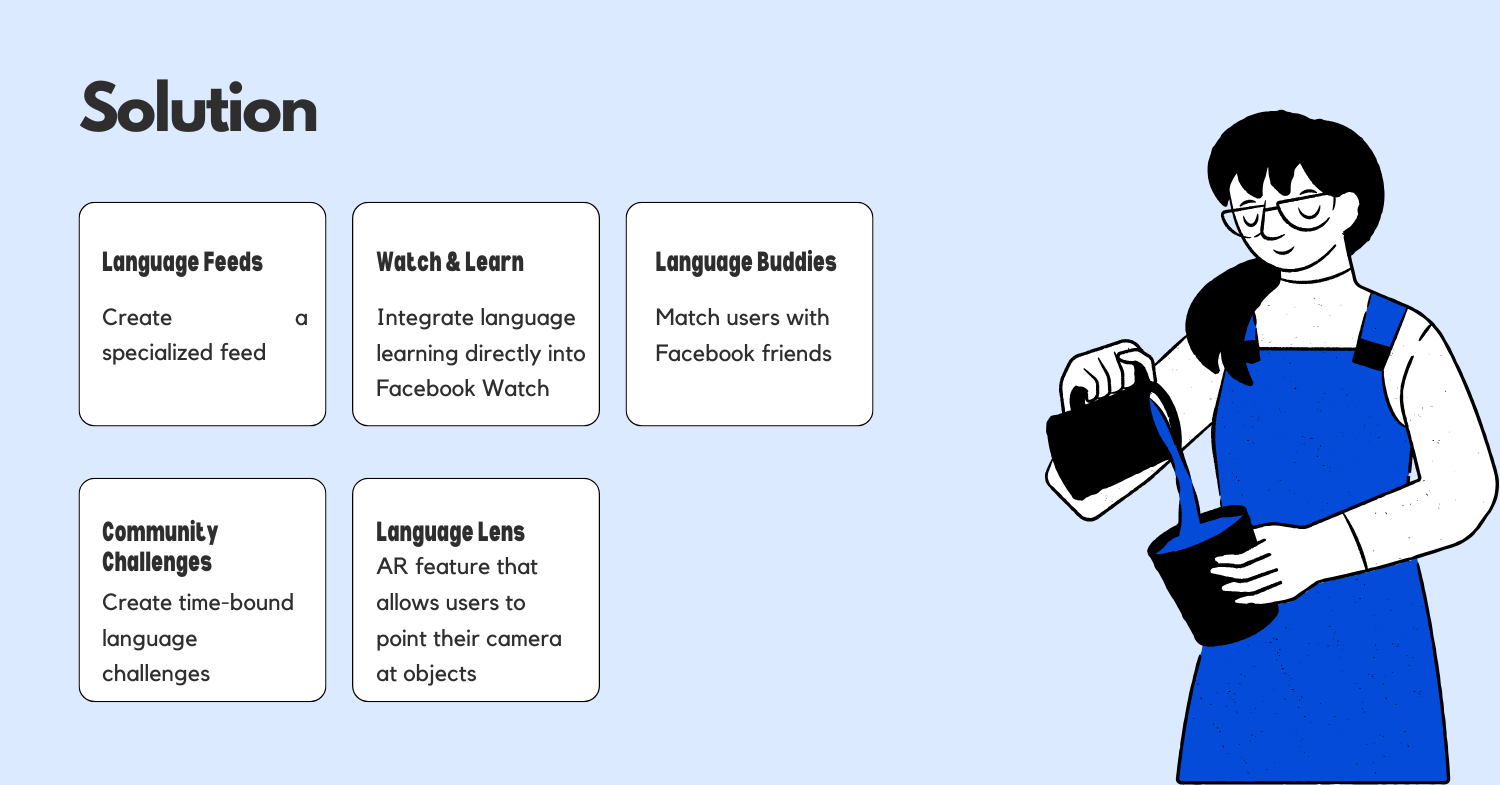
1. "Language Feeds"
Create a specialized feed that combines language learning content with authentic posts from regions where the target language is spoken. Users would see a mix of structured lessons, posts from language groups they've joined, content from creators in their target language, and posts from friends who speak that language. The feed would include interactive elements like vocabulary explanations on hover and pronunciation guides.
2. "Watch & Learn"
Integrate language learning directly into Facebook Watch with an overlay feature that provides real-time translations, explanations of cultural references, and interactive quizzes for content in the target language. Users could save phrases from videos and receive spaced-repetition practice later.
3. "Language Buddies"
Match users with Facebook friends (or friends-of-friends) who are either learning the same language or are native speakers interested in language exchange. The system would suggest conversation topics, provide guided activities, and offer feedback based on their interactions through Messenger.
4. "Community Challenges"
Create time-bound, group-based language challenges where friends commit to learning together. Daily activities would be assigned to the group, with social accountability features like visible progress trackers and group celebrations for milestones. Content would be themed around cultural topics (music, food, holidays) to provide context.
5. "Language Lens" (Moonshot)
An AR feature that allows users to point their camera at objects in their environment and see labels, pronunciation guides, and cultural context in their target language. The feature would include challenges like "find and photograph 5 household items and learn their names" to encourage active engagement with surroundings.
Solution Prioritization
| Solution | Reach (1-10) | Impact (1-10) | Feasibility (1-10) | Alignment (1-10) | Total |
|---|---|---|---|---|---|
| Language Feeds | 9 | 7 | 8 | 9 | 4536 |
| Watch & Learn | 7 | 9 | 6 | 8 | 3024 |
| Language Buddies | 6 | 8 | 7 | 9 | 3024 |
| Community Challenges | 8 | 9 | 7 | 8 | 4032 |
| Language Lens | 5 | 10 | 3 | 7 | 1050 |
Scoring Explanation:
- Language Feeds: High reach (leverages core Facebook experience), good impact (addresses context), high feasibility (builds on existing systems), excellent alignment (enhances core product)
- Watch & Learn: Moderate reach (Watch users only), high impact (combines entertainment and learning), moderate feasibility (requires content processing), good alignment
- Language Buddies: Lower reach (requires matching), high impact (addresses practice), moderate feasibility (messaging integration), excellent alignment (strengthens connections)
- Community Challenges: High reach (group-based viral potential), high impact (addresses consistency), moderate feasibility (requires new features), good alignment
- Language Lens: Limited reach (requires camera use), very high impact (immersive learning), low feasibility (complex AR), moderate alignment
Based on this analysis, I'll focus on developing the Community Challenges solution, as it effectively addresses our top pain point (inconsistent practice) while providing cultural context through themed challenges.
Detailed Solution: Community Challenges
The Community Challenges feature would allow users to form or join language learning groups with friends, creating social accountability and cultural immersion through structured, time-bound learning experiences.
User Flow
Key Features:
-
Themed Challenges: 7, 14, or 30-day challenges centered around cultural themes like "Spanish Film Festival," "Japanese Cuisine," or "French Holiday Traditions." Each challenge provides cultural context alongside language learning.
-
Social Accountability: Visible progress trackers show which group members have completed daily activities. Gentle reminders are sent when friends have completed their activities but you haven't.
-
Varied Activities: Each day features different activity types to maintain engagement:
- Mini-lessons with vocabulary and phrases
- Short video clips with comprehension questions
- Cultural facts with language components
- Speaking challenges to record and share
- Group activities requiring collaboration
-
Celebration Mechanics: Group milestones trigger celebration animations, badges, and potential real-world rewards (e.g., discounts on travel sites for completing a "Travel Spanish" challenge).
-
Personalized Difficulty: Content adapts to each user's proficiency level while maintaining the same themes, allowing mixed-ability groups to participate together.
Technical and Business Challenges:
-
Content Creation at Scale: Developing quality, culturally relevant content for numerous languages and themes would require significant resources or partnerships with language education providers.
-
Group Dynamics Management: Ensuring groups remain active and engaged when some members drop off would be challenging. We'd need mechanisms to merge groups or introduce new members.
-
Proficiency Assessment: Accurately determining and adapting to user proficiency levels without formal testing would require sophisticated algorithms and feedback mechanisms.
Step 7
Success Metrics (5 minutes)
To evaluate the effectiveness of our Community Challenges solution, I'd track these metrics:
User Metrics:
-
Challenge Completion Rate
- Percentage of users who complete their entire 7/14/30-day challenge
- Target: >40% completion (industry standard is 10-20% for language learning programs)
- This directly measures our success in addressing the inconsistent practice pain point
-
Daily Activity Completion Rate
- Percentage of daily activities completed by active challenge participants
- Target: >70% daily completion
- This measures day-to-day engagement and the effectiveness of our social accountability features
-
Cultural Confidence Score
- Self-reported survey metric on users' confidence in understanding cultural references
- Target: 30% improvement from beginning to end of challenge
- This measures our success in addressing the cultural context pain point
Product Metrics:
-
Challenge Participation Rate
- Percentage of invited users who join a challenge
- Target: >25% acceptance rate
- This measures the appeal of our core concept and invitation mechanism
-
Social Interaction Rate
- Average number of comments, reactions, and shares per challenge post
- Target: >3 interactions per post
- This measures the social engagement component that differentiates our solution
-
Cross-Challenge Retention
- Percentage of users who join a new challenge within 2 weeks of completing one
- Target: >40% retention
- This measures long-term engagement and habit formation
Leading Indicators:
-
Day 3 Retention
- Percentage of users still active on day 3 of their first challenge
- Target: >70% retention
- Early indicator of challenge design effectiveness and potential completion rates
-
Friend Invitation Rate
- Average number of friends invited by each challenge participant
- Target: >2 invitations per user
- Indicates viral potential and user satisfaction
These metrics align with our initial goal of creating a socially engaging language learning experience that promotes consistency and cultural understanding. By focusing on completion rates and social interaction metrics, we directly address our prioritized pain points while measuring Facebook's core engagement objectives.
Summary
To build a language learning product for Facebook, I've proposed a solution that leverages the platform's unique strengths in social connection and content discovery. By focusing on Cultural Enthusiasts who want to engage with international content and media, we address significant gaps in the current language learning market.
Our Community Challenges solution tackles the critical pain points of inconsistent practice and lack of cultural context by creating socially accountable, themed learning experiences. This approach differentiates from standalone language apps by making learning visible to friends, providing authentic cultural immersion, and creating shared experiences.
The solution aligns with Facebook's strategic goals by increasing meaningful interactions between users, driving daily engagement, and potentially creating new content consumption patterns across language barriers. Success would be measured through completion rates, social engagement metrics, and user-reported cultural confidence.
Next steps would include:
- Developing prototype challenges for 2-3 popular language pairs
- Testing with small user groups to refine the social dynamics
- Partnering with content creators for authentic cultural material
- Designing a scalable content creation framework
.png)