I'll approach this by exploring how Meta's social platforms and technologies could create a specialized marketplace for antiques, connecting buyers, sellers, and enthusiasts in this unique space.
Clarifying Questions
- Why it matters: Determines whether we build on existing user bases or create something new
- Expected answer: Integration with existing platforms
- Impact on approach: Would leverage Facebook Marketplace infrastructure vs building from scratch
- Why it matters: Different user segments have vastly different needs and behaviors
- Expected answer: Focus on mainstream collectors and casual sellers
- Impact on approach: Would emphasize different features based on professional vs casual focus
- Why it matters: Trust is crucial in high-value, unique item transactions
- Expected answer: Yes, authentication is a major concern
- Impact on approach: Would require expert integration or AI solutions for verification
- Why it matters: Determines core value proposition and feature prioritization
- Expected answer: Balance both with slight emphasis on transactions
- Impact on approach: Would affect resource allocation between social and commerce features
Propose the Goal
Given Meta's focus on connecting people and facilitating commerce, I believe the goal is to create a specialized marketplace that leverages social connections to make buying and selling antiques more accessible, trustworthy, and engaging than existing alternatives. Does this align with your vision?
Define the Scope
For this exercise, I'll focus on designing a product that integrates with Meta's existing platforms while addressing the unique needs of antique transactions. I'll assume we're targeting both casual collectors and professional dealers in the US market initially, with authentication being a key concern.
Does this approach sound good? I'll take a moment to organize my thoughts based on your feedback before proceeding.
Why build this?
Analyze Macro Trends and Opportunities
The antiques market presents several compelling opportunities for Meta:
-
Digital transformation of traditional markets: The $65B+ global antiques market remains largely offline or on legacy platforms. COVID-19 accelerated digital adoption among traditionally resistant dealers and collectors.
-
Growing interest in sustainability: There's increasing consumer preference for sustainable consumption, with antiques representing the ultimate recyclable product. This aligns with growing interest in circular economy principles.
-
Democratization of collecting: Younger generations are entering the antiques market but prefer digital-first experiences and more accessible price points than traditional channels provide.
-
Visual-first discovery: Antiques are highly visual products that align perfectly with Instagram and Facebook's visual platforms, creating natural synergy.
Competitor Analysis
Current solutions in the antiques space have significant limitations:
eBay: Strong in reach but poor in trust mechanisms and community. Authentication is minimal, and the experience isn't optimized for unique items.
1stDibs/Chairish: High-end focus with strong curation but limited reach and high seller fees (20-30%). Excellent photography requirements create barriers to casual sellers.
Etsy: Strong in vintage but weak in true antiques. Limited authentication capabilities and search optimization for unique items.
Local auction houses: Strong trust but extremely fragmented, with poor digital experiences and limited reach beyond local markets.
Meta's strengths in this space include:
- Massive user base across demographics
- Existing Marketplace infrastructure
- Advanced visual search and AI capabilities
- Community-building tools
- Identity verification systems
Value Chain Analysis
The antiques value chain has several friction points that remain unsolved:
- Discovery: Finding specific items across fragmented dealer networks
- Authentication: Verifying age, provenance, and condition
- Valuation: Determining fair market value for unique items
- Trust: Ensuring safe transactions between strangers
- Logistics: Safely shipping fragile, valuable items
Meta is uniquely positioned to address discovery, authentication (via community and AI), and trust issues. By connecting the fragmented market and adding social proof layers, Meta could capture significant value currently lost to inefficiencies.
User Segments
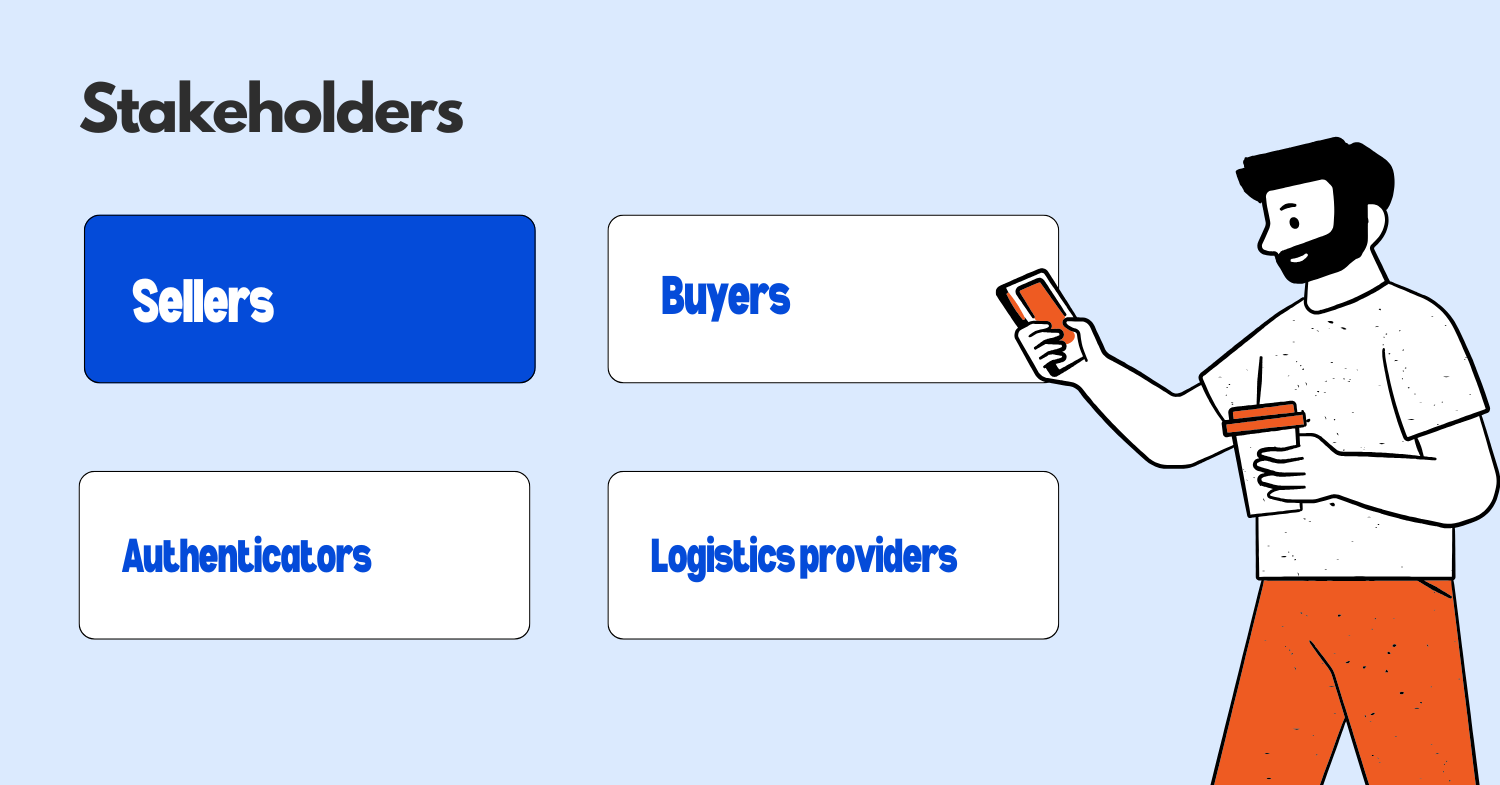 The antiques ecosystem includes several key stakeholders:
- Sellers (dealers, estates, casual sellers)
- Buyers (collectors, decorators, investors)
- Authenticators/Experts
- Logistics providers
For this product, I'll focus on the buyer and seller segments as primary users, with authenticators as a supporting segment.
Within these groups, I identify these sub-segments:
- Professional Dealers: Full-time antique sellers with inventory, expertise, and established businesses
- Casual Sellers: Individuals selling inherited items or occasional finds
- Serious Collectors: Knowledgeable buyers focused on specific categories
- Decorative Buyers: Purchasing for aesthetic rather than collectible value
Let me prioritize these segments:
| Segment | TAM | Engagement Frequency | Potential for Improvement | Score |
|---|---|---|---|---|
| Professional Dealers | 7 | 9 | 8 | 504 |
| Casual Sellers | 9 | 5 | 9 | 405 |
| Serious Collectors | 6 | 8 | 7 | 336 |
| Decorative Buyers | 8 | 4 | 6 | 192 |
Professional Dealers score highest because:
- While smaller in number than casual sellers, they drive consistent inventory
- They have high engagement frequency (daily/weekly listing activity)
- Current platforms serve them poorly with high fees and limited social features
Casual Sellers score well due to:
- Largest potential user base within Meta's ecosystem
- Highest potential for improvement (currently underserved)
- Significant pain points with existing solutions
I'll focus primarily on Professional Dealers as they'll supply consistent inventory quality and quantity, with Casual Sellers as a secondary focus to ensure supply breadth.
Pain Points
For Professional Dealers, the key pain points include:
-
Limited Audience Reach: "I have amazing pieces but can't find the right buyers locally. Online platforms don't connect me with people who appreciate what I have." Metric: Customer acquisition cost, time-to-sale
-
Trust and Authentication Challenges: "Buyers are hesitant to purchase high-value items online without seeing them in person. Proving authenticity remotely is difficult." Metric: Cart abandonment rate, buyer message frequency pre-purchase
-
High Platform Fees: "Existing specialized platforms charge 15-30% commission, which forces me to raise prices or reduce margins." Metric: Profit margin, price competitiveness
-
Poor Discovery Mechanisms: "My items get lost among thousands of listings. Current search tools don't understand the nuances of antiques categories and descriptions." Metric: Listing view-to-sale ratio, search-to-view conversion
-
Fragmented Communication: "I manage inquiries across multiple platforms, emails, and phone calls, making it hard to track potential buyers and provide consistent service." Metric: Response time, inquiry-to-sale conversion
Prioritization of Pain Points
| Pain Point | Severity (1-10) | Frequency (1-10) | Score |
|---|---|---|---|
| Limited Audience Reach | 9 | 10 | 90 |
| Trust and Authentication | 10 | 8 | 80 |
| High Platform Fees | 7 | 10 | 70 |
| Poor Discovery Mechanisms | 8 | 7 | 56 |
| Fragmented Communication | 6 | 8 | 48 |
I'll prioritize Limited Audience Reach and Trust and Authentication as our primary pain points to address.
The audience reach issue is both severe and constant - dealers consistently struggle to find the right buyers for specialized items. This directly impacts business viability and is experienced with every listing.
Trust and authentication scores highly on severity because high-value transactions simply won't happen without trust. While not every interaction involves authentication challenges, when they do arise, they're often deal-breakers.
These two pain points are also synergistic - solving the trust issue helps expand audience reach by enabling transactions with geographically distant buyers.
I'll take a moment to organize my thoughts on potential solutions before continuing.
Solution
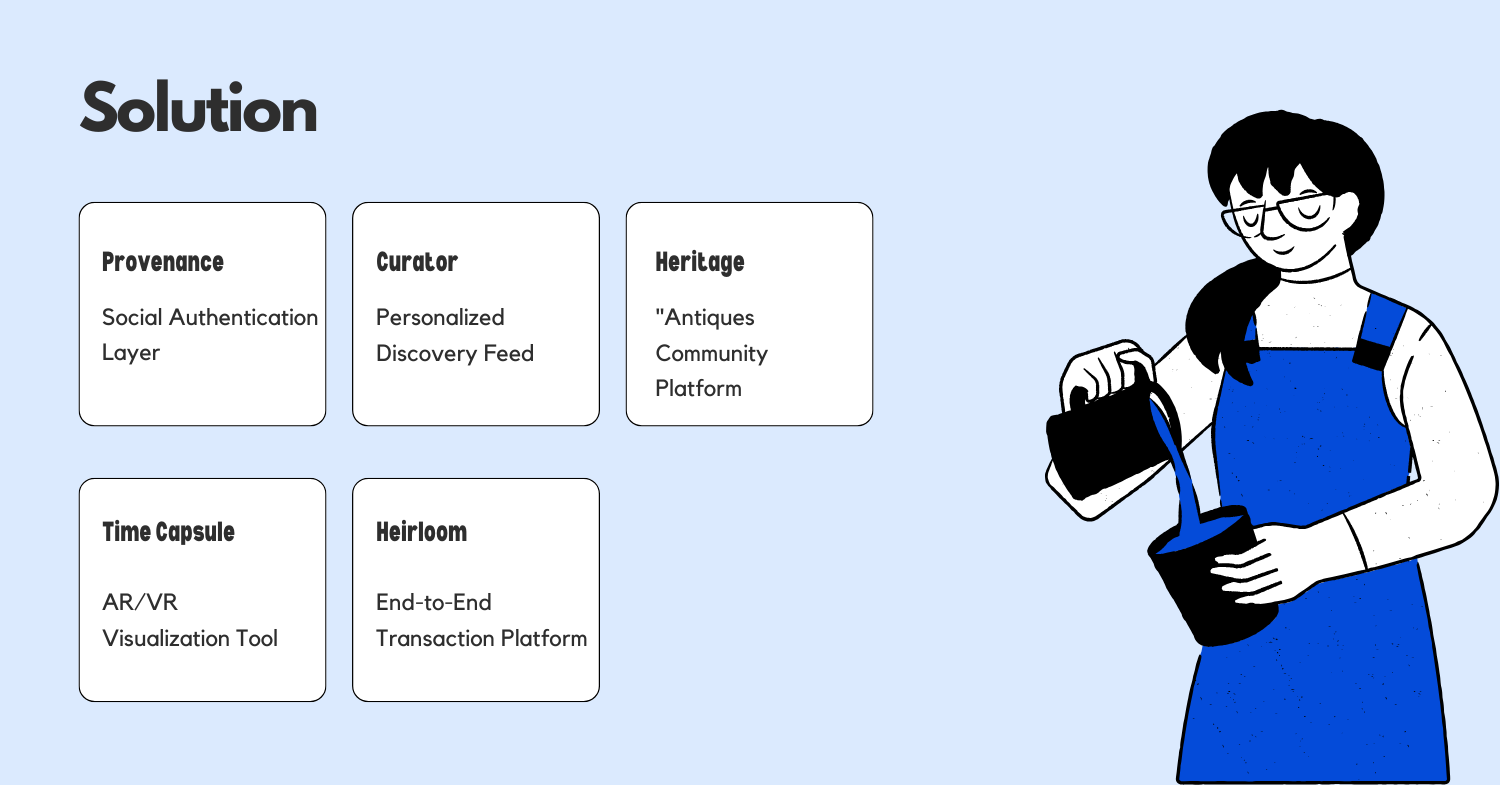 Based on our analysis, I've developed several potential solutions:
1. "Provenance" - Social Authentication Layer
A system that leverages Meta's social graph to create trust signals for antiques. Items would receive authentication through a combination of:
- Expert verification (via video calls or in-app consultations)
- Community validation (from recognized collectors/experts)
- AI-assisted analysis of visual characteristics and comparables
- Blockchain-recorded ownership history
This would create a "Provenance Score" visible on listings, building trust through social proof and expert validation.
2. "Curator" - Personalized Discovery Feed
A specialized feed algorithm that learns user preferences in antiques and surfaces relevant items. Unlike standard Marketplace, this would:
- Use visual recognition to understand style periods and characteristics
- Learn from browsing and saving behavior to identify preference patterns
- Allow following specific dealers, styles, or eras
- Provide personalized notifications when relevant items are listed
3. "Heritage" - Antiques Community Platform
A dedicated space within Meta's ecosystem for antiques enthusiasts to:
- Share collections and knowledge
- Participate in virtual shows and exhibitions
- Join category-specific groups moderated by experts
- Build reputation through knowledge sharing and authentication assistance
4. "TimeCapsule" - AR/VR Visualization Tool
Leveraging Meta's AR/VR capabilities to:
- Allow buyers to visualize antiques in their space before purchasing
- Create virtual showrooms for dealers to display inventory
- Enable virtual "handling" of items to inspect details
- Provide historical context through immersive experiences
5. "Heirloom" - End-to-End Transaction Platform (Moonshot)
A comprehensive solution that handles the entire antiques transaction process:
- Authentication and valuation services
- Escrow payment protection
- Specialized packing and shipping
- Insurance during transit
- Installation services for large pieces
- Digital certificates of authenticity and provenance
Solution Prioritization
| Solution | Reach (1-10) | Impact (1-10) | Feasibility (1-10) | Score |
|---|---|---|---|---|
| Provenance | 8 | 9 | 7 | 504 |
| Curator | 9 | 7 | 8 | 504 |
| Heritage | 7 | 6 | 9 | 378 |
| TimeCapsule | 6 | 8 | 5 | 240 |
| Heirloom | 9 | 10 | 4 | 360 |
I recommend pursuing a combination of Provenance and Curator as our core solution, which I'll call "Meta Antiquities".
Provenance scores highly on impact because it directly addresses the trust issue that prevents transactions. Its reach is strong because it can be applied to all listings. Feasibility is moderate as it requires building new authentication systems.
Curator matches Provenance in total score by excelling in reach (can be deployed to all users) and feasibility (builds on existing recommendation algorithms). Its impact is slightly lower as it addresses discovery but not trust directly.
User Flow for Meta Antiquities
Implementation Challenges
-
Expert Network Development: Building and maintaining a network of qualified authenticators across numerous antique categories will require significant recruitment and vetting.
-
Visual Recognition Training: Developing AI systems capable of recognizing period-specific characteristics across diverse antique categories will require extensive training data and expertise.
-
Trust Calibration: Balancing the rigor of authentication with the need for seller convenience will be challenging. Too strict, and sellers won't list; too lenient, and buyers won't trust.
Success Metrics
User Metrics
- Dealer Retention Rate: Percentage of dealers who list multiple items over time, measured against industry benchmarks.
- Cross-Region Transaction Rate: Percentage of transactions occurring between buyers and sellers in different geographic regions, indicating expanded market reach.
- Authentication Utilization: Percentage of eligible listings that use the authentication service, showing adoption of trust features.
Product Metrics
- Transaction Completion Rate: Percentage of initiated purchases that complete successfully, compared to standard Marketplace categories.
- Price Realization: Average percentage of asking price achieved, compared to dealer benchmarks from other platforms.
- Time-to-Sale: Average time from listing to completed sale, tracked against category and price point benchmarks.
Leading Indicators
- Listing Growth Rate: Week-over-week growth in new antique listings.
- Saved Item Ratio: Number of saves per view compared to standard Marketplace categories.
- Authentication Request Volume: Number of verification requests as a percentage of new listings.
These metrics directly tie to our goal of expanding dealer reach and building trust. The transaction completion rate and cross-region transaction metrics will show if we're successfully enabling deals that wouldn't happen otherwise. Authentication utilization and request volume will indicate if we're addressing the trust barrier effectively.
Summary
Meta Antiquities addresses a significant opportunity in the $65B+ antiques market by solving two critical pain points for professional dealers: limited audience reach and trust challenges. By combining social authentication (Provenance) with intelligent discovery (Curator), we create a platform that connects the right buyers with sellers while building the trust necessary for high-value remote transactions.
Our solution leverages Meta's unique strengths in social connections, AI capabilities, and existing marketplace infrastructure. The authentication system combines expert verification with community validation, creating trust signals that enable transactions across greater distances than currently possible.
Success will be measured primarily through cross-region transaction rates, authentication adoption, and transaction completion metrics. These will indicate whether we're truly expanding the market rather than just shifting existing transactions to our platform.
.png)