Introduction
As a product leader at Meta's Social Impact team, I'm tasked with designing a new product focused on either charitable giving or crisis response. This is an opportunity to leverage Meta's massive global reach and technological capabilities to create meaningful social impact. I'll approach this by understanding the landscape, identifying key user segments, addressing pain points, and developing a solution that aligns with Meta's mission while creating tangible social good.
Does this approach sound good? I'd like to confirm before proceeding with my analysis.
Step 1
Clarifying Questions (3 minutes)
- Why it matters: This helps narrow the scope and ensures I'm addressing the right problem space.
- Expected answer: Choose one and justify your choice.
- Impact on approach: Will determine whether I focus deeply on charitable giving OR crisis response.
- Why it matters: Helps determine if we're enhancing existing infrastructure or building something new.
- Expected answer: Consider both options and make recommendations.
- Impact on approach: Will influence whether I leverage existing Meta capabilities or propose new infrastructure.
- Why it matters: Affects the scope and technical approach of the solution.
- Expected answer: Cross-platform would be ideal but justify your recommendation.
- Impact on approach: Will determine integration points and user experience considerations.
- Why it matters: Helps align the product with Meta's strategic goals.
- Expected answer: Likely a combination, with emphasis on engagement and brand reputation.
- Impact on approach: Will influence how I prioritize features and measure success.
Propose the Goal
Given Meta's focus on connecting people and building communities, I believe the goal should be to create a product that empowers users to effectively respond to crises and support affected communities through a combination of information sharing, resource coordination, and fundraising capabilities. Does this align with your vision?
Define the Scope
For this product design challenge, I'd like to focus specifically on crisis response rather than general charitable giving. Crisis response represents time-sensitive situations where Meta's real-time communication capabilities can have the most immediate impact. I'll focus on natural disasters as the primary use case, with the understanding that the platform could eventually expand to other crisis types.
I'll take a moment to organize my thoughts before continuing with the analysis.
Based on our discussion, I'll proceed with the following assumptions:
- We're designing a crisis response product that works across Meta's platforms
- The primary goal is to help communities respond effectively to natural disasters
- We want to leverage Meta's existing infrastructure while creating new capabilities
- Success will be measured by community impact, user engagement, and brand perception
Step 2
Why build this? (5 minutes)
Analyze Macro Trends and Opportunities:
The frequency and severity of natural disasters are increasing globally due to climate change. According to the UN, we've seen a 30% increase in climate-related disasters over the past two decades. Simultaneously, we're witnessing several relevant trends:
-
Digital mobilization: Communities increasingly turn to social media first during crises, with 76% of people using social platforms to connect during emergencies.
-
Trust deficit: Traditional institutions face declining trust, while peer-to-peer networks gain credibility. People trust information from their networks 3x more than from official sources alone.
-
Real-time expectations: Users expect immediate information and action capabilities during crises, with 85% of smartphone owners keeping devices within reach 24/7.
-
Decentralized response: Crisis response is becoming more community-driven rather than solely institutional, with grassroots efforts often mobilizing faster than traditional aid.
Competitor Analysis:
Several players operate in this space, but none have fully leveraged their capabilities:
Google Crisis Response: Offers SOS alerts, crisis maps, and person finder tools. Strong on information but weaker on community mobilization and resource coordination.
Twitter: Excels at real-time information sharing during crises but lacks structured response tools and verification mechanisms.
NextDoor: Strong hyperlocal community connections but limited global reach and verification challenges.
Red Cross Emergency App: Comprehensive official information but limited social components and user-generated content.
Meta's unique strengths include:
- Unparalleled global reach across multiple platforms
- Strong identity verification capabilities
- Existing fundraising infrastructure
- Rich media sharing capabilities
- Groups and community infrastructure
Case studies that inform this analysis:
- During Hurricane Harvey, Facebook users raised over $20M through fundraisers, but coordination of physical resources remained challenging.
- WhatsApp groups became critical communication channels during the 2019 Mozambique cyclones, but lacked verification and structured response capabilities.
- Instagram Stories drove awareness during Australian bushfires, but converting awareness to action was inconsistent.
Value Chain Analysis:
The crisis response value chain includes:
- Early warning/information dissemination
- Needs assessment and verification
- Resource mobilization (financial, material, volunteer)
- Coordination and deployment
- Recovery and rebuilding
Currently, Meta addresses parts 1 and 3 effectively through existing tools, but gaps exist in verified needs assessment, coordination capabilities, and supporting long-term recovery. By creating a more comprehensive solution, Meta could establish a significant competitive advantage while delivering meaningful social impact.
Step 3
User Segments (5 minutes)
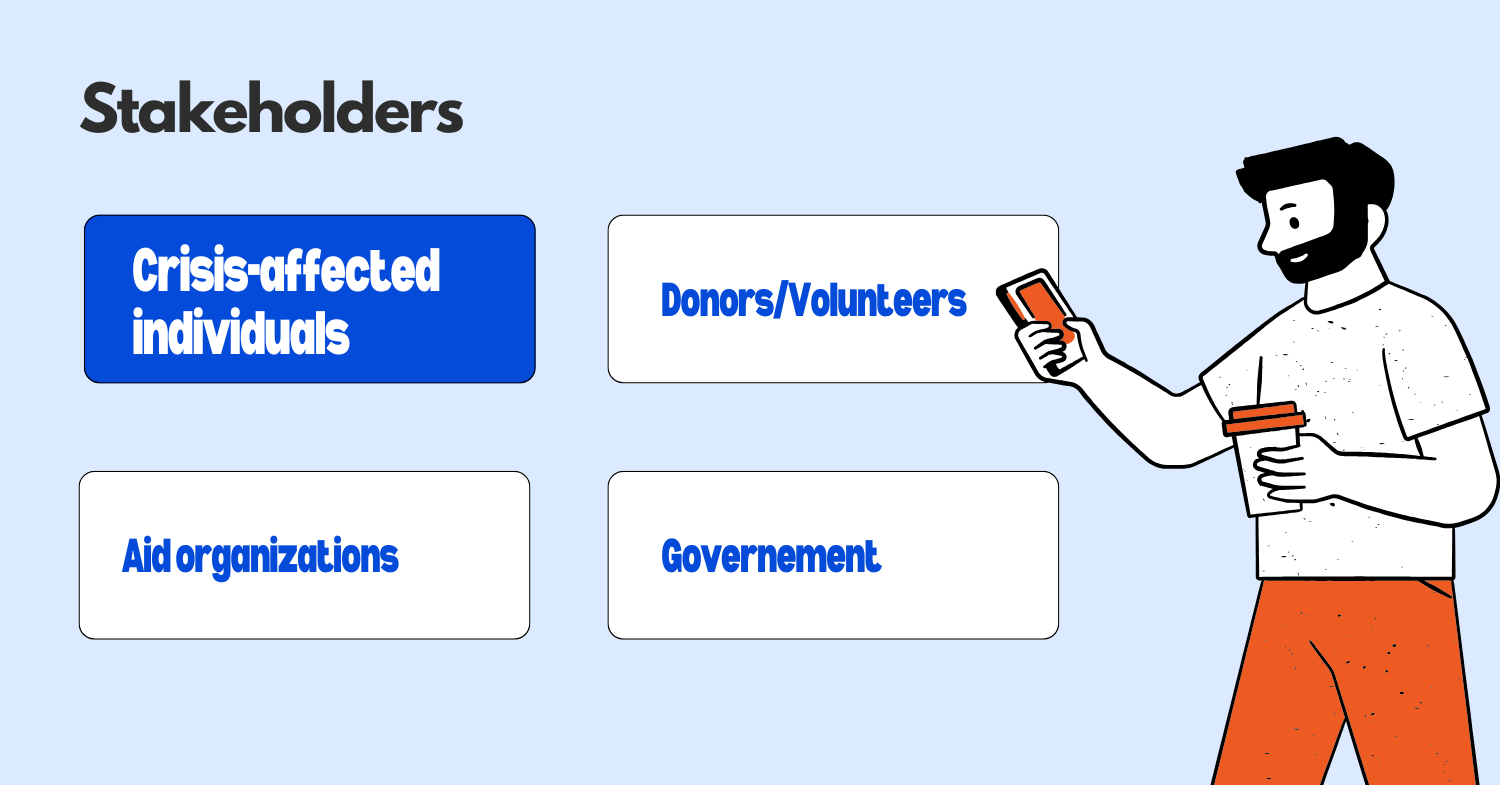 In the crisis response ecosystem, we have several key stakeholders:
- Crisis-affected individuals and communities
- Donors and volunteers
- Aid organizations and first responders
- Government agencies
- Media and information providers
Since we're building a Meta product, I'll focus on how our users interact with crises through our platforms. I've identified four key user segments:
User Segment Breakdown
-
Directly Affected Users: People in crisis zones who need immediate help, information, and connection. They use Meta platforms to signal safety, request assistance, and coordinate with neighbors.
-
Concerned Connectors: Friends and family of affected individuals who are geographically distant but emotionally invested. They use Meta to check on loved ones, gather information, and mobilize support networks.
-
Responsive Givers: Users who don't have personal connections to the crisis but are moved to help when aware. They respond to fundraisers, share information, and may volunteer remotely.
-
Institutional Responders: Representatives of aid organizations, government agencies, and community groups who use Meta platforms to coordinate response, share official information, and mobilize resources.
Prioritization Table
| Segment | TAM (1-10) | Engagement Potential (1-10) | Potential for Improvement (1-10) | Total Score |
|---|---|---|---|---|
| Directly Affected Users | 7 | 10 | 9 | 630 |
| Concerned Connectors | 9 | 8 | 7 | 504 |
| Responsive Givers | 10 | 6 | 8 | 480 |
| Institutional Responders | 5 | 9 | 10 | 450 |
Explanation of scores:
- Directly Affected Users: While not the largest group (7), they have the highest engagement potential (10) during crises and significant room for improved tools (9).
- Concerned Connectors: Larger audience (9) with strong engagement motivation (8) and moderate improvement potential (7).
- Responsive Givers: Largest potential audience (10) but more passive engagement (6) with good improvement potential (8).
- Institutional Responders: Smallest group (5) but highly engaged (9) with the most room for improved tools (10).
I'll focus primarily on Directly Affected Users as they have the most urgent needs and highest engagement potential during crises. By serving them effectively, we create value that radiates outward to other segments.
Step 4
Pain Points (5 minutes)
For Directly Affected Users during crises, I've identified these key pain points:
1. Information Fragmentation and Verification
Users struggle to find reliable, actionable information during crises when they need it most. Official sources, media reports, and personal accounts are scattered across platforms and feeds.
User quote: "During the wildfire, I was checking Facebook, Twitter, news sites, and government alerts constantly. I couldn't tell what information was current or which evacuation routes were still open."
Potential metric: Time spent searching for critical information; number of sources consulted before taking action.
2. Resource Coordination Challenges
Affected individuals often don't know what help is available or how to access it. Simultaneously, those offering help struggle to connect with those in need efficiently.
User quote: "After the flood, people were posting offers of temporary housing in different Facebook groups, but families who needed shelter weren't seeing these posts. It was all so disorganized."
Potential metric: Time between resource offer and successful matching; percentage of resource offers that go unutilized.
3. Communication Network Disruption
During disasters, normal communication patterns break down. Users struggle to notify multiple contacts about their status, coordinate with neighbors, and maintain connections when infrastructure is compromised.
User quote: "When the hurricane hit, I was constantly getting individual messages asking if I was safe. I couldn't keep up with responding while also trying to secure my home."
Potential metric: Number of redundant status inquiries; time to communicate status to key contacts.
4. Recovery Support Gaps
Once immediate danger passes, affected users face a prolonged recovery period with diminishing visibility and support. The initial surge of attention and assistance fades quickly.
User quote: "Two weeks after the earthquake, everyone had moved on, but we were still without power and dealing with insurance. It felt like we'd been forgotten."
Potential metric: Drop-off rate in engagement and support after initial crisis period; length of time to return to pre-crisis stability.
Step 5
Prioritization of Pain Points (3 minutes)
Let's prioritize these pain points based on severity (impact on users) and frequency (how often users encounter this issue):
| Pain Point | Severity (1-10) | Frequency (1-10) | Total Score |
|---|---|---|---|
| Information Fragmentation and Verification | 9 | 10 | 90 |
| Resource Coordination Challenges | 8 | 8 | 64 |
| Communication Network Disruption | 7 | 9 | 63 |
| Recovery Support Gaps | 8 | 6 | 48 |
Based on this analysis, I'll focus on addressing the top two pain points:
-
Information Fragmentation and Verification (Score: 90) This scores highest because access to reliable information is literally life-saving during crises. Users consistently report this as their most urgent need, and it affects virtually every user in a crisis zone. Meta is uniquely positioned to address this through our content distribution capabilities and verification tools.
-
Resource Coordination Challenges (Score: 64) This ranks second because effective resource coordination dramatically improves outcomes for affected communities. While slightly less universal than information needs, it represents a significant gap in current solutions that Meta's network effects could help solve.
While Communication Network Disruption scored similarly to Resource Coordination, I've prioritized the latter because it represents a more significant opportunity for Meta to create unique value. Communication has more existing solutions (though imperfect), while resource coordination remains largely unsolved at scale.
Recovery Support Gaps, while important, tend to be less time-sensitive and can be addressed in future iterations after establishing core crisis response functionality.
Now that we've identified and prioritized the key pain points, I'll take a moment to organize my thoughts before developing solution concepts.
Step 6
Solution (10 minutes)
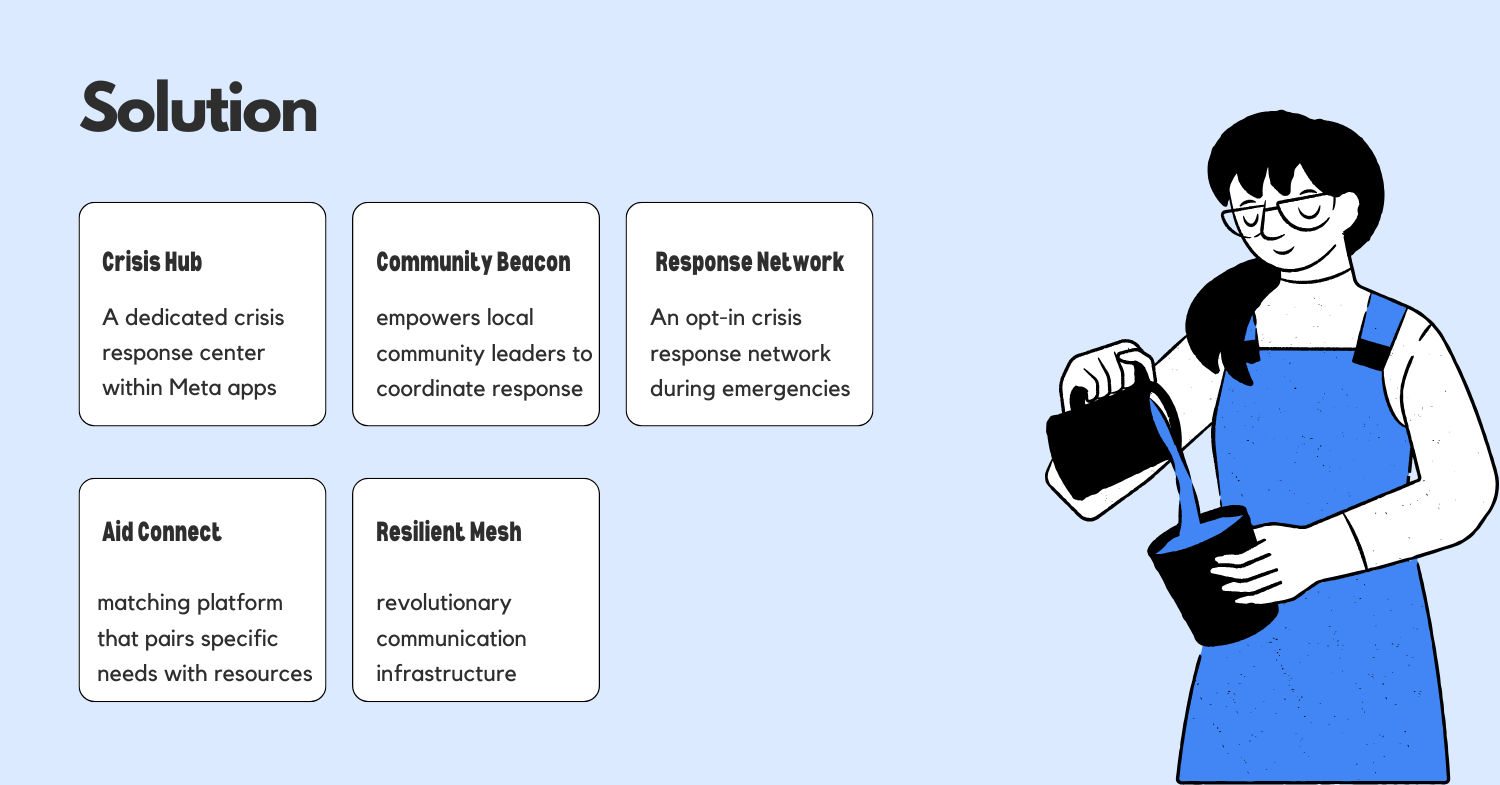 Based on our analysis, I've developed several potential solutions to address the prioritized pain points:
Solution Concepts
-
Crisis Hub: A dedicated crisis response center within Meta apps that activates for users in affected areas, providing verified information, needs matching, and communication tools in a single interface.
-
Community Beacon: A decentralized approach that empowers local community leaders to coordinate response through enhanced group capabilities, verified information sharing, and resource matching tools.
-
Response Network: An opt-in crisis response network that activates during emergencies, connecting affected users with nearby resources and providing verified information through a dedicated feed and notification system.
-
Aid Connect: A specialized matching platform that pairs specific needs with available resources during crises, using Meta's reach to quickly mobilize help and verify both requests and offers.
-
Moonshot: Resilient Mesh: A revolutionary communication infrastructure that enables Meta apps to function in mesh networks during connectivity disruptions, allowing communities to maintain coordination even when traditional internet access fails.
Solution Prioritization
| Solution | Reach (1-10) | Impact (1-10) | Feasibility (1-10) | Alignment (1-10) | Total Score |
|---|---|---|---|---|---|
| Crisis Hub | 9 | 8 | 7 | 9 | 33 |
| Community Beacon | 7 | 8 | 8 | 8 | 31 |
| Response Network | 8 | 9 | 6 | 9 | 32 |
| Aid Connect | 7 | 7 | 8 | 7 | 29 |
| Resilient Mesh | 10 | 10 | 3 | 8 | 31 |
Explanation:
- Crisis Hub: Highest overall score due to excellent reach (leverages existing Meta apps), strong impact (addresses multiple pain points), good feasibility (builds on existing capabilities), and perfect alignment with our goals.
- Response Network: Strong contender with excellent impact but slightly lower feasibility due to complex activation mechanisms.
- Community Beacon: Very balanced solution with good scores across all dimensions.
- Aid Connect: Solid but more narrowly focused on resource coordination only.
- Resilient Mesh: Potentially revolutionary impact but significantly lower feasibility due to technical complexity.
Selected Solution: Crisis Hub
I recommend proceeding with the Crisis Hub solution. This would be a dedicated space within Meta apps that activates automatically for users in crisis-affected areas, providing:
-
Verified Information Feed: Algorithmically prioritized and human-verified information from official sources, trusted partners, and community members, clearly labeled by source type and verification status.
-
Resource Exchange: A structured marketplace for needs and offers, with categories (shelter, transportation, supplies, etc.), verification mechanisms, and matching algorithms.
-
Status Communication: Simplified tools to communicate safety status to designated contacts and communities with minimal effort during stressful situations.
-
Recovery Support: Continued visibility and tools for affected communities during the recovery phase, including rebuilding resources and long-term support connections.
User Journey
Technical and Business Challenges
-
Information Verification at Scale: Developing systems that can quickly verify information during fast-moving crises while balancing speed and accuracy. This will require a combination of AI tools and human review from trusted partners.
-
Cross-Platform Integration: Ensuring consistent experience and data sharing across Facebook, Instagram, WhatsApp, and Messenger while respecting each platform's unique characteristics and user expectations.
-
Crisis Detection and Activation: Creating reliable systems to detect crises quickly and activate appropriate features for the right geographic areas without false positives or missing critical events.
Moonshot Idea: Resilient Mesh
Looking further ahead, I believe we should invest R&D resources in the Resilient Mesh concept. This would enable Meta apps to function in a limited capacity through device-to-device communication when traditional internet infrastructure is compromised during severe disasters.
This technology would use Bluetooth, WiFi Direct, and similar technologies to create local communication networks that could sync with the broader internet when connectivity is restored. While technically challenging, this capability would be transformative in the most severe crises when communication infrastructure fails completely.
Step 7
Success Metrics (5 minutes)
To evaluate the effectiveness of our Crisis Hub solution, I would track these key metrics:
User Metrics
-
Crisis Hub Activation Rate: Percentage of users in affected areas who engage with the Crisis Hub when activated. Target: >40% in first year, growing to >60%.
- Leading indicator: Initial notification click-through rate
-
Status Communication Efficiency: Average time between Crisis Hub activation and users communicating status to their network. Target: <30 minutes.
- Leading indicator: Status tool usage in first hour of crisis
-
Information Trust Score: User ratings of information reliability and usefulness within the Crisis Hub (survey-based). Target: >4.2/5.
- Leading indicator: Information sharing/saving rates
Product Metrics
-
Resource Match Rate: Percentage of help requests that are successfully matched with appropriate offers. Target: >70%.
- Leading indicator: Growth in resource offers vs. requests
-
Cross-Platform Engagement: Percentage of users engaging with Crisis Hub features across multiple Meta platforms during a crisis. Target: >25%.
- Leading indicator: Initial cross-platform notification response
-
Recovery Engagement Retention: Ratio of user engagement 2+ weeks post-crisis compared to crisis peak. Target: >40%.
- Leading indicator: Declining drop-off rate in daily active users
-
Crisis Response Time: Time between crisis onset and full Crisis Hub activation in affected areas. Target: <15 minutes for major disasters.
- Leading indicator: System detection speed vs. manual activation needs
These metrics directly align with our goal of empowering users to effectively respond to crises by measuring both the immediate crisis response capabilities and longer-term recovery support. They address our key pain points by tracking information access, resource coordination efficiency, and sustained engagement through recovery.
Summary
I've proposed creating Crisis Hub, a dedicated crisis response center within Meta's apps that activates automatically for users in affected areas. This solution addresses the most critical pain points faced by directly affected users: information fragmentation and resource coordination challenges.
The Crisis Hub would provide:
- A verified information feed combining official sources and community insights
- A structured resource exchange for matching needs with available help
- Streamlined status communication tools to reduce redundant inquiries
- Sustained recovery support beyond the immediate crisis period
This approach leverages Meta's unique strengths: our massive global reach, identity verification capabilities, and existing community infrastructure. By creating a dedicated space that activates during crises, we can deliver critical tools when users need them most without cluttering everyday experiences.
Success will be measured through user activation rates, resource matching efficiency, information trust scores, and sustained engagement through recovery phases.
Next steps would include:
- Creating detailed product specifications and user flows
- Developing partnerships with emergency management agencies and NGOs
- Building and testing verification systems for information and resource offers
- Planning a phased rollout starting with high-risk regions
.png)