Introduction
I'll be designing a travel feature for Facebook that enhances the social experience around travel planning, sharing, and discovery. This feature would leverage Facebook's existing social graph and engagement patterns while expanding into the travel vertical. I'll explore user needs, market opportunities, potential solutions, and success metrics.
My approach will include understanding user segments, identifying pain points, developing solutions, and establishing metrics to measure success.
Does this approach sound good? I'd like to confirm before proceeding.
Step 1
Clarifying Questions (3 minutes)
- Why it matters: Determines whether we build a complementary social feature or a full-service travel platform
- Expected answer: Focus on social connections with travel context
- Impact on approach: Would emphasize sharing, recommendations, and connections over booking capabilities
- Why it matters: Affects feature complexity, localization needs, and initial target audience
- Expected answer: Start with domestic travel with international expansion plans
- Impact on approach: Would influence language support, partnership strategy, and feature prioritization
- Why it matters: Determines revenue strategy and partnership requirements
- Expected answer: Blend of engagement and monetization opportunities
- Impact on approach: Would balance user experience with commercial opportunities
- Why it matters: Affects scope and complexity of the solution
- Expected answer: Strong integration with existing features
- Impact on approach: Would leverage existing infrastructure rather than building standalone capabilities
Propose the Goal
Given Facebook's focus on connecting people and fostering meaningful interactions, I believe the goal of this travel feature should be to enhance how people plan, share, and reminisce about travel experiences with their social connections. Does this align with your vision?
Define the Scope
For this product design challenge, I suggest we focus on the end-to-end social travel experience - from inspiration and planning through sharing during the trip and preserving memories afterward. I'll assume we're designing for Facebook's mobile app first, with web support as a secondary consideration.
I'll take a moment to organize my thoughts before continuing.
Based on our discussion, I'll assume we're designing a travel feature that:
- Prioritizes social connections and sharing over transactions
- Integrates with existing Facebook features
- Balances engagement goals with monetization opportunities
- Starts with domestic travel but is designed for global expansion
Step 2
Why build this? (5 minutes)
Analyze Macro Trends and Opportunities:
Travel is experiencing significant transformation with several key trends that make this an opportune time for Facebook to enter this space:
-
Post-pandemic travel resurgence: After years of restrictions, travel is rebounding strongly with pent-up demand, creating an opportunity to capture users during this high-interest period.
-
Experience-focused consumption: Younger generations increasingly value experiences over material possessions, with travel being a primary category for discretionary spending.
-
Social validation of experiences: Travel has become a form of social currency and self-expression, with 60% of travelers posting on social media during trips according to industry research.
-
Fragmented travel planning: The average traveler visits 38 websites before booking a trip, indicating a need for more integrated planning solutions.
Competitor Analysis:
The travel space has several established players, but none fully leverage the social graph the way Facebook could:
-
TripAdvisor: Strong in reviews and recommendations but lacks real-time social connection. Their community is transaction-focused rather than relationship-based.
-
Google Travel: Excellent for search and information organization but minimal social features. They excel at utility but not emotional connection.
-
Instagram: Strong in travel inspiration and sharing but weak in planning and practical information. While part of Meta, it focuses on aspirational content rather than practical planning.
-
Specialized apps (Hopper, Airbnb, etc.): Strong in specific verticals but don't connect the full travel journey with a user's social circle.
Facebook's strength lies in its unparalleled social graph and engagement. Unlike competitors who must build communities from scratch, Facebook already has the connections that make travel planning and sharing meaningful.
Value Chain Analysis:
The travel industry value chain includes inspiration, planning, booking, experiencing, and sharing. Currently:
- Inspiration: Dominated by Instagram, Pinterest, and influencer content
- Planning: Fragmented across Google, TripAdvisor, and specialized sites
- Booking: Owned by OTAs and direct providers
- Experiencing: Largely unaddressed by digital platforms beyond maps and local recommendations
- Sharing: Split between Instagram, Facebook, and messaging platforms
Facebook has a unique opportunity to connect these fragmented stages through its social graph. By focusing on the inspiration, planning, and sharing stages initially, Facebook can add value without directly competing in the commoditized booking space.
Step 3
User Segments (5 minutes)
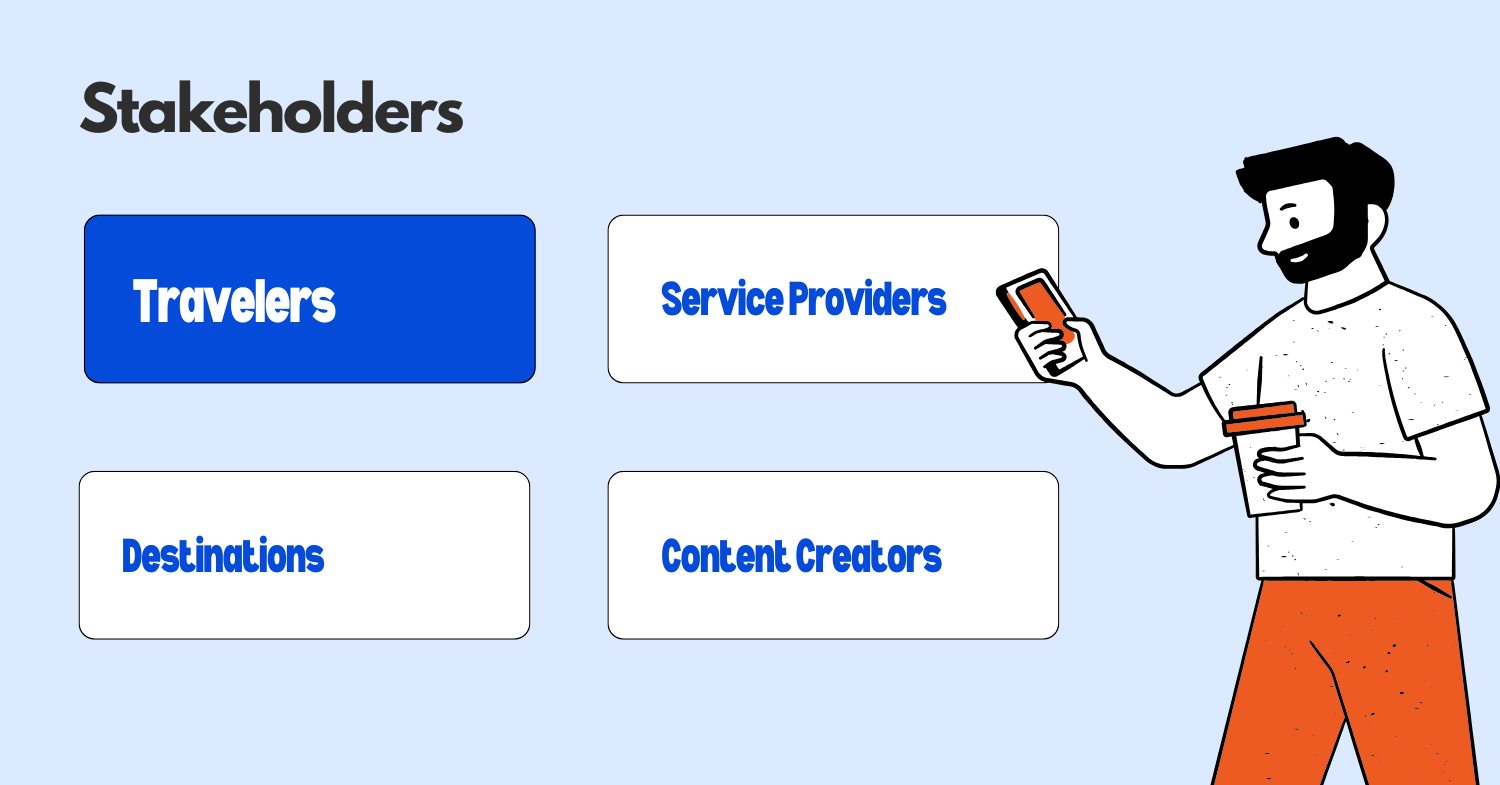 The key stakeholders in the travel ecosystem include:
- Travelers (individuals and groups)
- Travel service providers (hotels, airlines, tour operators)
- Destinations (cities, attractions, local businesses)
- Content creators (travel bloggers, photographers, influencers)
Since we're designing a feature for Facebook users, I'll focus on travelers as our primary stakeholders.
Within travelers, I can identify several distinct segments:
-
Social Explorers: Young adults (18-34) who travel frequently, share extensively on social media, and view travel as part of their identity. They seek unique experiences and social validation.
-
Family Memory Makers: Parents (30-45) coordinating trips for their families, focused on creating and preserving memories, and sharing experiences with extended family and friends.
-
Group Trip Planners: Adults organizing trips with friends, extended family, or special interest groups who need coordination tools and shared decision-making capabilities.
-
Local Experience Seekers: Travelers of all ages who prioritize authentic, non-touristy experiences and connections with locals when visiting new places.
Let's prioritize these segments:
| Segment | TAM (1-10) | Engagement Potential (1-10) | Monetization Potential (1-10) | Total Score |
|---|---|---|---|---|
| Social Explorers | 8 | 9 | 7 | 504 |
| Family Memory Makers | 7 | 7 | 9 | 441 |
| Group Trip Planners | 6 | 9 | 8 | 432 |
| Local Experience Seekers | 8 | 6 | 7 | 336 |
Social Explorers score highest because:
- They have high TAM due to their significant presence on Facebook and frequency of travel
- Their engagement potential is exceptional as they already actively share travel content
- Their monetization potential is good through partnerships and recommendations
Family Memory Makers have strong monetization potential due to higher travel budgets and willingness to pay for convenience, but slightly lower engagement frequency.
Group Trip Planners have excellent engagement potential during planning phases but represent a smaller overall market segment.
I'll focus primarily on Social Explorers as our target segment, with Family Memory Makers as a secondary consideration.
Step 4
Pain Points (5 minutes)
For Social Explorers, I've identified these key pain points related to travel:
-
Fragmented Planning Process: Social Explorers typically use 5-7 different apps and websites when planning trips, creating a disjointed experience.
User quote: "I have one group chat for sharing ideas, another app for saving places, and then I'm constantly texting links back and forth with friends. It's exhausting."
Potential metric: Number of app switches during travel planning process
-
Disconnected Social Recommendations: Despite valuing friends' opinions, there's no easy way to see aggregated recommendations from their social circle for specific destinations.
User quote: "I know several friends have been to Lisbon, but I have to individually ask each one for their recommendations or scroll through years of posts to find relevant content."
Potential metric: Time spent gathering recommendations from social connections
-
Ephemeral Travel Content: Travel stories and recommendations shared on social media quickly disappear in the feed, making them difficult to reference later.
User quote: "My friend posted amazing restaurant recommendations from her Japan trip last year, but I can't find them now that I'm planning my own trip."
Potential metric: Success rate in finding previously shared travel content
-
Disjointed Group Planning: Coordinating travel with friends involves multiple tools and fragmented conversations, making consensus difficult.
User quote: "We spent weeks going back and forth in a group chat trying to decide on dates and accommodations for our trip. Half the group stopped responding because it was so tedious."
Potential metric: Time to reach group consensus on travel decisions
Here's a mind map visualizing these pain points and their relationships:
                           ┌─────────────────────┐
                           │  Travel Experience  │
                           └─────────────────────┘
                                     │
           ┌─────────────────────────┼─────────────────────────┐
           │                         │                         │
┌─────────────────────┐  ┌─────────────────────┐  ┌─────────────────────┐
│  Before Travel      │  │  During Travel      │  │  After Travel       │
└─────────────────────┘  └─────────────────────┘  └─────────────────────┘
           │                         │                         │
           │                         │                         │
┌─────────────────────┐  ┌─────────────────────┐  ┌─────────────────────┐
│Fragmented Planning  │  │Real-time Sharing    │  │Content Preservation │
└─────────────────────┘  └─────────────────────┘  └─────────────────────┘
           │                         │                         │
           ▼                         ▼                         ▼
┌─────────────────────┐  ┌─────────────────────┐  ┌─────────────────────┐
│Disconnected Social  │  │Disjointed Group     │  │Ephemeral Travel     │
│Recommendations      │  │Coordination         │  │Content              │
└─────────────────────┘  └─────────────────────┘  └─────────────────────┘
Step 5
Prioritization of Pain Points (3 minutes)
Let's prioritize these pain points based on severity and frequency:
| Pain Point | Severity (1-10) | Frequency (1-10) | Score |
|---|---|---|---|
| Fragmented Planning Process | 8 | 9 | 72 |
| Disconnected Social Recommendations | 9 | 7 | 63 |
| Ephemeral Travel Content | 7 | 8 | 56 |
| Disjointed Group Planning | 8 | 6 | 48 |
Based on this analysis, I'll focus on addressing these top two pain points:
-
Fragmented Planning Process (Score: 72) This scores highest because it affects nearly every trip a user takes (high frequency) and creates significant friction (high severity). Solving this problem would create immediate value by reducing the cognitive load of travel planning and keeping users within the Facebook ecosystem.
-
Disconnected Social Recommendations (Score: 63) This is a close second because it represents a unique opportunity for Facebook to leverage its social graph in a way competitors cannot. The severity is high because users place tremendous value on trusted recommendations, and the frequency is substantial as users consistently seek input before traveling.
While Ephemeral Travel Content and Disjointed Group Planning are important issues, they have slightly lower impact scores. The ephemeral content issue is partially addressed by solving the recommendations problem, and group planning affects a smaller subset of trips.
Now that we've identified the key pain points, I'll take a moment to organize my thoughts before developing solutions.
Step 6
Solution (10 minutes)
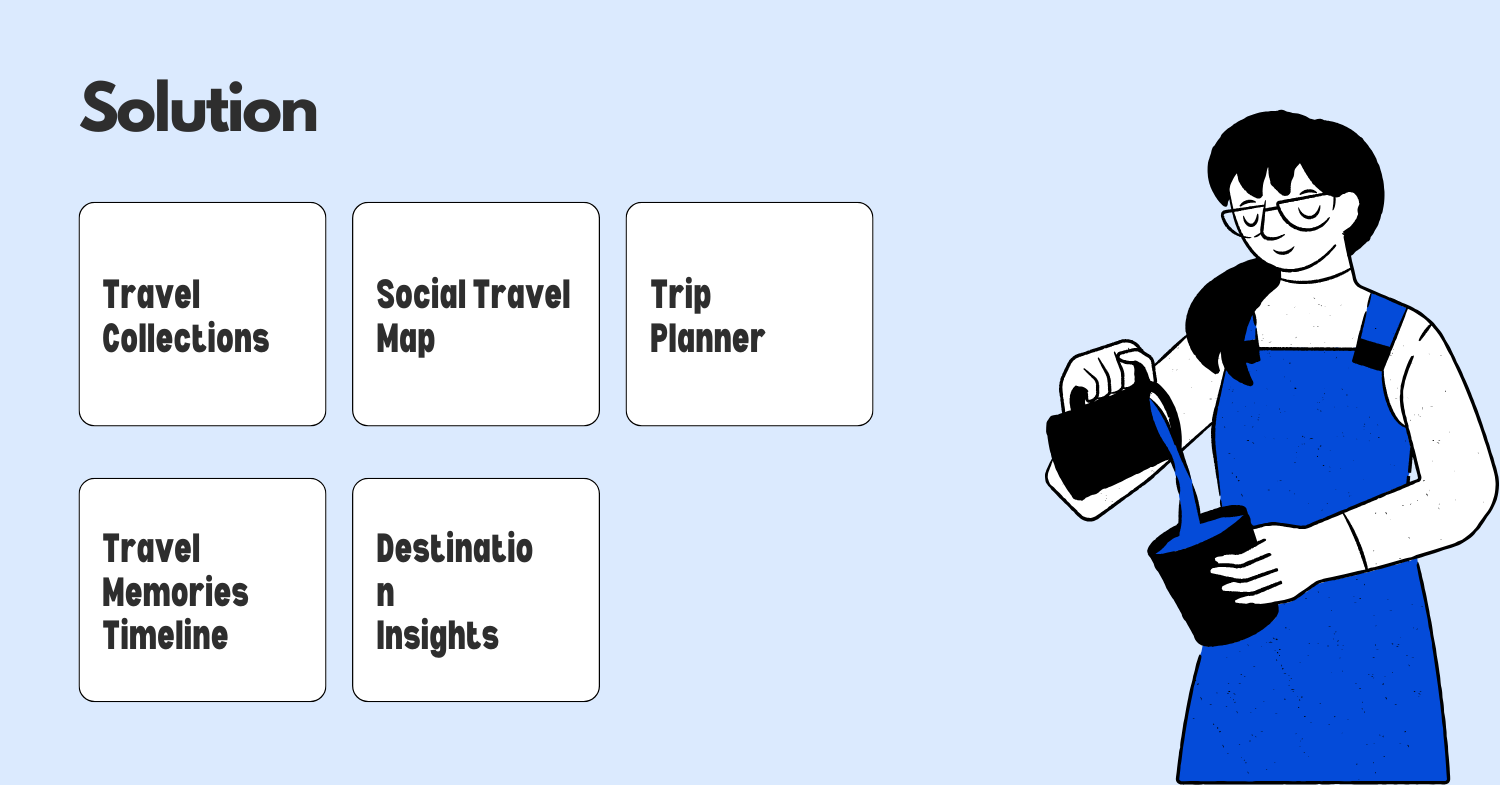 Based on our prioritized pain points, I've developed several potential solutions:
-
Travel Collections - A dedicated space within Facebook where users can save, organize, and share travel content from across the platform and the web. Collections would be searchable by destination and shareable with friends for collaborative planning.
-
Social Travel Map - An interactive map overlay for Facebook that visualizes where friends have traveled, with the ability to filter by recency, see recommendations, and connect with friends who've visited places you're interested in.
-
Trip Planner - A structured planning tool that allows users to create trip itineraries, invite friends to collaborate, and incorporate recommendations from their network, all within Facebook.
-
Travel Memories Timeline - A specialized view of a user's timeline that organizes past travel experiences chronologically and geographically, making it easy to revisit and share travel memories.
-
Destination Insights (Moonshot) - An AI-powered feature that analyzes your interests, friend activity, and travel patterns to suggest personalized destinations and experiences, complete with relevant content from your network.
Let's prioritize these solutions:
| Solution | Reach (1-10) | Impact (1-10) | Effort (1-10) | Alignment (1-10) | Score |
|---|---|---|---|---|---|
| Travel Collections | 9 | 8 | 6 | 9 | 10.8 |
| Social Travel Map | 8 | 9 | 7 | 8 | 9.1 |
| Trip Planner | 7 | 8 | 8 | 7 | 6.1 |
| Travel Memories Timeline | 8 | 6 | 5 | 7 | 6.7 |
| Destination Insights | 9 | 9 | 9 | 8 | 7.2 |
Score calculation: (Reach × Impact × Alignment) ÷ Effort
Travel Collections scores highest because:
- High reach: Applicable to all travelers regardless of planning style
- Strong impact: Directly addresses fragmented planning and recommendation issues
- Moderate effort: Builds on existing collections/saving functionality
- Excellent alignment: Enhances social connections through travel content
Social Travel Map is a close second with higher impact but slightly higher effort and lower reach.
I'll focus on developing the Travel Collections solution further.
User Flow for Travel Collections
Detailed Solution: Travel Collections
Travel Collections would be a dedicated feature within Facebook that allows users to:
-
Save and Organize: Users can save any content (posts, photos, links, Maps locations) to destination-specific collections. The system would automatically detect travel-related content and suggest saving it to relevant collections.
-
Discover Friend Recommendations: When viewing a collection for a specific destination, users would see relevant content and recommendations from friends who have visited that place, automatically aggregated without manual searching.
-
Collaborate and Plan: Collections can be private, shared with specific friends, or public. Collaborative collections allow friends to add their own recommendations and react to saved items, creating a social planning experience.
-
Convert to Trips: Collections can be converted to actual trip plans with dates, accommodations, and itineraries, with the option to create Facebook Events for trip components.
-
Integration Points: Collections would integrate with Facebook Events, Groups, Marketplace (for local experiences), and potentially partner with travel services for bookings.
The user journey would span from inspiration (seeing a friend's travel post and saving it) through planning (building a collection with input from friends) to experiencing (accessing saved recommendations during travel) and sharing (posting updates that link back to the collection).
Technical and Business Challenges
-
Content Organization: Automatically categorizing and organizing diverse travel content (posts, photos, links, locations) will require sophisticated AI/ML capabilities.
-
Privacy Considerations: Balancing sharing of travel plans with safety concerns about broadcasting future absences from home.
-
Partner Integration: Establishing partnerships with booking platforms and local businesses for monetization without disrupting the user experience.
Moonshot Idea: Immersive Travel Experiences
Looking further ahead, Facebook could leverage its investment in the metaverse to create immersive virtual travel experiences. Users could "preview" destinations through VR before booking, join virtual guided tours led by friends who've visited before, or create shared virtual spaces where distributed friend groups can "travel together" virtually when physical travel isn't possible.
Step 7
Success Metrics (5 minutes)
To evaluate the effectiveness of the Travel Collections feature, I would track these metrics:
User Metrics:
-
Collection Creation Rate: Percentage of users who create travel collections after seeing travel-related content. Target: 15% conversion rate.
-
Collection Engagement: Average number of interactions per collection (saves, contributions, comments). Target: 8+ interactions per active collection per month.
-
Cross-user Recommendation Utilization: Percentage of users who view or save recommendations from their network when planning trips. Target: 40% of users planning trips.
Product Metrics:
-
Travel Content Retention: Increase in discoverable travel content that would otherwise be lost in the feed. Target: 60% of travel content saved to collections.
-
Planning Session Duration: Time spent in travel collections vs. time spent on competing travel planning sites. Target: 25+ minutes per planning session.
-
Monetization Opportunities: Click-through rate on partner recommendations and booking opportunities. Target: 5% CTR on monetizable links.
Leading Indicators:
-
Collection Growth Rate: Week-over-week growth in new collections created, indicating adoption.
-
Sharing Velocity: How quickly and frequently collections are shared with friends.
-
Return Frequency: How often users return to their collections during different travel phases.
These metrics align with our goal of enhancing social connections through travel by measuring both the utility of the feature (creation and engagement rates) and its effectiveness at solving our key pain points (recommendation utilization and content retention).
Summary
I've designed a Travel Collections feature for Facebook that addresses key pain points for Social Explorers while leveraging Facebook's unique social graph advantage. The solution creates a dedicated space for users to save, organize, and share travel content, making recommendations from friends discoverable and preserving travel content that would otherwise be lost in the feed.
By focusing on the social aspects of travel planning rather than competing directly with booking platforms, this feature enhances Facebook's core value proposition while opening new engagement and monetization opportunities. The collaborative nature of collections strengthens connections between users while keeping them in the Facebook ecosystem throughout their travel journey.
Success will be measured through collection creation and engagement rates, recommendation utilization, and ultimately through increased time spent on Facebook for travel-related activities. The next steps would include prototyping the collection interface, testing with users, and developing partnerships with travel services for potential monetization.
.png)