Introduction
I'll approach designing an Uber experience specifically for blind users by focusing on accessibility, independence, and safety. This challenge requires us to rethink the entire ride-hailing experience through the lens of users with visual impairments while maintaining the core value proposition of Uber. I'll walk through understanding user needs, identifying pain points, and developing solutions that create an inclusive transportation experience.
Does this approach sound good? I'd like to confirm before proceeding.
Step 1
Clarifying Questions (3 minutes)
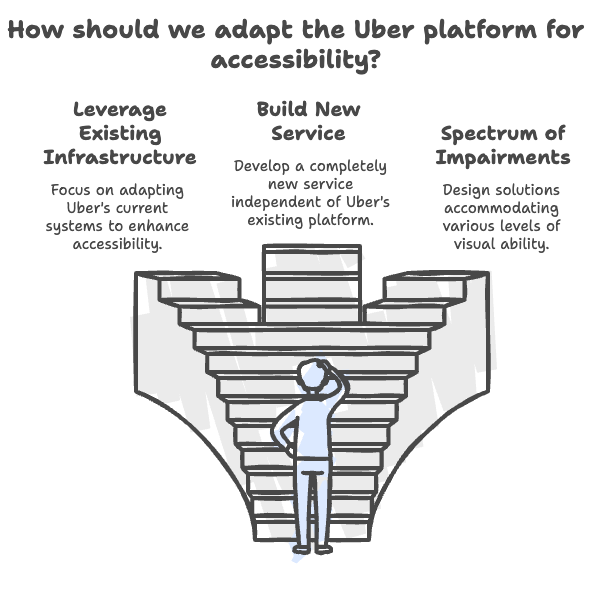
- Why it matters: This determines whether we leverage Uber's existing infrastructure or build something new.
- Expected answer: Yes, we're adapting the existing Uber platform.
- Impact on approach: We'll need to work within Uber's current ecosystem while making targeted modifications.
- Why it matters: Different levels of visual impairment require different design approaches.
- Expected answer: Consider the full spectrum of visual impairments.
- Impact on approach: We'll need to design solutions with flexibility to accommodate various levels of visual ability.
- Why it matters: Compliance with standards like ADA or WCAG would set baseline requirements.
- Expected answer: Yes, we need to comply with accessibility standards.
- Impact on approach: We'll incorporate these standards as fundamental requirements rather than optional features.
- Why it matters: Existing research would provide valuable insights to build upon.
- Expected answer: Some limited research exists but not comprehensive.
- Impact on approach: We may need to propose additional research while leveraging what's available.
Propose the Goal
Given Uber's focus on providing accessible transportation options for all users, I believe our goal should be to create an end-to-end ride-hailing experience that enables blind and visually impaired users to travel independently with the same level of convenience, safety, and reliability that sighted users enjoy. Does this align with your vision?
Define the Scope
For this product design challenge, I suggest we focus on the complete user journey from booking to completing a ride, with particular emphasis on the mobile app experience and the physical pickup/dropoff interactions. I'll assume we have access to Uber's existing technology stack and driver network, and that we can make reasonable modifications to both the rider and driver apps.
I'll take a moment to organize my thoughts before continuing.
Based on our discussion, I'll assume:
- We're enhancing Uber's existing platform, not creating a separate service
- We're designing for users across the visual impairment spectrum
- We need to comply with accessibility standards like ADA
- We'll need to conduct additional user research to validate our solutions
Step 2
Why build this? (5 minutes)
Analyze Macro Trends and Opportunities:
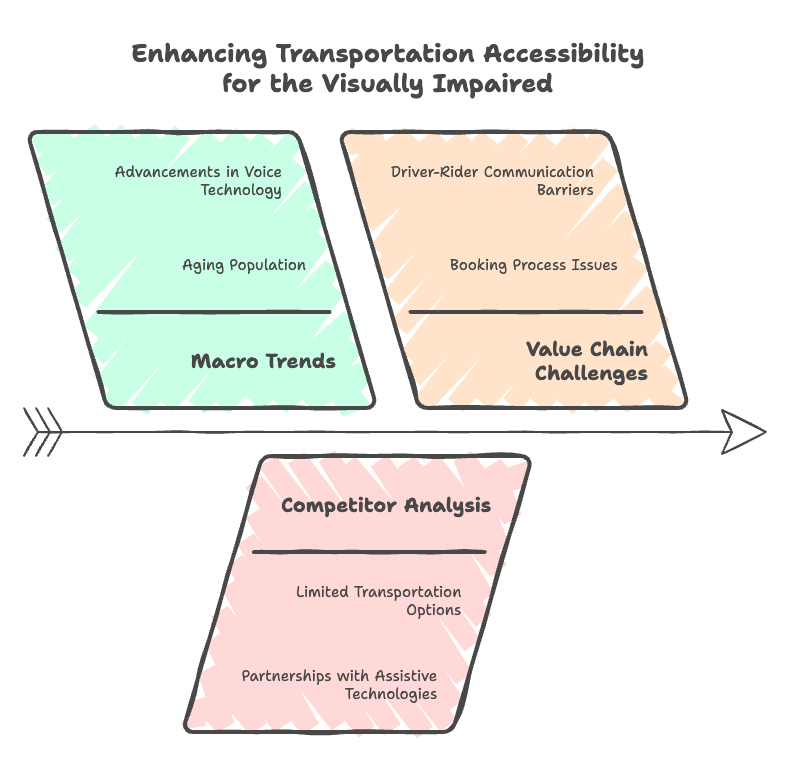
The need for accessible transportation solutions is growing significantly. According to the WHO, approximately 285 million people worldwide are visually impaired, with about 39 million classified as blind. In the US alone, over 7 million adults have a visual disability. Several macro trends make this an opportune time to address this market:
- Aging population: As populations age globally, the incidence of visual impairments increases
- Growing emphasis on inclusive design across industries
- Advancements in voice technology and haptic feedback systems
- Increasing regulatory pressure for accessible services
- Rising consumer expectations for inclusive products
Competitor Analysis:
Currently, blind individuals face limited transportation options:
- Traditional taxis: Often require phone calls and provide inconsistent experiences
- Public transportation: Limited coverage and requires learning complex routes
- Specialized paratransit: Usually requires advance booking (often 24+ hours)
- Lyft: Has implemented some accessibility features but still has significant gaps
- Be My Eyes/Aira: Provide visual assistance but aren't transportation-specific
Uber has strengths in its established network, technology infrastructure, and brand recognition. However, its current app has significant accessibility barriers for blind users despite some screen reader compatibility.
Case studies worth noting:
- Lyft's partnership with Aira to help blind passengers identify their rides
- Microsoft's Soundscape technology for spatial audio navigation
- BlindSquare's audio-based navigation system for the visually impaired
Value Chain Analysis:
In the ride-hailing value chain, several pain points remain unsolved for blind users:
- Booking process: Screen reader compatibility issues
- Driver-rider communication: Heavily relies on visual cues
- Pickup coordination: Visual identification of vehicles
- Navigation during ride: Lack of accessible progress updates
- Payment and tipping: Accessibility barriers
By addressing these gaps, Uber could gain a significant competitive advantage in serving an underserved market while building goodwill and brand equity. Additionally, many solutions developed for blind users would benefit all users in situations where visual attention is limited (e.g., at night, in bright sunlight, or when multitasking).
Step 3
User Segments (5 minutes)
The key stakeholders in this ecosystem include:
- Blind and visually impaired riders
- Uber drivers
- Uber's product and engineering teams
- Accessibility advocates and organizations
- Regulatory bodies
Since the question specifically asks about designing for blind people, I'll focus on blind and visually impaired riders as our primary stakeholders.
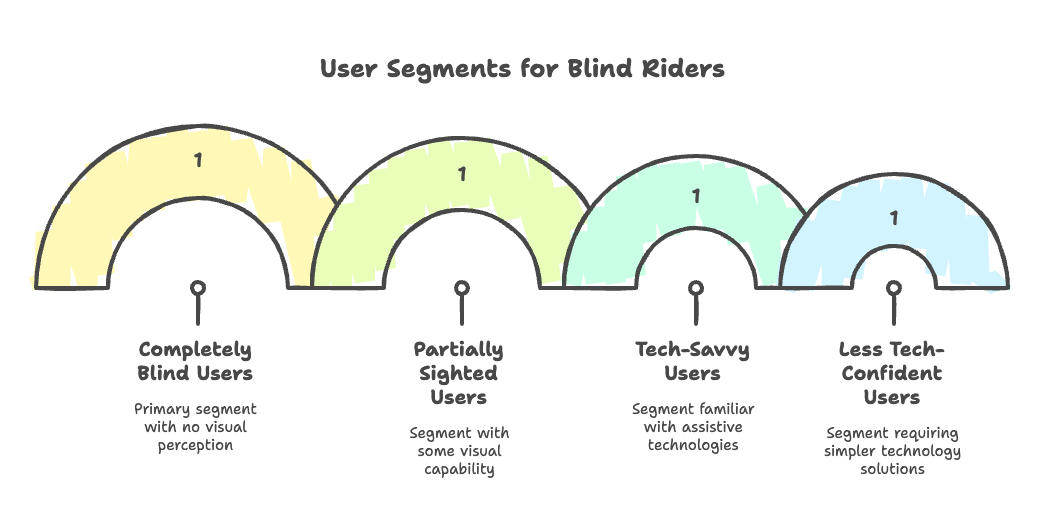
Within this group, I can identify several distinct segments:
-
Completely Blind Users: Individuals with no visual perception who rely entirely on non-visual interfaces like screen readers and haptic feedback.
- Characteristics: Heavy reliance on assistive technologies, often use guide dogs or canes
- Needs: Complete audio/tactile alternatives for all visual information
-
Partially Sighted Users: People with limited vision who may use screen magnification and high-contrast modes.
- Characteristics: Can perceive some visual information with assistance
- Needs: Enhanced visual elements (high contrast, large text) plus audio alternatives
-
Tech-Savvy Visually Impaired: Younger users comfortable with assistive technologies and smartphone navigation.
- Characteristics: Regular smartphone users, early adopters of accessibility features
- Needs: Seamless integration with existing assistive technologies
-
Less Tech-Confident Visually Impaired: Often older users who may be less comfortable with technology.
- Characteristics: May need assistance setting up rides, prefer simpler interfaces
- Needs: Simplified experience, possibly with human assistance options
Prioritization Table:
| Segment | TAM (1-10) | Frequency of Use (1-10) | Potential for Improvement (1-10) | Total Score |
|---|---|---|---|---|
| Completely Blind | 7 | 9 | 10 | 630 |
| Partially Sighted | 8 | 8 | 8 | 512 |
| Tech-Savvy VI | 6 | 9 | 7 | 378 |
| Less Tech-Confident VI | 7 | 6 | 9 | 378 |
Explanation of scores:
- Completely Blind users score highest on potential for improvement because current solutions have the most significant gaps for this segment
- Partially Sighted users have a larger TAM but slightly lower potential for improvement as they can use some existing visual features
- Tech-Savvy users would likely adopt quickly but represent a smaller segment
- Less Tech-Confident users have high potential for improvement but may use the service less frequently
Based on this analysis, I'll focus primarily on Completely Blind Users, as they have the highest total score driven by both high frequency of use and the greatest potential for improvement. Solutions designed for this segment will likely address the most critical accessibility barriers and can be adapted for other segments as well.
Step 4
Pain Points (5 minutes)
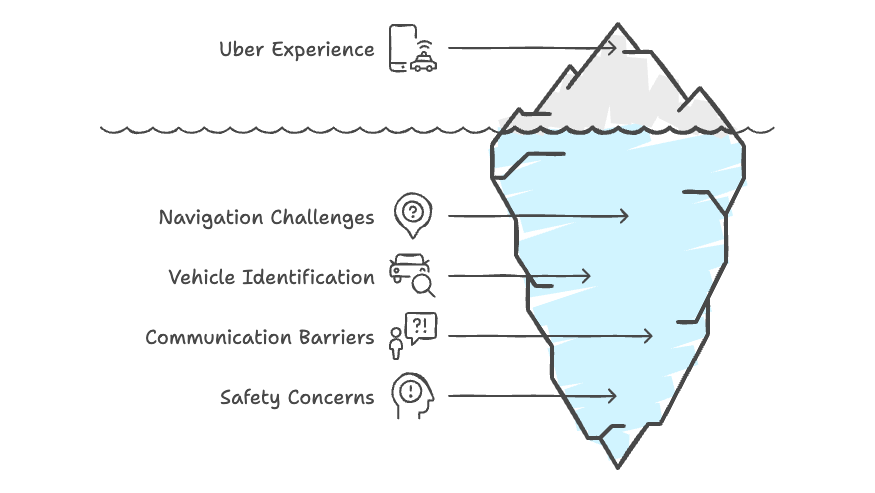
For completely blind users, I've identified these key pain points in the current Uber experience:
1. Difficult App Navigation and Booking Process
"I can't easily set my pickup location or destination because the map interface isn't fully compatible with my screen reader."
Many blind users struggle with the map-centric interface of ride-hailing apps. While screen readers can read text elements, interactive maps present significant challenges. Users often need to ask for sighted assistance to complete bookings.
Potential metrics: Time to complete booking, booking abandonment rate, frequency of address errors
2. Identifying the Correct Vehicle at Pickup
"I never know if I'm getting into the right car. I worry about my safety every time."
Without the ability to visually confirm license plates or car models, blind users face anxiety and safety concerns during pickup. They often need to ask drivers to confirm their name or destination, which can be awkward and potentially unsafe.
Potential metrics: Pickup time, incorrect vehicle incidents, user-reported safety concerns
3. Lack of Accessible Navigation Updates During Ride
"I have no idea where we are during the trip or how much longer until we arrive."
Sighted users can track progress on the map, but blind users lack equivalent access to this information. This creates anxiety about route deviations and arrival times.
Potential metrics: In-ride app engagement, post-ride satisfaction scores, reported anxiety levels
4. Driver Communication Challenges
"Drivers don't know how to help me, and I can't easily communicate my specific needs."
Many drivers haven't been trained on how to assist blind passengers, leading to awkward interactions and suboptimal service. Blind users often need to repeatedly explain their needs.
Potential metrics: Driver ratings from blind users, communication-related complaints, time spent on driver-passenger communication
Step 5
Prioritization of Pain Points (3 minutes)
 I'll prioritize these pain points based on severity (impact on user experience) and frequency (how often users encounter this issue):
| Pain Point | Severity (1-10) | Frequency (1-10) | Total Score |
|---|---|---|---|
| Difficult App Navigation | 8 | 10 | 80 |
| Vehicle Identification | 10 | 10 | 100 |
| Lack of Navigation Updates | 7 | 8 | 56 |
| Driver Communication | 8 | 7 | 56 |
Based on this analysis, I'll prioritize:
-
Vehicle Identification at Pickup (Score: 100) This scores highest because it presents both a critical safety issue and occurs during every ride. The consequences of getting into the wrong vehicle can be severe, and the anxiety this creates significantly degrades the user experience. This pain point also directly undermines Uber's core value proposition of safe, reliable transportation.
-
Difficult App Navigation (Score: 80) This is a close second because it affects every interaction with the service and can completely prevent users from accessing rides independently. If users can't book rides without assistance, the service fails at its most basic function.
While the other pain points are important, addressing these top two would create the most immediate impact for blind users. Navigation updates and driver communication are still significant issues but have slightly lower combined severity and frequency.
Now that we've identified the key pain points, I'll take a moment to organize my thoughts before developing solutions.
Step 6
Solution (10 minutes)
Solution Ideas
1. Audio Beacon System ("SoundRide")
Create a system where the driver's phone emits a distinctive audio signal that gets louder as the blind user approaches the correct vehicle. The rider's phone would detect this signal and provide directional guidance through spatial audio cues or vibration patterns. This would solve the critical vehicle identification problem without requiring visual confirmation.
2. Voice-First Interface ("UberVoice")
Redesign the core booking experience around conversation rather than visual maps. Users would interact through a voice assistant that handles natural language requests like ""Get me a ride to the doctor's office on Main Street"" and provides audio confirmations. The system would remember frequent destinations and allow quick booking through voice shortcuts.
3. Haptic Navigation System ("TouchGuide")
Develop a system of standardized vibration patterns that communicate ride status, direction changes, and proximity to destination. This would provide non-visual navigation updates during the ride and help users prepare for arrival without needing to watch the map.
4. Driver-Rider Connection Protocol ("AccessConnect")
Create a specialized onboarding flow for drivers serving blind passengers that provides just-in-time training on appropriate assistance. For riders, implement preference settings that automatically communicate their specific needs to drivers before pickup. This would streamline communication and set clear expectations.
5. Moonshot: "UberGuide" Smart Cane Integration
Develop a smart cane attachment or standalone device that pairs with the Uber app and provides haptic feedback to guide users directly to their vehicle. The device would vibrate more intensely as users approach their ride and could even guide them to the correct door. This would create a completely independent pickup experience without requiring smartphone interaction in public spaces.
Solution Prioritization
| Solution | Reach (1-10) | Impact (1-10) | Effort (1-10) | Alignment (1-10) | Total Score |
|---|---|---|---|---|---|
| SoundRide | 9 | 10 | 7 | 10 | 1286 |
| UberVoice | 8 | 8 | 8 | 9 | 720 |
| TouchGuide | 7 | 7 | 6 | 8 | 653 |
| AccessConnect | 9 | 8 | 5 | 8 | 1152 |
| UberGuide | 6 | 10 | 10 | 9 | 540 |
Explanation:
- SoundRide scores highest on impact as it directly addresses the critical safety issue
- UberVoice has high alignment but requires significant effort to implement natural language processing
- TouchGuide has moderate scores across all categories
- AccessConnect scores well on reach and has a favorable effort ratio
- UberGuide would be transformative but requires significant hardware development
Based on this analysis, I'll focus on the SoundRide solution as our primary approach, with AccessConnect as a complementary solution that could be implemented in parallel.
User Flow for SoundRide
User Journey with Emotional States
-
Booking (Neutral → Confident) User opens app and uses voice commands to book ride. Receives audio confirmation.
-
Waiting (Slightly Anxious → Informed) User receives audio updates about driver's ETA and vehicle details.
-
Driver Arrival (Anxious → Reassured) App announces driver arrival and activates SoundRide beacon system.
-
Vehicle Location (Uncertain → Confident) User follows audio guidance to locate the correct vehicle safely.
-
Verification (Cautious → Relieved) App confirms correct vehicle through beacon handshake.
-
Ride Progress (Curious → Informed) User receives audio updates about journey progress and ETA.
-
Arrival (Alert → Prepared) App provides countdown to arrival and confirms destination.
Technical and Business Challenges
-
Audio Beacon Reliability: The audio beacon system needs to work in noisy environments and distinguish between multiple Uber vehicles in busy areas. We'll need sophisticated audio processing algorithms and possibly ultrasonic frequencies.
-
Driver Adoption: Drivers may be resistant to new procedures or feel uncomfortable with specialized interactions. We'll need effective training and incentives.
-
Battery Consumption: The continuous use of microphone and speaker for beacon functionality could drain battery quickly. We'll need to optimize power usage.
Step 7
Success Metrics (5 minutes)
User Metrics
-
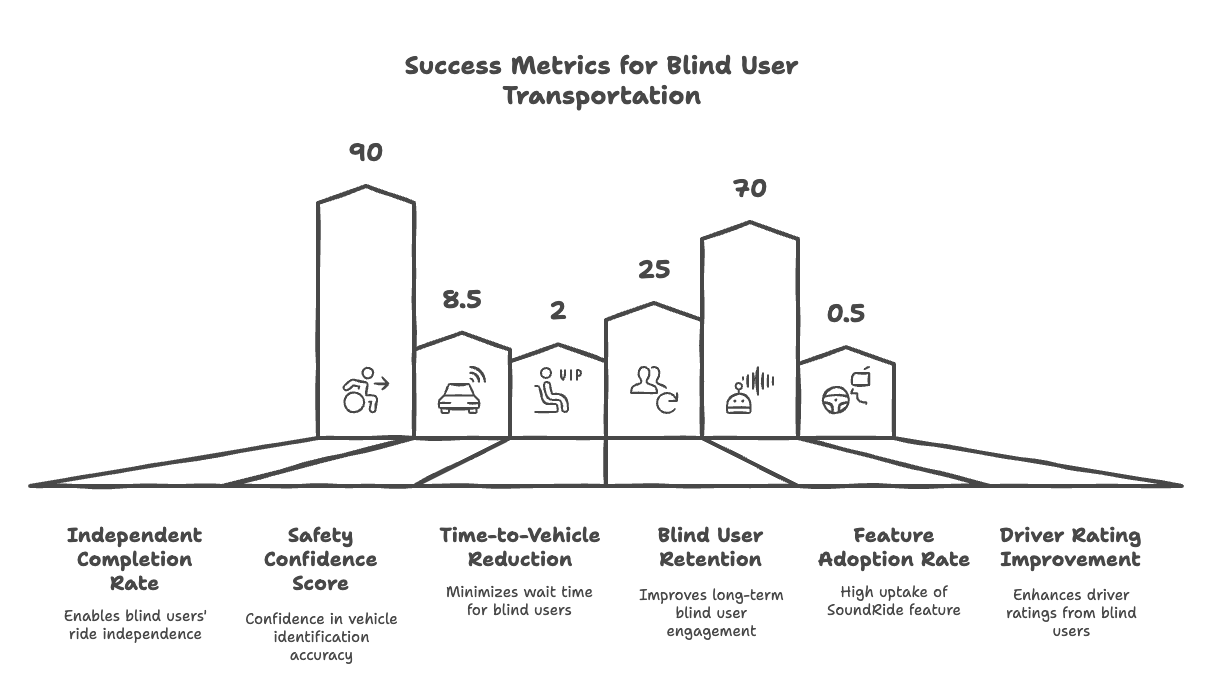
Independent Completion Rate Percentage of rides that blind users complete without requiring assistance from others. This directly measures our goal of enabling independence. Target: 90%+ rides completed independently
-
Safety Confidence Score Survey metric measuring user confidence in identifying the correct vehicle. Target: 8.5+ on 10-point scale (50% improvement from baseline)
-
Time-to-Vehicle Reduction Average time between driver arrival notification and passenger entering vehicle. Target: <2 minutes (40% reduction from current average)
Product Metrics
-
Blind User Retention 30-day and 90-day retention rates for blind users compared to baseline. Target: 25% improvement in 90-day retention
-
Feature Adoption Rate Percentage of eligible blind users who opt to use the SoundRide feature. Target: 70%+ adoption within 6 months
-
Driver Rating Improvement Average rating given by blind users to drivers after implementation. Target: 0.5-star improvement from baseline
Leading Indicators
-
Onboarding Completion Percentage of blind users who complete the accessibility setup process. This would indicate early interest and potential adoption.
-
Feature Usage Frequency How often blind users activate the SoundRide feature when available. Early and repeated usage would suggest the solution is providing value.
These metrics directly align with our goal of creating an independent, safe transportation experience for blind users. The user metrics focus on the experience quality, while the product metrics help us understand business impact. Together, they provide a holistic view of whether we're successfully addressing the identified pain points.
Summary
I've approached designing Uber for blind people by focusing on creating an accessible, independent, and safe ride-hailing experience. After identifying completely blind users as our primary segment, I prioritized solving two critical pain points: vehicle identification at pickup and difficult app navigation.
The proposed SoundRide solution uses audio beacon technology to guide blind users directly to their vehicle, addressing the highest-priority safety concern. This would be complemented by the AccessConnect protocol to improve driver-rider communication. Together, these solutions create a more seamless experience that maintains Uber's core value proposition while making it truly accessible.
Success would be measured through metrics focused on independence, safety, and efficiency, with targets set for significant improvements in each area. The solutions leverage Uber's existing infrastructure while introducing innovative approaches to accessibility that could potentially benefit all users in certain scenarios.
.png)