Introduction
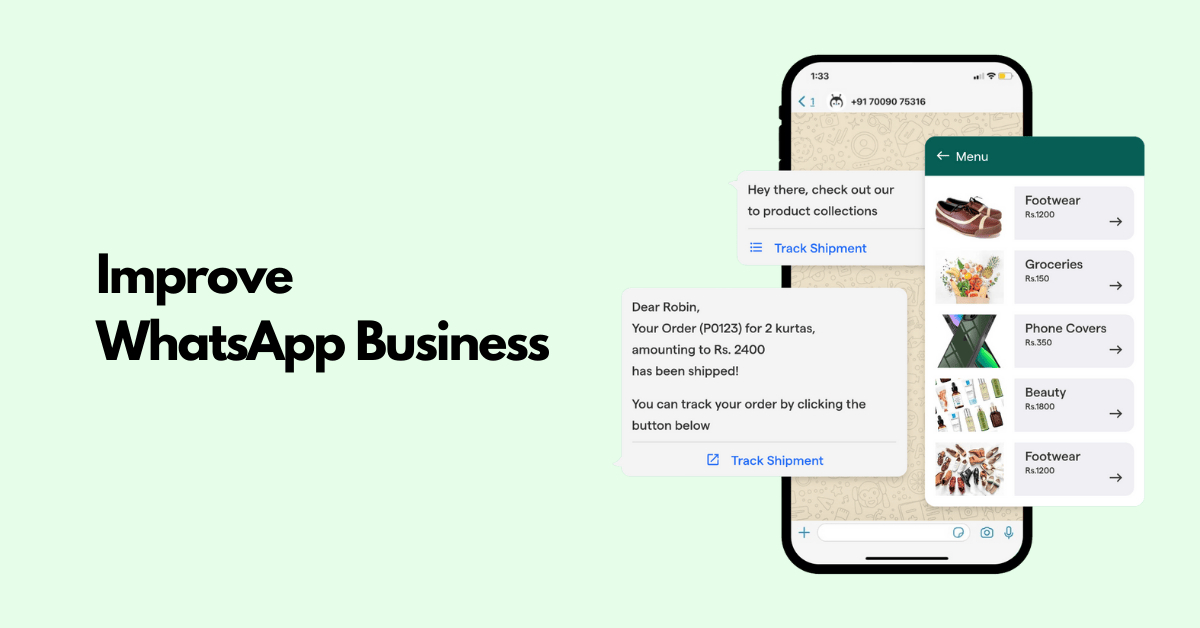
To improve WhatsApp Business, I'll focus on identifying key user segments, understanding their pain points, and developing strategic solutions that enhance the platform's value proposition. I'll approach this by examining the current state of WhatsApp Business, identifying opportunities for improvement, and proposing a roadmap that aligns with both user needs and business objectives.
Step 1
Clarifying Questions
- Why it matters: This fundamentally shapes whether we prioritize acquisition, retention, or monetization features.
- Expected answer: Likely a focus on deepening engagement with existing business users while expanding monetization opportunities.
- Impact on approach: If focused on adoption, I'd prioritize simplifying onboarding; if engagement, I'd focus on advanced tools; if monetization, I'd explore premium features.
- Why it matters: Different business segments have vastly different needs and willingness to pay.
- Expected answer: SMBs likely represent the volume while enterprise represents revenue potential.
- Impact on approach: Would tailor solutions to either simplicity and scale (SMBs) or robust integration and security (enterprise).
- Why it matters: Helps distinguish between surface-level improvements and fundamental product limitations.
- Expected answer: Likely challenges around automation, integration with existing business systems, or analytics capabilities.
- Impact on approach: Would focus solutions on either enhancing existing features or building entirely new capability areas.
- Why it matters: Helps identify whether we need to strengthen core differentiators or address competitive weaknesses.
- Expected answer: WhatsApp likely has reach/scale advantages but may face pressure on enterprise features or integration capabilities.
- Impact on approach: Would emphasize either doubling down on existing strengths or addressing capability gaps.
I'd like to take a minute to organize my thoughts before proceeding to the next section.
Step 2
User Segmentation
Key Stakeholders
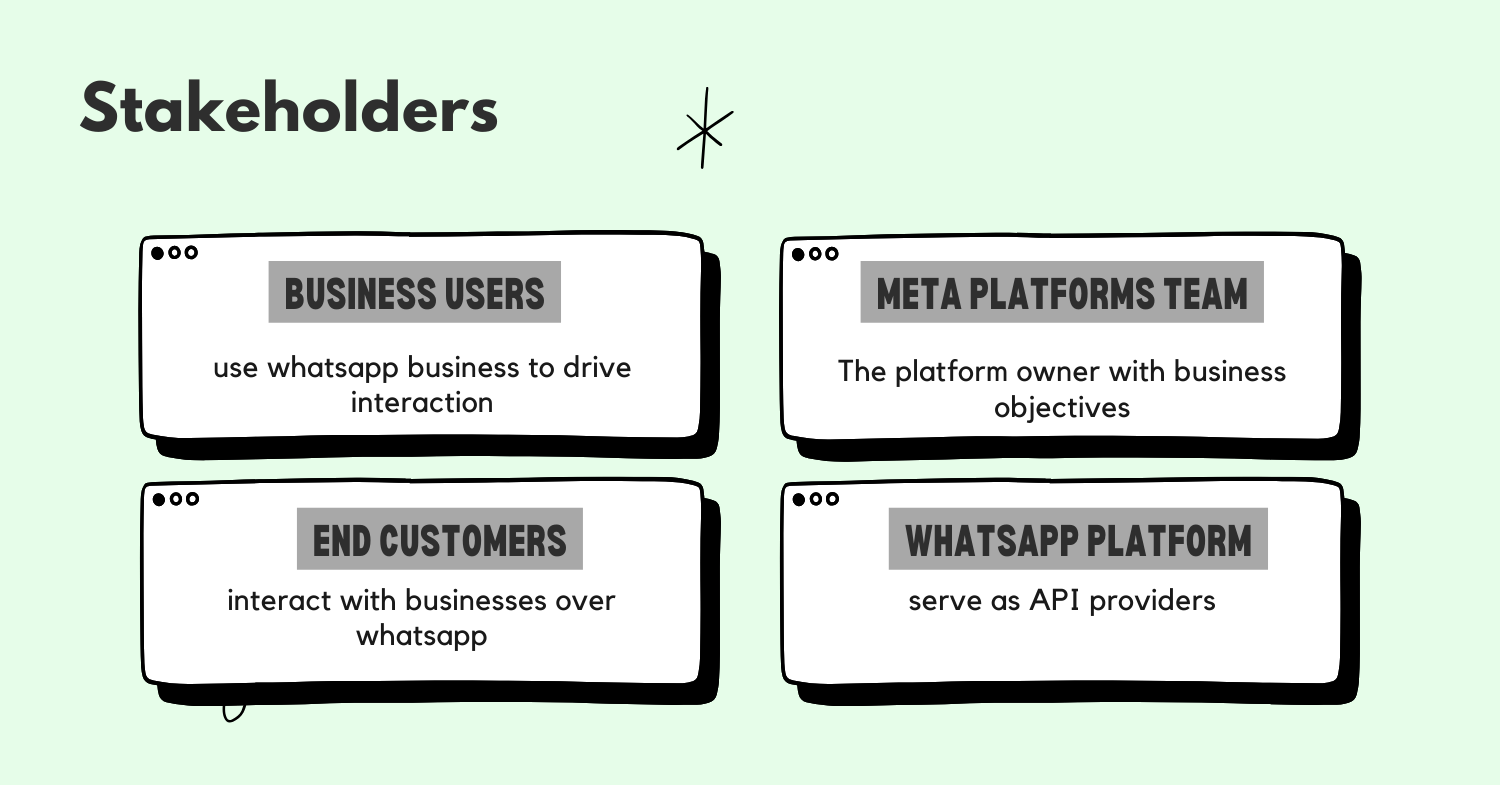
In the WhatsApp Business ecosystem, I see four primary stakeholders:
- Business Users - Organizations using WhatsApp Business to communicate with customers
- End Consumers - Individuals interacting with businesses through WhatsApp
- Platform Partners - Third-party solution providers building on the WhatsApp Business API
- Meta/WhatsApp - The platform owner with business objectives
For this analysis, I'll focus on Business Users as they're the direct customers of WhatsApp Business and the primary drivers of platform adoption and revenue.
Sub-segments
Within the Business Users segment, I identify these key sub-segments:
- Small Local Businesses - Single-location businesses with limited staff (restaurants, boutiques, local services)
- Mid-sized Regional Businesses - Multiple locations with dedicated customer service teams
- Large Enterprise Clients - National/global companies with complex integration needs
- Digital-Native Businesses - Online-only businesses using WhatsApp as a primary channel
Prioritization Table
| Sub-Segment | TAM (1-10) | Frequency (1-10) | Potential Value (1-10) | Total Score |
|---|---|---|---|---|
| Small Local Businesses | 9 | 8 | 6 | 432 |
| Mid-sized Regional Businesses | 7 | 7 | 8 | 392 |
| Large Enterprise Clients | 5 | 9 | 10 | 450 |
| Digital-Native Businesses | 6 | 10 | 7 | 420 |
Score Explanations:
- Small Local Businesses: Highest TAM (millions of potential users) but moderate potential value (limited budgets)
- Mid-sized Regional Businesses: Good balance of scale and value potential
- Large Enterprise Clients: Highest potential value (willingness to pay for premium features) but smaller TAM
- Digital-Native Businesses: Highest frequency of use (rely heavily on digital channels) with moderate TAM
Based on this analysis, I'll focus on Large Enterprise Clients as they represent the highest potential value, though I recognize the importance of the other segments as well.
Primary Persona: Enterprise Client
Persona: Sarah, Enterprise Customer Experience Director
- Demographics: 42-year-old director at a national retail chain with 500+ locations
- Behaviors: Manages a team of 50+ customer service agents, uses multiple communication channels
- Goals: Increase customer satisfaction, reduce response times, integrate customer data across systems
- Pain Points: Difficulty scaling WhatsApp operations, limited analytics, challenges with system integration
- Motivations: Seeking competitive advantage through superior customer experience
Step 3
Pain Points Analysis
User Journey for Enterprise Clients
For Sarah, our Enterprise Customer Experience Director, here's the typical journey when using WhatsApp Business:
-
Initial Setup & Configuration
- Registering business account
- Verifying business identity
- Setting up team access and permissions
-
Integration with Existing Systems
- Connecting to CRM systems
- Integrating with customer support platforms
- Setting up data flows between systems
-
Daily Operations
- Managing high-volume customer conversations
- Assigning conversations to team members
- Tracking conversation status and metrics
-
Customer Engagement
- Creating automated responses and workflows
- Developing rich media messaging campaigns
- Personalizing customer interactions
-
Analysis & Optimization
- Reviewing performance metrics
- Identifying bottlenecks in customer service
- Optimizing response strategies
Pain Points Identification
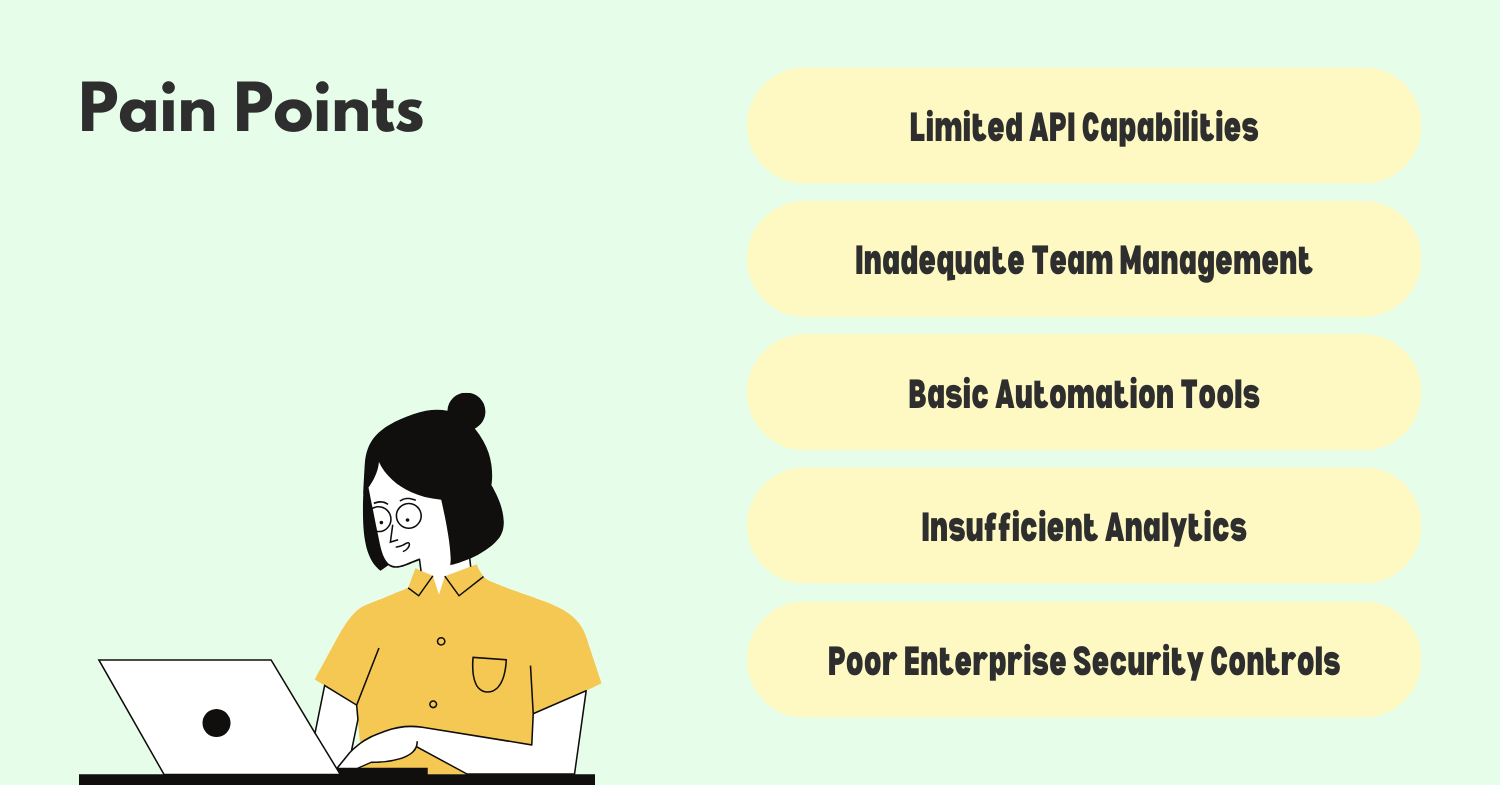
Based on the user journey, I've identified these key pain points:
-
Limited API Capabilities
- Difficulty integrating with enterprise systems
- Restricted access to customer data across platforms
- "We spend more time building workarounds for the API limitations than actually improving our customer experience."
-
Inadequate Team Management
- Challenges in assigning and tracking conversations across large teams
- Limited visibility into agent performance
- "With 50+ agents handling WhatsApp conversations, it's nearly impossible to ensure consistent quality and response times."
-
Basic Automation Tools
- Current automation capabilities don't support complex decision trees
- Limited personalization options in automated flows
- "Our customers expect sophisticated self-service options, but WhatsApp's automation feels primitive compared to our other channels."
-
Insufficient Analytics
- Lack of detailed reporting on customer interactions
- Difficulty measuring ROI and business impact
- "We're flying blind when it comes to understanding what's working and what's not in our WhatsApp strategy."
-
Poor Enterprise Security Controls
- Limited role-based access controls
- Insufficient audit logging for compliance
- "Our compliance team is constantly concerned about our inability to properly secure and audit WhatsApp communications."
Pain Points Prioritization
| Pain Point | Severity (1-10) | Frequency (1-10) | Total Score |
|---|---|---|---|
| Limited API Capabilities | 9 | 10 | 90 |
| Inadequate Team Management | 8 | 9 | 72 |
| Basic Automation Tools | 7 | 8 | 56 |
| Insufficient Analytics | 8 | 7 | 56 |
| Poor Enterprise Security Controls | 9 | 6 | 54 |
Prioritization Reasoning:
The top three pain points I'll focus on are:
-
Limited API Capabilities (90): This scores highest because it fundamentally limits what enterprises can do with WhatsApp Business. It affects nearly every interaction and creates significant operational inefficiencies. Solving this would unlock numerous downstream improvements.
-
Inadequate Team Management (72): For large enterprises, the ability to efficiently manage large support teams is critical to delivering consistent customer experiences. This pain point directly impacts operational costs and customer satisfaction.
-
Basic Automation Tools (56): As customer expectations for self-service increase, the limitations in WhatsApp's automation capabilities are becoming more problematic. Enhancing these would allow businesses to scale their WhatsApp operations more effectively.
These pain points have likely increased in severity as enterprises have deepened their adoption of WhatsApp Business and discovered the platform's limitations compared to purpose-built enterprise communication tools.
Now that we've identified the key pain points, let's take a brief moment to organize our thoughts before developing solutions.
Step 4
Solution Generation
Based on the three prioritized pain points, I'll develop comprehensive solutions that address the needs of our enterprise clients while considering the broader WhatsApp Business ecosystem.
Solution 1: Enterprise Integration Platform
To address the Limited API Capabilities pain point, I propose developing a robust Enterprise Integration Platform:
Key Components:
- Enhanced API Framework with expanded endpoints and capabilities
- Pre-built Connectors for major CRM, ERP, and customer service platforms
- Custom Data Mapping Tools to facilitate seamless data exchange
- Webhook Management System for real-time event processing
- Developer Portal with comprehensive documentation and testing tools
User Flow Example:
- Enterprise IT admin accesses the new WhatsApp Business Integration Hub
- Selects from pre-built connectors (Salesforce, Zendesk, etc.) or custom integration
- Maps customer data fields between systems using visual interface
- Sets up business rules for data synchronization
- Tests integration in sandbox environment
- Deploys to production with monitoring dashboard
Potential Challenges:
- Technical Complexity: Requires significant engineering resources to build and maintain
- Security Concerns: Need to ensure enterprise-grade data protection
- Adoption Barriers: May require professional services support for complex implementations
Solution 2: Team Collaboration Suite
To address the Inadequate Team Management pain point:
Key Components:
- Advanced Agent Workspace with unified customer view
- Intelligent Routing System based on agent skills, availability, and conversation context
- Team Performance Analytics with individual and group metrics
- Conversation Supervision Tools for quality assurance
- Knowledge Management System integrated into the agent interface
User Flow Example:
- Customer message arrives and is automatically categorized by intent
- System routes to appropriate agent based on expertise and workload
- Agent receives context-rich notification with customer history
- Supervisor can view real-time team dashboard showing queue status and agent activity
- Quality assurance team can review conversations and provide feedback through integrated tools
Potential Challenges:
- Change Management: Requires significant training for customer service teams
- Performance Optimization: Must ensure system remains responsive at enterprise scale
- Feature Bloat Risk: Need to maintain simplicity while adding powerful features
Solution 3: Advanced Automation Builder
To address the Basic Automation Tools pain point:
Key Components:
- Visual Flow Builder for creating complex conversation paths
- AI-Powered Response System that learns from agent interactions
- Dynamic Content Templates with personalization variables
- Conditional Logic Engine for sophisticated decision trees
- Integration with Business Systems for data-driven automation
User Flow Example:
- Business user creates automation flow using drag-and-drop interface
- Defines decision points based on customer inputs or profile data
- Creates personalized responses using dynamic content blocks
- Sets up handoff conditions for transitioning to human agents
- Tests flow with simulation tools before publishing
- Monitors performance metrics and iterates based on customer feedback
Potential Challenges:
- Balancing Simplicity and Power: Making advanced features accessible to non-technical users
- Maintaining Conversation Quality: Ensuring automated interactions feel natural and helpful
- Platform Limitations: Working within WhatsApp's messaging constraints
Moonshot Idea: WhatsApp Business Intelligence Platform
Going beyond incremental improvements, I propose a transformative solution that leverages WhatsApp's unique position in business communications:
Key Components:
- Predictive Customer Intelligence using conversation analysis and pattern recognition
- Cross-Channel Journey Orchestration that integrates WhatsApp with other communication channels
- Real-time Market Insights based on anonymized conversation trends
- Conversational Commerce Engine with advanced payment and inventory integration
- Augmented Reality Product Experiences delivered through WhatsApp
This platform would transform WhatsApp Business from a communication channel into a comprehensive business intelligence and customer engagement hub, creating significant competitive advantage and new revenue opportunities.
Step 5
Solution Evaluation and Prioritization
Let's evaluate our proposed solutions using the RICE framework:
RICE Analysis
| Solution | Reach (1-10) | Impact (1-10) | Confidence (%) | Effort (person-months) | RICE Score |
|---|---|---|---|---|---|
| Enterprise Integration Platform | 8 | 9 | 80% | 10 | 57.6 |
| Team Collaboration Suite | 9 | 8 | 90% | 8 | 81.0 |
| Advanced Automation Builder | 10 | 7 | 70% | 6 | 81.7 |
| Business Intelligence Platform | 7 | 10 | 50% | 15 | 23.3 |
Score Explanations:
Enterprise Integration Platform
- Reach: 8 - Would benefit most enterprise clients but not all need deep integration
- Impact: 9 - Transformative for those who implement it fully
- Confidence: 80% - Strong market signals for this need
- Effort: 10 person-months - Significant engineering complexity
Team Collaboration Suite
- Reach: 9 - Applicable to nearly all enterprise clients with teams
- Impact: 8 - Substantial improvement to daily operations
- Confidence: 90% - Very clear user need based on feedback
- Effort: 8 person-months - Moderate complexity
Advanced Automation Builder
- Reach: 10 - Valuable for businesses of all sizes
- Impact: 7 - Significant but not transformative
- Confidence: 70% - Some uncertainty about adoption
- Effort: 6 person-months - Leverages existing platform capabilities
Business Intelligence Platform
- Reach: 7 - Initially valuable to sophisticated enterprise users
- Impact: 10 - Potentially game-changing
- Confidence: 50% - Innovative but unproven
- Effort: 15 person-months - Major new capability area
Implementation Roadmap
Based on the RICE analysis, I recommend this implementation sequence:
-
Advanced Automation Builder (Q1-Q2 2023)
- Highest RICE score and relatively lower effort
- Creates immediate value for all business segments
- Builds foundation for more advanced features
-
Team Collaboration Suite (Q2-Q3 2023)
- Close second in RICE score
- Addresses critical operational needs for enterprise clients
- Can be rolled out incrementally with early wins
-
Enterprise Integration Platform (Q3 2023-Q1 2024)
- More complex but highly impactful
- Benefits from learnings in earlier implementations
- Can be developed in parallel with later stages of Team Collaboration Suite
-
Business Intelligence Platform (Long-term vision)
- Begin R&D work in parallel but with smaller team
- Plan for beta release in 2024
- Position as premium enterprise offering
Validation Approach
For each solution, I would implement this validation process:
- Concept Testing: Share wireframes and concepts with select enterprise clients
- Alpha Testing: Develop MVP features with 3-5 design partners
- Beta Program: Expand to 20-30 businesses with structured feedback loops
- Phased Rollout: Gradually expand availability while monitoring performance metrics
- Continuous Iteration: Establish regular feedback cycles with user advisory council
Step 6
Metrics and Measurement
To measure the success of our improvements, I propose these metrics:
Primary Success Metrics
-
Enterprise Client Retention Rate
- Directly measures if our improvements are addressing critical needs
- Target: Increase from current baseline to 95%+ for enterprise segment
-
Average Revenue Per Business Account (ARPBA)
- Indicates willingness to pay for enhanced capabilities
- Target: 30% increase within 12 months of full implementation
-
Message Volume Per Business
- Measures increased platform utilization
- Target: 40% growth year-over-year
Secondary Success Metrics
-
API Integration Adoption Rate
- Percentage of enterprise clients using new integration capabilities
- Target: 70% adoption within first year
-
Team Efficiency Metrics
- Average handling time, first response time, resolution rate
- Target: 25% improvement in efficiency metrics
-
Automation Utilization
- Percentage of conversations using automated flows
- Target: 50% of appropriate conversations handled by automation
Guardrail Metrics
-
End-User Satisfaction
- Measured through CSAT or NPS in post-conversation surveys
- Ensure we're not sacrificing customer experience for business efficiency
-
Platform Stability
- Error rates, system availability, message delivery success
- Must maintain 99.9%+ reliability while adding new capabilities
-
Security Incidents
- Number of reported security or privacy issues
- Must remain at zero as we expand capabilities
Step 7
Summary and Next Steps
Summary
To improve WhatsApp Business for enterprise clients, I've identified three critical pain points: limited API capabilities, inadequate team management, and basic automation tools. My proposed solutions address these challenges through an Enterprise Integration Platform, Team Collaboration Suite, and Advanced Automation Builder.
Based on RICE prioritization, I recommend starting with the Advanced Automation Builder, followed by the Team Collaboration Suite, and then the Enterprise Integration Platform. This approach balances immediate impact with strategic long-term value.
The proposed improvements align with WhatsApp's broader strategy of becoming an essential business communication platform while creating new monetization opportunities through premium enterprise features.
Next Steps
- Validate Priorities: Conduct focused interviews with 10-15 enterprise clients to confirm pain points and solution priorities
- Form Cross-Functional Team: Assemble product, engineering, design, and customer success specialists
- Develop Detailed PRD: Create comprehensive product requirements for the Advanced Automation Builder
- Establish Success Metrics Baseline: Measure current performance on key metrics before implementation
- Create Design Partners Program: Recruit 5-7 enterprise clients for early testing and feedback
.png)